


Altri Economisti » Saggi, articoli su riviste. Krugman ed altri » Selezione del Mese
In quale tipo di crisi si trasformerebbe lo scoppio di una bolla dell’Intelligenza Artificiale? Simon Wren-Lewis (dal blog Mainly Macro, 6 gennaio 2026)
Tuesday, 6 January 2026
What kind of crisis would a bursting AI bubble become?
Simon Wren-Lewis
 In this post I’m not going to speculate about whether the current boom in AI infrastructure (mainly data centres, mainly in the US) is a bubble or not, but rather ask what would happen if it was and, as bubbles do, it burst. [a] What kind of impact might this have on the world economy? There are three main elements that might be involved in any bubble bursting: a stock market collapse, a collapse in real investment, and financial sector problems.
A stock market collapse is perhaps the least interesting, and least worrying. The current boom in the US stock market is very much led by a small number of tech companies. Now my Google AI overview says that a “stock market collapse centered on the artificial intelligence (AI) sector would likely be highly deflationary, primarily by triggering a sharp recession.” It’s possible, of course, but the key point is that the transmission mechanism between a stock market collapse and a recession is a fall in aggregate demand, and specifically a fall in consumer confidence. One thing we know for sure is that policy can influence aggregate demand. [b]
The most immediate impact of a stock market collapse would be a fall in short term interest rates, as the central bank attempts to avoid a recession. A decline in interest rates will not reverse the fall in the stock market, but it may well offset the impact of the stock market decline on consumption and therefore aggregate demand. Indeed that is exactly what the central bank will try and do.
It is possible, of course, that central banks, and particularly the US Fed, will run out of ammunition because interest rates hit their lower bound, just as they did after the Global Financial Crisis. But then a fiscal stimulus can take its place, and at least in the US my guess would be that Trump will not hesitate to pull that lever for purely short term political reasons. That in turn will make US fiscal sustainability even worse, but I doubt whether that will lead to fiscal stimulus having a insignificant or contractionary effect.
A second element of a bursting bubble might be a sudden slowdown in the amount of investment in new data centres. Less new buildings will be built, and less chips to put in them will be bought. That will have a direct negative impact on aggregate demand, mainly in the US. My own guess would be that we are unlikely to see a sudden stop in such investment, for two reasons. First, AI will still be used and will need testing and developing, and the chips required to do that don’t last very long, so will need replacing. A more likely outcome is that investment falls back as some of the companies bow out of the AI race.
Once again, this is a hit to aggregate demand in the short run, so everything noted above about a stock market collapse also applies. Short term interest rates will fall to at least offset the impact on employment of the investment decline, although perhaps not to offset the impact on GDP.
Both scenarios indicate a key point that is often neglected when talking about the consequences of a bursting bubble. If the bubble bursting hits aggregate demand, then policymakers can replace that demand using monetary and fiscal policy. As long as policymakers are prepared to use these instruments, the impact of shocks that just reduce aggregate demand is not nearly as significant as is often portrayed. Keynes taught us that we could stop demand driven recessions, and he was right.
The wildcard in all this is the financial sector. For some companies the initial expansion in AI investment was financed out of these companies’ huge cash reserves, and it is only more recently that investment has been funded by borrowing. Once the investment is financed by borrowing, the possibility that companies may not be able to pay back (or service) that borrowing arises. If default happens, then the financial sector is hit.
The Global Financial Crisis (GFC) involved three elements, all of which were necessary to produce it. The first, and perhaps the least important, was the collapse of the US sub-prime mortgage market. Why do I say least important? Because shocks to the financial sector are bound to occur from time to time. The financial sector should be robust to such shocks. The second element was how interconnected Western banks had become, so problems in a US market hit banks not just in the US, but also the UK and Europe. (Those that forecast a crisis because the UK private sector was borrowing too much were not spot on: the big UK banks got into difficulty because of the exposure to US defaults.) That was why a US centred crisis became global. The third, and the key, problem before the GFC, was that the banking sector in most Western countries had made itself extremely fragile to such shocks.
The crucial concept here is leverage: the ratio of loans to the capital a financial company has. Here is this data for US banks (source).
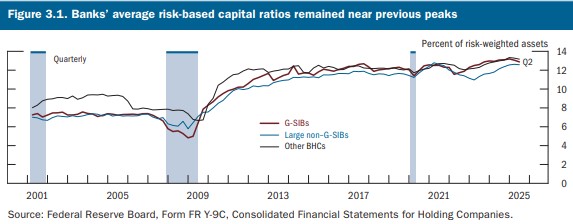
G-SIBs are ‘global systemically important banks’. You can see how, before the GFC, banks reduced the amount of capital they had relative to loans, which meant that they became much more vulnerable to shocks. That has been more than reversed since the crisis (largely because of tougher rules imposed by governments), so banks at least should be more resilient to a financial shock such as defaults on loans for AI investments.
It would be nice to conclude that the financial system should now be able to weather an AI shock, but that would be a dangerous assumption for two reasons. First, while banks are more resilient now than they were in 2007, they still will be vulnerable if the shock to hit them is very large. As I argued in various posts, capital requirements for banks should be much higher than they currently are, because there is little justification for the state to implicitly provide an insurance policy to banks against very large financial shocks. Second, the financial system remains both extremely complex and interconnected, so it is possible that some non-bank institutions might fail as a result of a sufficiently big AI shock, and that will intensify any impact on banks. As Paul Kedrosky outlines here, there are elements of the GFC collapse that are being repeated with the AI boom. See also this.
Note also that instances of default and financial concern need not be caused by a complete collapse of the AI bubble. Perhaps more likely is that some firms succeed in generating revenues to pay back loans (through AI or their existing activities) while others do not. What we just do not know for certain is whether this more limited AI financial shock can be absorbed by the financial sector as a whole, or not,
Here I want to make a more general point about financial crises and macroeconomic forecasts. It is extremely unlikely that macroeconomic forecasts will ever anticipate a financial crisis, because to anticipate a financial crisis involves deep knowledge of a very opaque and rapidly changing financial system that very few people have. Before the GFC, some well known economists did know about the increase in bank leverage and did try and justify it with invalid arguments, and at least one other economist publicly disagreed. As I argue here, to suggest that economics as a whole is somehow discredited as a result of the GFC is nonsense. Equally it is foolish to believe that macroeconomists like myself can tell you whether bursting of the AI bubble will precipitate a similar crisis.
What is well known and is a legitimate issue of concern is that policymakers, at least in the US and UK, are currently focused on reducing rather than increasing banking sector capital requirements. The reasons why the current administration in the US wants to do this are obvious and not worth discussing. Rather more surprising, as David Aikman – the new NIESR director – notes in a recent blog, is that the Bank of England’s Fiscal Policy Committee also thinks the appropriate capital requirement for UK banks has fallen. Aikman starts his blog with “Did they get the sign wrong?” Readers can judge themselves by reading the latest FPC report, about whether it squares its opening statement “Risks to financial stability have increased during 2025″ with this recommendation at the end, and whether pressure from the Chancellor that the report discusses in between is material or not.
None of this suggests that we should be sanguine about the consequence of an AI bubble bursting. But nor is it the case that we should be fatalistic about the consequences of such an event. Policy can do a great deal to moderate the impact of a burst AI bubble. While fiscal policy failed to take such action in a consistent way after the GFC, it did react in a much more appropriate manner during the pandemic, and in the UK at least may have provided too much fiscal support. The biggest risk, but also perhaps the least likely, is that a bursting bubble creates insolvencies in parts of the financial system.
[a] For those that just want to find out more about what AI is and the nature of the boom, I would recommend this discussion between Paul Krugman and Paul Kedrosky.
[b] There would be a risk if a stock market bust hurt institutional investors. However, as Adam Tooze notes here: “the current bubble is a self-feeding surge in confidence, amplified by endogenous credit creation with retail investors and the media to the fore. The risks to the financial system are somewhat moderated by the fact that institutional investors are taking more cautious positions. If there is a bust, this is good news, at least so long as retail investors are not as heavily leveraged as professional hedge funds might be.”
In quale tipo di crisi si trasformerebbe lo scoppio di una bolla dell’Intelligenza Artificiale?
Simon Wren-Lewis
In questo post non mi occuperò di indagare se l’attuale boom delle infrastrutture di intelligenza artificiale (principalmente data center, soprattutto negli Stati Uniti) sia una bolla o meno, ma piuttosto di chiedermi cosa accadrebbe se lo fosse e, come accade alle bolle, scoppiasse. [a] Che tipo di impatto potrebbe avere sull’economia mondiale? Ci sono tre elementi principali che potrebbero essere coinvolti nello scoppio di qualsiasi bolla: un crollo del mercato azionario, un crollo degli investimenti reali e problemi nel settore finanziario.
Un crollo del mercato azionario è forse il meno interessante e il meno preoccupante. L’attuale boom del mercato azionario statunitense è in gran parte guidato da un piccolo numero di aziende tecnologiche. Ora, il mio rendiconto di Google AI afferma che un “crollo del mercato azionario incentrato sul settore dell’intelligenza artificiale (IA) sarebbe probabilmente altamente deflazionistico, principalmente innescando una forte recessione”. È possibile, ovviamente, ma il punto chiave è che il meccanismo di trasmissione tra un crollo del mercato azionario e una recessione è un calo della domanda aggregata, e in particolare un calo della fiducia dei consumatori. Una cosa che sappiamo per certo è che la politica economica può influenzare la domanda aggregata. [b]
L’impatto più immediato di un crollo del mercato azionario sarebbe un calo dei tassi di interesse a breve termine, nel tentativo della banca centrale di evitare una recessione. Un calo dei tassi di interesse non invertirà la caduta del mercato azionario , ma potrebbe compensare l’impatto del calo del mercato azionario sui consumi e quindi sulla domanda aggregata. In effetti, questo è esattamente ciò che la banca centrale cercherà di fare.
È possibile, naturalmente, che le banche centrali, e in particolare la Fed statunitense, esauriscano le munizioni perché i tassi di interesse hanno raggiunto il limite inferiore, proprio come è successo dopo la crisi finanziaria globale. Ma allora uno stimolo fiscale può prendere il suo posto, e almeno negli Stati Uniti, la mia ipotesi è che Trump non esiterà a premere quella leva per ragioni politiche puramente a breve termine. Ciò, a sua volta, peggiorerà ulteriormente la sostenibilità fiscale degli Stati Uniti, ma dubito che renderà insignificante o restrittivo l’effetto dello stimolo fiscale.
Un secondo elemento di una bolla che scoppia potrebbe essere un improvviso rallentamento degli investimenti in nuovi data center. Verranno costruiti meno nuovi edifici e verranno acquistati meno chip da installare. Ciò avrà un impatto negativo diretto sulla domanda aggregata, soprattutto negli Stati Uniti. La mia ipotesi è che sia improbabile assistere a un arresto improvviso di tali investimenti, per due motivi. In primo luogo, l’intelligenza artificiale continuerà a essere utilizzata e dovrà essere testata e sviluppata, e i chip necessari per farlo non durano a lungo, quindi dovranno essere sostituiti. Un risultato più probabile è che gli investimenti diminuiscano, poiché alcune aziende si ritireranno dalla corsa all’intelligenza artificiale.
Ancora una volta, questo rappresenterebbe un duro colpo per la domanda aggregata nel breve periodo, quindi tutto quanto detto sopra in merito al crollo del mercato azionario si applica anche in questo caso. I tassi di interesse a breve termine scenderanno almeno per compensare l’impatto del calo degli investimenti sull’occupazione, anche se forse non per compensare l’impatto sul PIL.
Entrambi gli scenari indicano un punto chiave che viene spesso trascurato quando si parla delle conseguenze dello scoppio di una bolla. Se lo scoppio della bolla colpisce la domanda aggregata, gli operatori politici possono sostituirla con la politica monetaria e fiscale. Finché gli operatori sono disposti a utilizzare questi strumenti, l’impatto degli shock che si limitano a ridurre la domanda aggregata non è così significativo come spesso viene descritto. Keynes ci insegnò che possiamo fermare le recessioni guidate dalla domanda, e aveva ragione.
L’incognita in tutto questo è il settore finanziario. Per alcune aziende, l’espansione iniziale degli investimenti in IA è stata finanziata con le enormi riserve di liquidità di queste aziende, e solo più di recente gli investimenti sono stati finanziati tramite prestiti. Una volta che l’investimento è finanziato tramite prestiti, sorge il rischio che le aziende non siano in grado di rimborsare (o onorare) il prestito. In caso di default, il settore finanziario ne risente.
La crisi finanziaria globale (GFC) coinvolse tre elementi, tutti necessari per produrla. Il primo, e forse il meno importante, fu il crollo del mercato statunitense dei mutui subprime. Perché dico meno importante? Perché è inevitabile che si verifichino shock al settore finanziario di tanto in tanto. Il settore finanziario dovrebbe essere resistente a tali shock. Il secondo elemento fu il livello di interconnessione raggiunto dalle banche occidentali, con i problemi del mercato statunitense che colpirono non solo le banche statunitensi, ma anche quelle del Regno Unito e dell’Europa. (Chi previde una crisi perché il settore privato britannico si stava indebitando troppo non colse nel segno: le grandi banche britanniche si trovarono in difficoltà a causa dell’esposizione ai default statunitensi). Fu così che una crisi incentrata sugli Stati Uniti divennne globale. Il terzo, e fondamentale, problema prima della GFC era che il settore bancario nella maggior parte dei paesi occidentali si era reso estremamente fragile a tali shock.
Il concetto cruciale qui è la leva finanziaria: il rapporto tra prestiti e capitale di una società finanziaria. Ecco i dati per le banche statunitensi ( fonte ).
[1]
Le G-SIB sono “banche di importanza sistemica globale”. È possibile osservare come, prima della crisi finanziaria globale, le banche avessero ridotto la quantità di capitale disponibile rispetto ai prestiti, il che le rese molto più vulnerabili agli shock. Questa tendenza si è più che invertita dopo la crisi (in gran parte a causa delle norme più severe imposte dai governi), quindi le banche dovrebbero almeno essere più resilienti a uno shock finanziario come i default sui prestiti per investimenti in intelligenza artificiale.
Sarebbe bello concludere che il sistema finanziario dovrebbe ora essere in grado di resistere a uno shock causato dall’IA, ma sarebbe un’ipotesi pericolosa per due motivi. In primo luogo, sebbene le banche siano ora più resilienti rispetto al 2007, saranno comunque vulnerabili se lo shock che le colpirà sarà molto ingente. Come ho sostenuto in vari post , i requisiti patrimoniali per le banche dovrebbero essere molto più elevati di quelli attuali, perché vi è poca giustificazione per cui lo Stato fornisca implicitamente una polizza assicurativa alle banche contro shock finanziari molto ingenti. In secondo luogo, il sistema finanziario rimane estremamente complesso e interconnesso, quindi è possibile che alcune istituzioni non bancarie possano fallire a causa di uno shock causato dall’IA sufficientemente grande, e ciò intensificherebbe qualsiasi impatto sulle banche. Come sottolinea Paul Kedrosky qui , ci sono elementi del crollo della crisi finanziaria globale che si stanno ripetendo con il boom dell’IA. Si veda anche questa connessione .
Si noti inoltre che i casi di default e le preoccupazioni finanziarie non devono essere necessariamente causati dal completo collasso della bolla dell’IA. Forse è più probabile che alcune aziende riescano a generare ricavi per rimborsare i prestiti (attraverso l’IA o le loro attività esistenti), mentre altre non ci riescono. Ciò che non sappiamo con certezza è se questo shock finanziario più limitato dell’IA possa essere assorbito o meno dal settore finanziario nel suo complesso.
Qui vorrei fare un’osservazione più generale sulle crisi finanziarie e le previsioni macroeconomiche. È estremamente improbabile che le previsioni macroeconomiche possano mai prevedere una crisi finanziaria, perché anticipare una crisi finanziaria implica una conoscenza approfondita di un sistema finanziario molto opaco e in rapida evoluzione, che pochissime persone possiedono. Prima della crisi finanziaria globale, alcuni noti economisti erano a conoscenza dell’aumento della leva finanziaria bancaria e hanno cercato di giustificarlo con argomentazioni non valide, e almeno un altro economista ha pubblicamente espresso il suo disaccordo. Come sostengo qui , suggerire che l’economia nel suo complesso sia in qualche modo screditata a causa della crisi finanziaria globale è una sciocchezza. Allo stesso modo, è sciocco credere che macroeconomisti come me possano dire se lo scoppio della bolla dell’intelligenza artificiale causerà una crisi simile.
Ciò che è ben noto e costituisce una legittima preoccupazione è che gli operatori politici, almeno negli Stati Uniti e nel Regno Unito, sono attualmente concentrati sulla riduzione, piuttosto che sull’aumento, dei requisiti patrimoniali del settore bancario. Le ragioni per cui l’attuale amministrazione statunitense vuole farlo sono ovvie e non vale la pena discuterne. Piuttosto sorprendente, come osserva David Aikman, il nuovo direttore del NIESR, in un recente blog , è che anche il Comitato per la Politica Fiscale della Banca d’Inghilterra ritenga che il requisito patrimoniale appropriato per le banche del Regno Unito sia diminuito. Aikman inizia il suo blog con “Hanno sbagliato il cartello?”. I lettori possono giudicare autonomamente leggendo l’ ultimo rapporto del FPC , per verificare se la sua affermazione iniziale “I rischi per la stabilità finanziaria sono aumentati nel corso del 2025″ sia coerente con questa raccomandazione finale, e se la pressione del Cancelliere , di cui il rapporto discute nel frattempo, sia sostanziale o meno.
Niente di tutto ciò suggerisce che dovremmo essere ottimisti sulle conseguenze dello scoppio di una bolla dell’intelligenza artificiale. Ma non è nemmeno il caso di essere fatalisti sulle conseguenze di un simile evento. La politica può fare molto per moderare l’impatto di una bolla dell’intelligenza artificiale scoppiata. Sebbene la politica fiscale non sia riuscita a intraprendere tali azioni in modo coerente dopo la crisi finanziaria globale, ha reagito in modo molto più appropriato durante la pandemia, e almeno nel Regno Unito potrebbe aver fornito un sostegno fiscale eccessivo. Il rischio maggiore, ma forse anche il meno probabile, è che una bolla scoppiata crei insolvenze in alcune parti del sistema finanziario.
[a] Per coloro che vogliono semplicemente scoprire di più su cosa sia l’intelligenza artificiale e sulla natura del boom, consiglierei questa discussione tra Paul Krugman e Paul Kedrosky .
[b] Ci sarebbe un rischio se un crollo del mercato azionario danneggiasse gli investitori istituzionali. Tuttavia, come osserva Adam Tooze qui : “l’attuale bolla è un’ondata di fiducia che si autoalimenta, amplificata dalla creazione endogena di credito con gli investitori al dettaglio e i media in primo piano. I rischi per il sistema finanziario sono in qualche modo moderati dal fatto che gli investitori istituzionali stanno assumendo posizioni più caute. Se c’è un crollo, questa è una buona notizia, almeno finché gli investitori al dettaglio non sono così pesantemente indebitati come potrebbero esserlo i fondi speculativi professionali”.
[1] Il titolo del diagramma è “I rapporti medi di capitale basati su rischio delle banche sono rimasti vicini ai picchi del passato”.
I Risk Based Capital Ratios (Rapporti di Capitale Basati sul Rischio) sono indicatori cruciali nel settore bancario che misurano la solidità patrimoniale di una banca, rapportando il capitale disponibile ai rischi che essa assume, tramite le Attività Ponderate per il Rischio (RWA); in sintesi, più un’attività è rischiosa (es. prestiti a clienti in difficoltà), maggiore è il peso che contribuisce alla formula, richiedendo più capitale a copertura, garantendo che banche più esposte a rischio abbiano maggiore “cuscinetto” protettivo, come il famoso CET1 Ratio.
By mm
E' possibile commentare l'articolo nell'area "Commenti del Mese"