


Altri Economisti » Saggi, articoli su riviste. Krugman ed altri » Selezione del Mese
La Groenlandia contro il prezzo delle scimmie da laboratorio. Di ADAM TOOZE ( (Chartbook 426, 18 gennaio 2026)
Jan 18, 2026
Chartbook 426 Greenland v. the price of lab monkeys.
 Another weekend. Another outrageous Trump-centered crisis to derail any kind of sustained thought. Venezuela, the Fed, now Greenland (again).
I start the weekend determined to write about something systemic, recurring and fundamental, but not obvious – the price of lab monkeys.
Instead, we are here. With the headlines warning of naked NATO-on-NATO violence and the real possibility of a historic European surrender. Or perhaps not. Who knows. What is clear is that the Trump-Greenland saga is gratuitous, grotesque, absurd. It would be a bad idea to spend too much mental effort trying to rationalize it. But how can we not? And how can we not ask, why there is no one in America willing or able to put an end to humiliating nonsense? But as important as those questions are, the crisis that provokes them is utterly gratuitous.
So what do we do? How to continue thinking seriously about the world when so much of the news is dominated by a very powerful clown with no one to stop him?
I am brought back to the dualistic image of a recent New York Times piece in which I contrasted Trump’s steam punk, COSPLAY madhouse with the classic dialectic of modern power, which in China is being raised to a new pitch. China is both rolling out massive green energy capacity and struggling with huge problems of decarbonization. These are real challenges. Trump, by contrast, simply denies the issue. Bans wind turbines and has his family money invested fusion.
The short Times piece was about energy. But I think this dualism applies more generally. We are living through a historic divergence in rationality. This isn’t to say that Trump does not have his reasons. Everyone has reasons. But his reasons and those of the subordinates who encourage and enable him, are clearly ordered in quite idiosyncratic ways.
Does one type of (ir)rationality condition the other? Is this another instance of uneven and combined development? Is it China’s rise that drives America mad? Perhaps. But the Frankenstein monster that is MAGA has roots that go back deeper.
In any case, there is a danger that trying to make sense of Trump becomes our sole preoccupation. This not only distract us from broader and more productive developments going on around the world. MAGA’s darkness makes more conventional modernity seem more clean-cut than it really is.
Which brings us to the price of lab monkeys.
This issue first caught my eye a few years ago in the wake of COVID, when I had first begun to follow pharma with real interest. As it turns out, the price of Non Human Primates – monkeys – that are used in their tens of thousands in pharmaceutical testing are regularly tracked by bank analysts. Why? Because, the more dynamic the biotech sector the more monkeys the scientists need.
The problem is that it takes four years to raise a monkey to sufficient maturity to be suitable for full blown testing. So you have what economists call a “hog cycle”, in which prices oscillate between highs and lows as supply adjusts in a lagged fashion to shifts in demand.
The report that caught my eye at the beginning of 2026 by Eleanor Olcott the FT’s China tech correspondent, informed us that monkey prices were now at historic highs.
“The cost of the monkeys — a proxy for the volume of clinical trials — is projected to reach Rmb150,000 ($21,000) at the start of 2026, up from an average of Rmb103,000 in 2025. … Monkey prices have see-sawed since the pandemic, rising to a record Rmb188,000 in 2022 before slumping the following year as investment retreated. Breeders did not increase primate populations during the downturn … contributing to today’s supply crunch. … it takes about four years for monkeys to be raised to a stage suitable for clinical trials.”
The price of monkeys is given in RMB because the driver of this entire story, is not simply the hog-cycle dynamics of a market with inelastic supply, but the secular, long-term rise of Chinese biotech. The reason that influential bank analysts like Chen Chen at UBS track monkey prices is that it is a good proxy for the volume of biotech testing going on across Chinese labs.
Source: FT
Before the current China-biotech boom began, back in 2019, lab monkeys could be had for as little as $4000.
“The “monkey price has been on a roller-coaster ride over the past few years, largely mirroring the ups and downs of pre-clinical activities in China’s biotech sector”, opined Bruce Liu, partner at consultancy Simon-Kucher, back in 2022. At the time, falling primate prices were prompting Chinese biotech groups that bought monkey farms during pandemic-era supply crunches to write down the value of their assets. Beijing-based Joinn Laboratories, which acquired two lab animal suppliers in 2022, has warned about the impact of falling primate prices on its business. “The company’s main biological asset are NHPs used for pre-clinical trials. Because we have significant inventory of NHPs, price fluctuations will cause significant changes to the fair value of the biological assets,” said Gao Dapeng, Joinn’s general manager, during a call with investors at the end of last year. In its 2023 financial report, the company said the value of its primate assets had fallen by about $40mn.
Since then the Chinese pharma industry has come roaring back. Prices have recovered. The business of supplying monkey “models” to researchers is booming. And China is leading the world in the scale of the monkey populations it maintains in its research labs. Magazines like Science have reported on prominent neuroscientists from the West considering moves to China, where they are attracted by an abundant supply of NHP and the possibility to conduct their experiments sheltered from any possibility of animal rights protest.
And then MAGA struck. In December 2025 David Grimm reported in Science:
“In his strongest condemnation yet of animal research, U.S. Department of Health and Human Services (HHS) Secretary Robert F. Kennedy Jr. said over the weekend that his department, which oversees several science agencies, is “deeply committed to ending animal experimentation.” He also called for an end to the importation of monkeys for scientific studies, claimed the federally funded National Primate Research Centers (NPRCs) are driven by profit, and floated the idea of moving research monkeys to sanctuaries. The remarks, made Saturday on a Fox News program hosted by the daughter-in-law of President Donald Trump, have sent shock waves through the biomedical community. “What a disaster this would be for not only infectious disease, but also neuroscience, behavior, reproductive biology, and transplant research,” says JoAnne Flynn, a microbiologist at the University of Pittsburgh who uses nonhuman primates to study tuberculosis. Leaders of the seven primate centers, all of which are funded by the National Institutes of Health (NIH), also pushed back. Kennedy’s claims that NPRCs are driven by profit are “wrong and offensive to those who have dedicated their lives to helping others and providing care for the animals,” says Joyce Cohen, associate director of animal resources at the Emory NPRC. “It has taken decades to build the NPRCs into world-class facilities that … produce scientific advancements that save and improve human and animal lives.” She adds that her facility is committed to researching nonanimal approaches, but such models currently “cannot replicate the complexity of multiple systems working together in a living organism.” Biomedical researchers who work with animals have been on edge since Trump took office for his second term in January. Over the past year, the Food and Drug Administration, the Environmental Protection Agency, and NIH have announced plans to reduce their reliance on animal studies. Monkey researchers have been especially concerned. In 2023, a National Academies of Sciences, Engineering, and Medicine report concluded that the supply of nonhuman primates for biomedical research was at a crisis point, with access to animals from both domestic and foreign sources becoming unreliable. U.S. labs use about 70,000 monkeys a year; the shortage, researchers argued, was compromising studies on infectious diseases, neurodegenerative conditions, and vaccines. Lobbying efforts to get the United States to increase funding for NPRCs have been unsuccessful, however. The concerns have intensified recently. Since last summer, rumors have swirled among researchers that the government is considering closing the NPRCs—which house about 20,000 animals used in academic labs—and converting them into sanctuaries, in part because private sanctuaries have no room. Then, last month the Centers for Disease Control and Prevention moved to phase out all of its monkey studies. And on Friday, a group of Republicans and Democrats in the U.S. House of Representatives sent a letter to NIH Director Jayanta “Jay” Bhattacharya, urging him to prioritize nonanimal models and reduce funding to the NPRCs. Kennedy made his remarks during a pretaped segment of My View with Lara Trump titled “Ending Animal Abuse in America.” Seated between Secretary of Agriculture Brooke Rollins and Attorney General Pam Bondi, who condemned puppy mills and dog fighting, respectively, Kennedy said internal studies by HHS had concluded that “the predictivity of animal models is very, very poor for human health outcomes.” Nonanimal approaches such as artificial intelligence “are much better,” he said. “We’re re-educating researchers so that they know that there are these other forms of research that are much more predictive.” … Kennedy didn’t specify why he wanted to end monkey imports, but the animal rights group People for the Ethical Treatment of Animals (PETA) says it met with him in June to present evidence that foreign monkeys can carry tuberculosis, herpes, and other infectious diseases. “PETA applauds the secretary for speaking the truth and offering a way forward that will help human patients without caging and killing other primates,” the organization’s senior vice president, Kathy Guillermo, says. An HHS spokesperson did not respond to a request for more details on Kennedy’s remarks. “Across the Trump administration, there is a shift to prioritize animal welfare,” the spokesperson told Science. “At HHS, that includes moves to reduce unnecessary animal testing requirements and prioritizing human-based research.” The seven primate centers have an annual budget of more than $100 million. “Any cuts to the NPRCs would deliver a major setback to U.S. scientific progress,” Cohen says. Jay Rappaport, director of the Tulane National Biomedical Research Center, another NPRC, warns the U.S. could regret closing these facilities if a new pandemic emerges. “We have to be ready for new biological and infectious disease threats, and we need to be able to compete with China,” he says. (China has been rapidly expanding its primate breeding and research facilities.) Still, Rappaport notes that his center has recently rebranded, replacing “primate” with “biomedical” to signal a more diverse focus on nonmonkey studies. “Nonhuman primate work is still a foundational pillar of our center, but we’re expanding into other areas.”
The monkey supply chain issues go back to the early 2020s, as Science reported in 2023:
“The U.S. uses about 70,000 monkeys per year in studies of the brain, infectious disease, and aging; the EU about 5000; and the U.K. about 2000. In the early days of the COVID-19 pandemic, China stopped exporting research monkeys, shutting off a key pipeline for the United States and United Kingdom. At the time, the U.S. was receiving 60% of its imported monkeys from China. The vast majority of these were cynomolgus macaques (or cynos), a species mostly used by private industry for drug and vaccine research. (Rhesus macaques, the primary monkey species used in U.S. academic labs, are mostly bred domestically in the U.S.) The U.S. and other countries were able to make up for some of the shortfall by increasingly sourcing monkeys from Southeast Asia and the Indian Ocean island of Mauritius. But the pandemic spiked demand, sucking up monkeys for vaccine research. “COVID left the cupboard bare, and we’re still struggling to recover,” says Jonah Sacha, an immunologist at Oregon Health & Science University who uses rhesus macaques and cynos to study various infectious diseases. In 2022, Air France became the last major airline to refuse to transport monkeys for research, increasing the difficultly of getting these animals to labs. That same year, the International Union for Conservation of Nature classified cynos as endangered, citing growing demand from the research industry and prompting fears that the animals would become even harder to import. Then, in November 2022, Cambodia—which had largely made up for the shuttered Chinese pipeline by supplying more than 29,000 cynos in 2020, the vast majority to the U.S.—was hit with a major smuggling scandal. U.S. investigators charged several individuals with illegally exporting hundreds—and potentially more than 2000—wild-caught cynos to the U.S. and falsely labeling them as captive-bred. Since then, two of the world’s largest suppliers of cynos—Inotiv and Charles River Laboratories—have stopped their imports from Cambodia. Both companies tell Science they are working on new procedures that would ensure any monkeys they import have a legitimate provenance. (Some groups have claimed that the U.S. Fish and Wildlife Service is blocking monkey imports, but the agency tells Science in an email that it “has not implemented any new policies banning the importation or exportation of non-human primates.”) The U.S. and EU breed some monkeys domestically—a few thousand in total, and mostly for academic researchers—but these facilities, too, have struggled to meet demand.”
Culture wars over the science establishment, Robert Kennedy Jr, China-US, Cambodia, supply chains, the COVID shock …. Here we are well and truly in the world of uneven and combined development. In the end perhaps the lesson here is that though Trump’s obsession with Greenland may still be a stretch, what expresses itself in the gyrations of lab monkey prices is, indeed, the polycrisis of our age.
La Groenlandia contro il prezzo delle scimmie da laboratorio (Chartbook 426).
Adam Tooze
Un altro fine settimana. Un’altra scandalosa crisi incentrata su Trump, che vanifica ogni tipo di pensiero sostenibile. Venezuela, Fed, ora la Groenlandia (di nuovo).
Inizio il fine settimana determinato a scrivere di qualcosa di sistemico, ricorrente e fondamentale, ma non ovvio: il prezzo delle scimmie da laboratorio.
Invece, siamo qui. Con i titoli che mettono in guardia dalla violenza aperta tra NATO e NATO e dalla concreta possibilità di una storica resa europea. O forse no. Chissà. Ciò che è chiaro è che la saga Trump-Groenlandia è gratuita, grottesca, assurda. Sarebbe una cattiva idea sforzarsi troppo mentalmente nel tentativo di razionalizzarla. Ma come potremmo non farlo? E come potremmo non chiederci perché non ci sia nessuno in America disposto o in grado di porre fine a queste umilianti assurdità? Ma per quanto importanti siano queste domande, la crisi che le provoca è del tutto gratuita.
Quindi cosa facciamo? Come continuare a pensare seriamente al mondo quando gran parte delle notizie sono dominate da un pagliaccio potentissimo che non ha nessuno che possa fermarlo?
Mi torna in mente l’immagine dualistica di un recente articolo del New York Times in cui ho contrapposto il manicomio steampunk [1] e cosplay [2] di Trump alla classica dialettica del potere moderno, che in Cina sta raggiungendo nuovi livelli. La Cina sta sviluppando un’enorme capacità di energia verde e allo stesso tempo sta affrontando enormi problemi di decarbonizzazione. Queste sono sfide reali. Trump, al contrario, nega semplicemente il problema. Vieta le turbine eoliche e investe i soldi della sua famiglia nella fusione.
Il breve articolo del Times parlava di energia. Ma credo che questo dualismo si applichi più in generale. Stiamo vivendo una divergenza storica nella razionalità. Questo non significa che Trump non abbia le sue ragioni. Tutti hanno le loro ragioni. Ma le sue ragioni e quelle dei subordinati che lo incoraggiano e lo abilitano sono chiaramente ordinate in modi piuttosto peculiari.
Un tipo di (ir)razionalità condiziona l’altro? Si tratta di un altro esempio di sviluppo diseguale e combinato? È l’ascesa della Cina a far impazzire l’America? Forse. Ma il mostro di Frankenstein che è il MAGA ha radici più profonde.
In ogni caso, c’è il rischio che cercare di dare un senso a Trump diventi la nostra unica preoccupazione. Questo non solo ci distrae dagli sviluppi più ampi e produttivi in corso in tutto il mondo, ma l’oscurità del MAGA fa sembrare la modernità più convenzionale più netta di quanto non sia in realtà.
E questo ci porta al prezzo delle scimmie da laboratorio.
Questo tema ha attirato la mia attenzione per la prima volta qualche anno fa, sulla scia del COVID, quando avevo iniziato a seguire il settore farmaceutico con reale interesse. A quanto pare, il prezzo dei primati non umani (scimmie) utilizzati a decine di migliaia nei test farmaceutici viene regolarmente monitorato dagli analisti bancari. Perché? Perché più il settore biotecnologico è dinamico, più scimmie servono agli scienziati.
Il problema è che ci vogliono quattro anni per allevare una scimmia fino a raggiungere una maturità sufficiente a renderla idonea per i test completi. Si verifica quindi quello che gli economisti chiamano un “ciclo del maiale“, in cui i prezzi oscillano tra massimi e minimi mentre l’offerta si adegua in ritardo alle variazioni della domanda.
Il rapporto che ha attirato la mia attenzione all’inizio del 2026, redatto da Eleanor Olcott, corrispondente cinese del Financial Times per la tecnologia, ci informava che i prezzi delle scimmie avevano ormai raggiunto massimi storici.
“Si prevede che il costo delle scimmie – un indicatore del volume delle sperimentazioni cliniche – raggiungerà i 150.000 renminbi (21.000 dollari) all’inizio del 2026, in aumento rispetto a una media di 103.000 renminbi nel 2025. … I prezzi delle scimmie hanno oscillato dalla pandemia, raggiungendo il record di 188.000 renminbi nel 2022, prima di crollare l’anno successivo con il calo degli investimenti. Gli allevatori non hanno aumentato le popolazioni di primati durante la crisi … contribuendo all’attuale crisi dell’offerta. … Ci vogliono circa quattro anni perché le scimmie raggiungano uno stadio adatto alle sperimentazioni cliniche.”
Il prezzo delle scimmie è espresso in renminbi perché il motore di tutta questa storia non è semplicemente la dinamica del ciclo di un mercato con un’offerta anelastica, ma l’ascesa secolare e a lungo termine delle biotecnologie cinesi. Il motivo per cui influenti analisti bancari come Chen Chen di UBS monitorano i prezzi delle scimmie è che rappresentano un buon indicatore del volume di test biotecnologici in corso nei laboratori cinesi.
Fonte: FT
Prima che iniziasse l’attuale boom biotecnologico cinese, nel 2019 , le scimmie da laboratorio potevano essere acquistate per appena 4000 dollari.
“Il prezzo dei primati ha registrato oscillazioni negli ultimi anni, rispecchiando in gran parte gli alti e bassi delle attività precliniche nel settore biotecnologico cinese”, affermava Bruce Liu, partner della società di consulenza Simon-Kucher, già nel 2022. All’epoca, il calo dei prezzi dei primati stava spingendo i gruppi biotecnologici cinesi che avevano acquistato allevamenti di scimmie durante le crisi di approvvigionamento dovute alla pandemia a svalutare il valore dei loro asset. Joinn Laboratories, con sede a Pechino, che ha acquisito due fornitori di animali da laboratorio nel 2022, ha messo in guardia dall’impatto del calo dei prezzi dei primati sulla propria attività. “Il principale asset biologico dell’azienda sono gli NHP [4] utilizzati per le sperimentazioni precliniche. Poiché disponiamo di un inventario significativo di NHP, le fluttuazioni dei prezzi causeranno variazioni significative al giusto vaolore degli asset biologici”, ha affermato Gao Dapeng, direttore generale di Joinn, durante una call con gli investitori alla fine dello scorso anno. Nel suo rapporto finanziario del 2023, la società ha affermato che il valore dei suoi asset sui primati è diminuito di circa 40 milioni di dollari.
Da allora, l’industria farmaceutica cinese è tornata a crescere. I prezzi si sono ripresi. Il business della fornitura di “modelli” di scimmie ai ricercatori è in piena espansione. E la Cina è leader mondiale per la scala delle popolazioni di scimmie che mantiene nei suoi laboratori di ricerca. Riviste come Science hanno riferito di eminenti neuroscienziati occidentali che stanno prendendo in considerazione il trasferimento in Cina , attratti da un’abbondante fornitura di “persone non umane” e dalla possibilità di condurre i loro esperimenti al riparo da qualsiasi possibilità di proteste per i diritti degli animali.
E poi è arrivato il MAGA. Nel dicembre 2025 David Grimm ha scritto su Science :
“Nella sua più ferma condanna della ricerca sugli animali, il Segretario del Dipartimento della Salute e dei Servizi Umani degli Stati Uniti (HHS) Robert F. Kennedy Jr. ha dichiarato nel fine settimana che il suo dipartimento, che sovrintende a diverse agenzie scientifiche, è “profondamente impegnato a porre fine alla sperimentazione animale”. Ha anche chiesto la fine dell’importazione di scimmie per studi scientifici, ha affermato che i National Primate Research Centers (NPRC), finanziati a livello federale, sono guidati dal profitto e ha lanciato l’idea di trasferire le scimmie da laboratorio in rifugi. Le dichiarazioni, rilasciate sabato durante un programma di Fox News condotto dalla nuora del presidente Donald Trump, hanno sconvolto la comunità biomedica. “Che disastro sarebbe non solo per le malattie infettive, ma anche per le neuroscienze, il comportamento, la biologia riproduttiva e la ricerca sui trapianti”, afferma JoAnne Flynn, microbiologa dell’Università di Pittsburgh che utilizza primati non umani per studiare la tubercolosi. Anche i dirigenti dei sette centri per la ricerca sui primati, tutti finanziati dai National Institutes of Health (NIH), hanno reagito. Le affermazioni di Kennedy secondo cui gli NPRC sono guidati dal profitto sono “sbagliate e offensive per coloro che hanno dedicato la propria vita ad aiutare gli altri e a prendersi cura degli animali”, afferma Joyce Cohen, direttrice associata delle risorse animali presso l’NPRC di Emory. “Ci sono voluti decenni per trasformare gli NPRC in strutture di livello mondiale che… producono progressi scientifici che salvano e migliorano la vita di esseri umani e animali”. Aggiunge che la sua struttura è impegnata nella ricerca di approcci non animali, ma tali modelli attualmente “non possono replicare la complessità di più sistemi che lavorano insieme in un organismo vivente”. I ricercatori biomedici che lavorano con gli animali sono in ansia da quando Trump è entrato in carica per il suo secondo mandato a gennaio. Nell’ultimo anno, la Food and Drug Administration, l’Environmental Protection Agency e il NIH hanno annunciato piani per ridurre la loro dipendenza dagli studi sugli animali . I ricercatori sulle scimmie sono rimasti particolarmente preoccupati. Nel 2023, un rapporto delle National Academies of Sciences, Engineering and Medicine ha concluso che la fornitura di primati non umani per la ricerca biomedica era in un momento di crisi , con l’accesso agli animali da fonti nazionali ed estere che stava diventando inaffidabile. I laboratori statunitensi utilizzano circa 70.000 scimmie all’anno; la carenza, sostenevano i ricercatori, stava compromettendo gli studi su malattie infettive, condizioni neurodegenerative e vaccini. Tuttavia, gli sforzi di lobbying per convincere gli Stati Uniti ad aumentare i finanziamenti per i centri di ricerca nazionali non hanno avuto successo. Le preoccupazioni si sono intensificate di recente. Dall’estate scorsa, tra i ricercatori circolano voci secondo cui il governo starebbe valutando la possibilità di chiudere i centri di ricerca nazionali – che ospitano circa 20.000 animali utilizzati nei laboratori accademici – e di convertirli in rifugi, in parte perché i rifugi privati non hanno spazio . Poi, il mese scorso,I Centers for Disease Control and Prevention (CDC) hanno deciso di eliminare gradualmente tutti gli studi sulle scimmie . Venerdì, un gruppo di repubblicani e democratici della Camera dei rappresentanti degli Stati Uniti ha inviato una lettera al direttore del NIH Jayanta “Jay” Bhattacharya, esortandolo a dare priorità ai modelli non animali e a ridurre i finanziamenti ai NPRC. Kennedy ha fatto le sue osservazioni durante un segmento preregistrato di My View con Lara Trump intitolato ‘Porre fine all’abuso sugli animali’ in America”. Seduto tra il Segretario all’Agricoltura Brooke Rollins e il Procuratore Generale Pam Bondi, che hanno condannato rispettivamente gli allevamenti intensivi di cuccioli e i combattimenti tra cani, Kennedy ha affermato che studi interni dell’HHS hanno concluso che “la predittività dei modelli animali è molto, molto scarsa per gli esiti sulla salute umana”. Approcci non animali come l’intelligenza artificiale “sono molto migliori”, ha affermato. “Stiamo rieducando i ricercatori in modo che sappiano che esistono altre forme di ricerca molto più predittive”. … Kennedy non ha specificato perché volesse porre fine alle importazioni di scimmie, ma l’organizzazione per i diritti degli animali People for the Ethical Treatment of Animals (PETA) afferma di averlo incontrato a giugno per presentare prove che le scimmie straniere possono essere portatrici di tubercolosi, herpes e altre malattie infettive. “PETA applaude il segretario per aver detto la verità e aver offerto una soluzione che aiuterà i pazienti umani senza rinchiudere e uccidere altri primati”, afferma la vicepresidente senior dell’organizzazione, Kathy Guillermo. Un portavoce dell’HHS non ha risposto a una richiesta di maggiori dettagli sulle dichiarazioni di Kennedy. “In tutta l’amministrazione Trump, c’è un cambiamento nel dare priorità al benessere degli animali”, ha dichiarato il portavoce a Science . “All’HHS, questo include misure per ridurre i test sugli animali non necessari e dare priorità alla ricerca sull’uomo”. I sette centri per i primati hanno un budget annuale di oltre 100 milioni di dollari. “Qualsiasi taglio ai NPRC rappresenterebbe una grave battuta d’arresto per il progresso scientifico statunitense”, afferma Cohen. Jay Rappaport, direttore del Tulane National Biomedical Research Center, un altro NPRC, avverte che gli Stati Uniti potrebbero pentirsi di aver chiuso queste strutture se dovesse emergere una nuova pandemia. “Dobbiamo essere pronti a nuove minacce di malattie biologiche e infettive e dobbiamo essere in grado di competere con la Cina”, afferma. (La Cina sta rapidamente espandendo le sue strutture di allevamento e ricerca sui primati.) Tuttavia, Rappaport osserva che il suo centro ha recentemente cambiato nome, sostituendo “primati” con “biomedico” per segnalare un focus più diversificato sugli studi non sulle scimmie. “Il lavoro sui primati non umani è ancora un pilastro fondamentale del nostro centro, ma ci stiamo espandendo in altre aree”.
I problemi nella catena di approvvigionamento delle scimmie risalgono ai primi anni del 2020, come riportato da Science nel 2023:
“Gli Stati Uniti utilizzano circa 70.000 scimmie all’anno per studi sul cervello, sulle malattie infettive e sull’invecchiamento; l’UE circa 5.000; e il Regno Unito circa 2.000. All’inizio della pandemia di COVID-19, la Cina ha smesso di esportare scimmie da ricerca, interrompendo un canale chiave per gli Stati Uniti e il Regno Unito. All’epoca, gli Stati Uniti ricevevano il 60% delle scimmie importate dalla Cina. La stragrande maggioranza di queste erano macachi cynomolgus (o cynos), una specie utilizzata principalmente dall’industria privata per la ricerca su farmaci e vaccini. (I macachi rhesus, la principale specie di scimmia utilizzata nei laboratori accademici statunitensi, sono per lo più allevati negli Stati Uniti). Gli Stati Uniti e altri paesi sono riusciti a compensare parte della carenza approvvigionandosi sempre più di scimmie dal Sud-est asiatico e dall’isola di Mauritius, nell’Oceano Indiano. Ma la pandemia ha fatto impennare la domanda, assorbendo scimmie per la ricerca sui vaccini . “Il COVID ha lasciato la dispensa vuota e stiamo ancora lottando per riprenderci”, afferma Jonah Sacha, immunologo presso l’Oregon Health & Science University che utilizza macachi rhesus e cinocefali per studiare varie malattie infettive. Nel 2022, Air France è diventata l’ultima grande compagnia aerea a rifiutarsi di trasportare scimmie per la ricerca , aumentando la difficoltà di portare questi animali ai laboratori. Nello stesso anno, l’Unione Internazionale per la Conservazione della Natura ha classificato i cinocefali come specie in via di estinzione, citando la crescente domanda da parte dell’industria della ricerca e alimentando il timore che questi animali sarebbero diventati ancora più difficili da importare. Poi, nel novembre 2022, la Cambogia, che aveva ampiamente compensato la chiusura del canale cinese fornendo oltre 29.000 cinocefali nel 2020, la stragrande maggioranza agli Stati Uniti, è stata colpita da un grave scandalo di contrabbando . Gli investigatori statunitensi hanno accusato diversi individui di aver esportato illegalmente centinaia – e potenzialmente più di 2000 – cinocefali catturati in natura negli Stati Uniti, etichettandoli falsamente come allevati in cattività. Da allora, due dei maggiori fornitori mondiali di cinocefali – Inotiv e Charles River Laboratories – hanno bloccato le importazioni dalla Cambogia. Entrambe le aziende hanno dichiarato a Science di stare lavorando a nuove procedure che garantiscano la provenienza legittima di tutte le scimmie importate. (Alcuni gruppi hanno affermato che il Fish and Wildlife Service statunitense sta bloccando le importazioni di scimmie, ma l’agenzia ha dichiarato a Science in un’e-mail di “non aver implementato nuove politiche che vietino l’importazione o l’esportazione di primati non umani”). Gli Stati Uniti e l’Unione Europea allevano alcune scimmie a livello nazionale – alcune migliaia in totale, principalmente per ricercatori accademici – ma anche queste strutture hanno faticato a soddisfare la domanda.”
Guerre culturali sull’establishment scientifico, Robert Kennedy Jr., Cina-Stati Uniti, Cambogia, catene di approvvigionamento, lo shock del COVID… Eccoci qui, in un mondo di sviluppo diseguale e combinato. Alla fine, forse la lezione da trarre è che, sebbene l’ossessione di Trump per la Groenlandia possa essere ancora un’esagerazione, ciò che si esprime nelle oscillazioni dei prezzi delle scimmie da laboratorio è, in effetti, la policrisi della nostra epoca.
[1] Lo steampunk è un movimento culturale e un genere di fantascienza che immagina un futuro alternativo, dove la tecnologia è dominata dall’energia a vapore (“steam”) e dall’estetica della Rivoluzione Industriale, specialmente dell’epoca vittoriana, unendo ingranaggi, macchine complesse e abiti d’epoca a elementi futuristici, come dirigibili e protesi meccaniche. Combina il fascino del passato tecnologico con la speculazione fantascientifica, creando un’estetica rétro-futuristica che influenza moda, letteratura, arte e cinema.
[2] Passatempo consistente nel travestirsi da personaggi di videogiochi, fumetti, cartoni animati, film o letteratura fantasy, per ritrovarsi in raduni, convegni, festival.
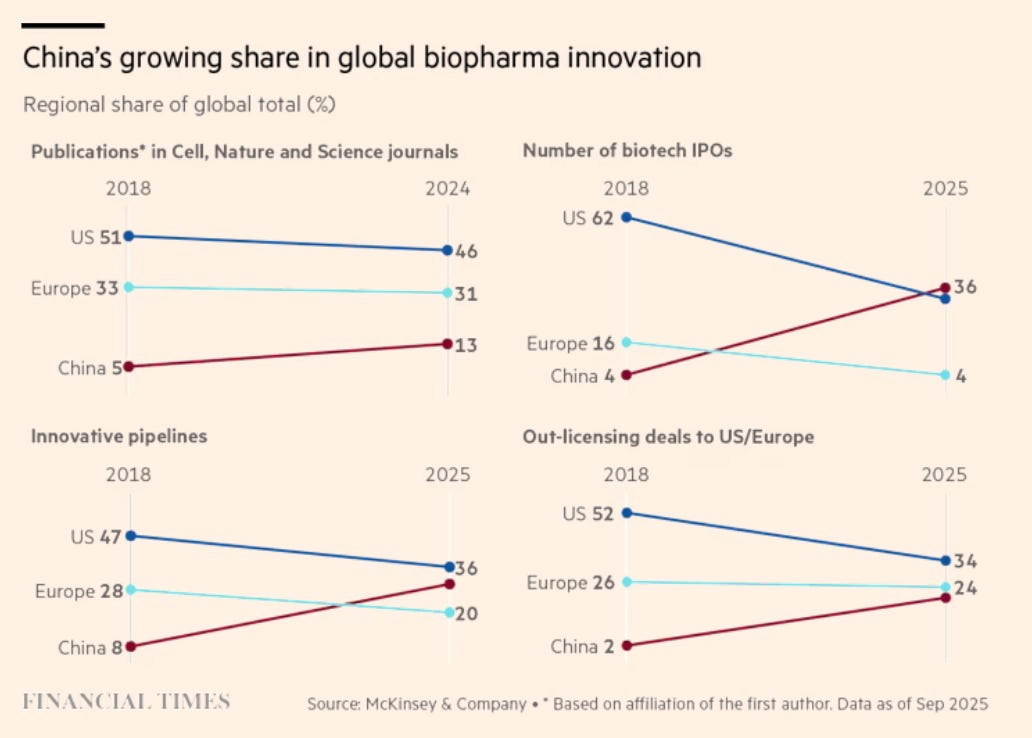
[3] Il titolo del diagramma è “La quota crescente della Cina nell’innovazione globale biofarmaceutica”. Il primo riquadro (a sinistra) mostra le evoluzioni delle pubblicazioni nelle riviste che trattano di cellule, di natura e di scienza (la Cina passa da 5 a 13 nel periodo 2018-2024). Il secondo riquadro, a destra, mostra l’evoluzione del numero di IPO boiotecnologiche (un’offerta pubblica iniziale, in sigla IPO, è un’offerta al pubblico dei titoli di una società che intende quotarsi per la prima volta su un mercato regolamentato). La Cina negli ultimi 7 anni è aumentata di 9 volte, da 4 a 36, superando gli Stati Uniti e di gran lunga l’Europa (che passano da 62 a 34 e da 16 a 4). Il terzo riquadro a sinistra mostra i numeri dei processi innovativi, dove la Cina quasi raggiunge gli Stati Uniti passando da 8 circa 30 e supera l’Europa, che resta a 20. Il quarto riquadro a destra mostra l’evoluzione negli accordi di cessione a terzi dei diritti di sfruttamento di proprietà intellettuali, dove la Cina – sempre in 7 anni – a partire da un numero di 2 accordi nel 2018, aumenta più di 10 volte, raggiungendo l’Europa e totalizzando 24 accordi, mentre gli Stati Uniti passano da 52 a 36 accordi.
I dati impressionanti provengono da uno studio del Financial Times.
[4] NHP è l’acronimo per “persone non umane”, ovvero, in questo caso, scimmie.
By mm
E' possibile commentare l'articolo nell'area "Commenti del Mese"