


Altri Economisti » Saggi in evidenza » Saggi, articoli su riviste. Krugman ed altri » Selezione del Mese
Lo spirito degli anni Novanta e il malessere di oggi. Di BRANKO MILANOVIC (da Global Inequality and more, 19 agosto 2026)
Aug 19, 2026
The spirit of the nineties and the malaise of today
 It does not require great originality nor insightfulness to contrast the world of the 1990s and that of today. They are dramatically different in terms of distribution of economic power between nations and in terms of inequalities within nations. But they also differ in the ruling spirit, at least in the Western world.
Perhaps one can begin with Tocqueville’s characterization of a similar age in the 1830s France:
“The particular spirit of the middle class became the general spirit of government; it dominated foreign policy as well as internal affairs: an active spirit, industrious, often dishonest, generally orderly, bold out of vanity and egoism, timid by temperament, moderate in all things except in its taste for comfort, and mediocre; a spirit which, mingled with that of the people or of the aristocracy, can do wonders, but which alone, will never produce but a government without virtue and without grandeur.” (Tocqueville, Souvenirs [of 1848], my translation)
That spirit “bold out of vanity and egoism,” permeated societies within, and informed international politics. It was fundamentally born out of the defeat of Communism. It was an optimistic spirit of resuscitated capitalism brought to the front first by Margaret Thatcher and then Ronald Reagan, and Deng Xiaoping although he did not call it by that name. By the mid-1980s with Gorbachev in power in the USSR, the ideological ascendancy of capitalism as the way to organize the economy, and of liberalism as the way to organize society was reaching its peak. With the dissolution of the Warsaw pact and the disappearance of the Soviet Union, ideological and geopolitical dimensions were united. It was a triumph of an ideology, but equally a triumph of a set of Western countries. The two triumphs were distinct but in the minds of many of its beneficiaries they were seen as one: the triumph of the West was made possible by its adoption of a superior ideology. Nothing in principle impeded others of being equally successful if they accepted the same rules. Moreover, it was said, the catch-up in the technological and economic development that this would entail would not be resented by the then dominant powers because –and this was a significant part of the ideology—the world was “condemned” to live in peace and harmony. For does not trade between nations and individuals create a harmony of interests and a global market that can prosper only in peace, and do not “satisfied” democratic nations (to use John Rawls’ terminology) not envy each other and not covet territory or riches and thus have no need for wars?
Was the spirit of the nineties really believed by those who professed it, and were they aware that they might have believed it because it was pleasing to them morally and materially? I had always had trouble finding an answer to that question. But I have no difficulty describing and locating that spirit, particularly because I lived through it in an environment which reflected it probably better than any other place in the world: in Washington, D.C., working for an international institution and then for a US think tank. I was at the cross-section of the spirit that emanated originally from the ruling classes of the United States, but by the early 1990s became accepted by everybody who mattered anywhere in the world. Everybody who mattered (that is, who had some amount of political and economic influence)—and these were the people I would meet in and around Washington, might have they arrived from whatever faraway county—believed in it. Or seemed to believe in it.
It was a spirit that saw violent conflict as obsolete, that believed that all issues can be set aright through technological advances or economic schemes. It saw the commercialization of all activities not only as desirable as such but as a tool toward more prosperous and peaceful world. If there was still a problem, it was because no technical solution for it was yet invented, or a market where the problem would be auctioned off and resolved had not been created. It was exactly the middle-class narrow spirit, as described by Tocqueville: sans grandeur, but quite unaware of it and not seeking it. It was not a bellicose spirit; it was pacific and trustful of perfectibility of man and society. It was teleological. It did not see history as cyclical, but as a straight upward line.
What many of its adherents did not perceive was that it also suited their own material interests. They did not want to look at that part, or most likely were reluctant to acknowledge it even to themselves, And, in fact, that part was not even apparent so long as their interests were in accord with the spirit of the time. What created problems and ultimately destroyed the spirit of the nineties was that material interests of many individuals and geopolitical interests of some nations were no longer served well by the spirit of the nineties.
Materially, the rise of China and more broadly of Asia lowered the economic position of Western middle classes, made their jobs redundant or precarious, while on the geopolitical stage, the rise of China challenged the dominant position of the United States. This double change (at the individual, and national levels) revealed deep inconsistencies in the spirit of the nineties. It was argued that the spirit was “sharing” and cosmopolitan; and indeed it was so long as the relative betterment of the Third World involved countries and peoples without significant power or role globally. But as soon as that betterment spread sufficiently (as it did with China), it was no longer desirable. So, one was forced to conclude: improvement in welfare of the poor is desirable only so long as it does not markedly affect the relative power and the position of the rich. Once such a caveat is made, though, the entire pacific and cosmopolitan spirit if the nineties is exposed as an ideological cover to service interests of the rich.
If we go farther and look at the concrete applications of that ostensibly generous and cosmopolitan spirit, we find increasing inconsistencies: it applied variously to friends and to others. In words of Mark Carney: “we knew the story of the international rules-based order was partially false. That the strongest would exempt themselves when convenient. That trade rules were enforced asymmetrically. And we knew that international law applied with varying rigour depending on the identity of the accused or the victim”. Political self-determination in one case was approved, while in another it was frowned upon; liberal principles of multiculturalism and intermingling were in one case celebrated; in the other they were excoriated; democracy, if it brought to power desirable parties was praised, but the same mechanism in the case of “bad delivery” was ignored.
The more the redistribution of economic and political power advanced, the more the contradiction in the spirit of the nineties became visible. Rules had to be applied with increasing inconsistency because ideological inconsistency was the only way to maintain material superiority. Thus the spirit of the nineties began its slow, and then accelerated, decomposition until it was revealed to have been no different than the spirit of many past ages: an ideology adopted and promoted by those classes that did well by its rules and had an interest to maintain it. Once that became obvious, the elaborate ideological scaffolding created to make the system appear as equitable and as promoting global welfare, collapsed as well. We were back to the traditional situation when covering one’s own interest in the cloth of some general human advantage was no longer credible—so we went to a more brutal, but in many ways more candid, times of open struggle motivated by own interests alone.
- Empirical evidence on some of the points made here is presented in my Great Global Transformation.
Lo spirito degli anni
Novanta e il malessere di oggi
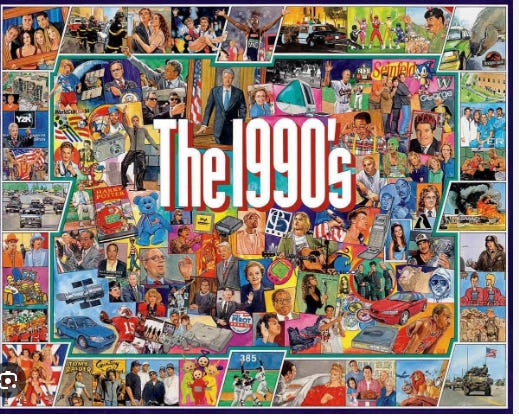
Non ci vuole grande originalità né perspicacia per mettere a confronto il mondo degli anni ’90 con quello di oggi. Sono profondamente diversi in termini di distribuzione del potere economico tra le nazioni e in termini di disuguaglianze al loro interno. Ma differiscono anche nello spirito di governo, almeno nel mondo occidentale.
Forse si potrebbe iniziare con la descrizione che Tocqueville fa di un’epoca simile nella Francia degli anni Trenta dell’Ottocento:
«Lo spirito particolare della borghesia divenne lo spirito generale del governo; dominò la politica estera così come gli affari interni: uno spirito attivo, industrioso, spesso disonesto, generalmente ordinato, audace per vanità ed egoismo, timido per temperamento, moderato in tutto tranne che nel gusto per il comfort, e mediocre; uno spirito che, mescolato a quello del popolo o dell’aristocrazia, può fare miracoli, ma che da solo non produrrà mai altro che un governo senza virtù e senza grandezza.» (Tocqueville, Souvenirs [del 1848], traduzione mia)
Quello spirito, “audace per vanità ed egoismo”, permeò le società interne e influenzò la politica internazionale. Nacque fondamentalmente dalla sconfitta del comunismo. Era uno spirito ottimistico di rinato capitalismo, portato alla ribalta prima da Margaret Thatcher e poi da Ronald Reagan, e infine da Deng Xiaoping, sebbene non lo chiamasse con questo nome. Verso la metà degli anni ’80, con Gorbaciov al potere in URSS, l’ascesa ideologica del capitalismo come modello economico e del liberalismo come modello sociale raggiunse il suo apice. Con lo scioglimento del Patto di Varsavia e la scomparsa dell’Unione Sovietica, le dimensioni ideologiche e geopolitiche si unirono. Fu il trionfo di un’ideologia, ma anche il trionfo di un insieme di paesi occidentali. I due trionfi erano distinti, ma nella mente di molti dei loro beneficiari venivano percepiti come un unico risultato: il trionfo dell’Occidente fu reso possibile dall’adozione di un’ideologia superiore. Nulla, in linea di principio, impediva ad altri paesi di raggiungere lo stesso successo, a patto che accettassero le stesse regole. Inoltre, si diceva, il recupero del divario nello sviluppo tecnologico ed economico che ne sarebbe derivato non sarebbe stato osteggiato dalle potenze allora dominanti perché – e questo era un aspetto significativo dell’ideologia – il mondo era “condannato” a vivere in pace e armonia. Dopotutto, il commercio tra nazioni e individui non crea forse un’armonia di interessi e un mercato globale che può prosperare solo in pace? E le nazioni democratiche “soddisfatte” (per usare la terminologia di John Rawls) non si invidiano forse a vicenda, non bramano territori o ricchezze e quindi non hanno bisogno di guerre?
Lo spirito degli anni Novanta era davvero creduto da coloro che lo professavano, ed erano consapevoli di crederci perché risultava loro gradito moralmente e materialmente? Ho sempre avuto difficoltà a trovare una risposta a questa domanda. Ma non ho problemi a descrivere e localizzare quello spirito, soprattutto perché l’ho vissuto in un ambiente che lo rifletteva probabilmente meglio di qualsiasi altro luogo al mondo: a Washington, DC, lavorando per un’istituzione internazionale e poi per un gruppo di ricerca statunitense. Mi trovavo al crocevia di quello spirito che inizialmente emanava dalle classi dirigenti degli Stati Uniti, ma che all’inizio degli anni Novanta era stato accettato da chiunque contasse, ovunque nel mondo. Tutti coloro che contavano (ovvero, che avevano una qualche influenza politica ed economica) – e queste erano le persone che incontravo a Washington e dintorni, anche se provenivano da chissà quale paese lontano – ci credevano. O almeno sembravano crederci.
Era uno spirito che considerava il conflitto violento obsoleto, che credeva che tutti i problemi potessero essere risolti attraverso progressi tecnologici o strategie economiche. Vedeva la commercializzazione di ogni attività non solo come auspicabile in quanto tale, ma come uno strumento per un mondo più prospero e pacifico. Se persisteva un problema, era perché non era ancora stata inventata una soluzione tecnica, o perché non era stato creato un mercato in cui il problema potesse essere messo all’asta e risolto. Era esattamente lo spirito ristretto della classe media, come descritto da Tocqueville: privo di grandiosità, ma del tutto inconsapevole di essa e non ricercandola. Non era uno spirito bellicoso; era pacifico e fiducioso nella perfettibilità dell’uomo e della società. Era teleologico. Non vedeva la storia come ciclica, ma come una linea retta ascendente.
Ciò che molti dei suoi sostenitori non percepirono fu che tale spirito si adattava anche ai loro interessi materiali. Non volevano prendere in considerazione quell’aspetto, o più probabilmente erano riluttanti ad ammetterlo persino a se stessi. E, di fatto, quell’aspetto non era nemmeno evidente finché i loro interessi erano in sintonia con lo spirito del tempo. Ciò che creò problemi e alla fine distrusse lo spirito degli anni Novanta fu che gli interessi materiali di molti individui e gli interessi geopolitici di alcune nazioni non venivano più ben serviti da quello spirito.
A livello materiale, l’ascesa della Cina e, più in generale, dell’Asia, ha indebolito la posizione economica delle classi medie occidentali, rendendo i loro posti di lavoro superflui o precari, mentre sul piano geopolitico ha sfidato la posizione dominante degli Stati Uniti. Questo duplice cambiamento (a livello individuale e nazionale) ha rivelato profonde contraddizioni nello spirito degli anni Novanta. Si sosteneva che tale spirito fosse di “condivisione” e cosmopolita; e lo era effettivamente finché il relativo miglioramento del Terzo Mondo coinvolgeva paesi e popoli privi di potere o ruolo significativi a livello globale. Ma non appena tale miglioramento si è diffuso a sufficienza (come è accaduto con la Cina), non è più stato auspicabile. Pertanto, si è stati costretti a concludere: il miglioramento del benessere dei poveri è auspicabile solo finché non incide in modo significativo sul potere e sulla posizione dei ricchi. Una volta fatta tale precisazione, tuttavia, l’intero spirito pacifico e cosmopolita degli anni Novanta si rivela essere una copertura ideologica al servizio degli interessi dei ricchi.
Se andiamo oltre e analizziamo le applicazioni concrete di quello spirito apparentemente generoso e cosmopolita, troviamo crescenti incongruenze: veniva applicato in modo diverso agli amici e agli altri. Per usare le parole di Mark Carney [1]: “sapevamo che la storia dell’ordine internazionale basato sulle regole era in parte falsa. Che i più forti si sarebbero esentati quando conveniente. Che le regole commerciali venivano applicate in modo asimmetrico. E sapevamo che il diritto internazionale veniva applicato con rigore variabile a seconda dell’identità dell’accusato o della vittima”. L’autodeterminazione politica in un caso veniva approvata, mentre in un altro veniva vista con disapprovazione; i principi liberali di multiculturalismo e mescolanza venivano in un caso celebrati, in un altro aspramente criticati; la democrazia, se portava al potere partiti desiderabili, veniva elogiata, ma lo stesso meccanismo, in caso di “cattiva applicazione”, veniva ignorato.
Quanto più avanzava la redistribuzione del potere economico e politico, tanto più si manifestava la contraddizione insita nello spirito degli anni Novanta. Le regole dovevano essere applicate con crescente incoerenza, perché l’incoerenza ideologica era l’unico modo per mantenere la superiorità materiale. Così, lo spirito degli anni Novanta iniziò la sua lenta, e poi accelerata, decomposizione, fino a rivelarsi non diverso dallo spirito di molte epoche passate: un’ideologia adottata e promossa da quelle classi che traevano vantaggio dalle sue regole e avevano interesse a mantenerla. Una volta che ciò divenne evidente, crollò anche l’elaborata impalcatura ideologica creata per far apparire il sistema equo e promotore del benessere globale. Ci ritrovammo nella situazione tradizionale, in cui mascherare i propri interessi con il pretesto di un vantaggio umano generale non era più credibile: si passò quindi a un’epoca più brutale, ma per molti versi più schietta, di lotta aperta motivata unicamente dagli interessi personali.
P.S. Alcune delle prove empiriche a sostegno di quanto affermato qui sono presentate nel mio libro ” La Grande Trasformazione Globale” .
[1] Mark Carney è un economista, banchiere e politico canadese, attuale 24º Primo ministro del Canada e leader del Partito Liberale del Canada. Entrato in carica nel marzo 2025 dopo aver sostituito Justin Trudeau, Carney è una delle figure più influenti e note della finanza internazionale, celebre per aver guidato due banche centrali differenti prima di iniziare la sua carriera politica.
La citazione proviene da un recente discorso di Carney che ha provocato notevole impressione sulla attuale politica statunitense trumpiana.
By mm
E' possibile commentare l'articolo nell'area "Commenti del Mese"