


Altri Economisti » Saggi in evidenza » Saggi, articoli su riviste. Krugman ed altri » Selezione del Mese
L’ultimo dei maghi: Thomas Mann, John Maynard Keynes e l’alchimia del liberalismo borghese (Un saggio di Adam Tooze e Stefan Eich, Chartbook 465, 9 agosto 2026).
Aug 09, 2026
Chartbook 465 The Last of the Magicians: Thomas Mann, John Maynard Keynes and the Alchemy of Bourgeois Liberalism
An essay by Adam Tooze and Stefan Eich
 “The new, socialized world, the world of planning and co-operation, will come; humanity will get rid of unnecessary sufferings that are a disgrace to intelligence; and this will be achieved by a great and sober effort that has already enrolled under its banner all who have turned their backs upon a cult of musty, obscurantist, petty bourgeois sentiment. It will come; for a rational outward order of things in keeping with the present stage of human enlightenment must be created, or, if the worst happens, will be produced by violent convulsions. Only then can the heart reassert its rights with good conscience. The great sons of the bourgeois age, those whose capacity for spiritual growth raised them above the level of their class, are living proof of the fact that there are in the bourgeois nature infinite potentialities, unlimited potentialities for self-liberation and self-conquest. Our time summons the middle class to remember these innate powers and to take their stand upon them intellectually and ethically. The right to power is contingent upon the conviction that one has a historic mission to perform. If any class refuses to do this, or is too weak, it will have to step aside, abdicate power, and make way for a type that knows none of the inhibitions and ties of atavistic sentiment, which, one cannot but fear at times, may render the European middle class unfit to guide the body politic and economic into a new world.
Without doubt, the credit that history is still willing to accord to the bourgeois republic to-day—a short-term credit, indeed—rests upon the faith not yet lost that democracy also has that ability which its increasingly powerful enemies claim as their own: the ability to undertake our guidance into the new age. It is not by staging celebrations for its great sons that the middle class proves itself worthy of them. The greatest of these, Goethe, hails it:
Turn your backs upon dead trappings,
Let us love what is alive!”
Whose words are these? We are in the spring of 1932. The themes are familiar. The appeal to the educated middle class standing at a turning point. The idea of living on borrowed time.
The obvious suspect is John Maynard Keynes. And yet this is clearly not Keynes. For one, if this passage was by Keynes, it would be very well-known. But it is also a little too bombastic, too European in its evocation of class categories and the reference to Goethe would be out of character too.
In fact, it is the text of a speech written by Thomas Mann speaking on the centennial of the death of his great literary hero Goethe on March 22, 1932.
Nevertheless, the resemblance in contemporary diagnosis between Keynes and Mann is intriguing. In continuation of the thought begun in Chartbook 463, it is fascinating to explore the parallels and divergences between two of the most famous liberal intellectuals of the period from the 1920s to the 1940s.
Was there contact between them? Not, as far as we know, in direct terms. So what follows is not intellectual history but speculative juxtaposition. Nevertheless, the connection is not merely imaginary.
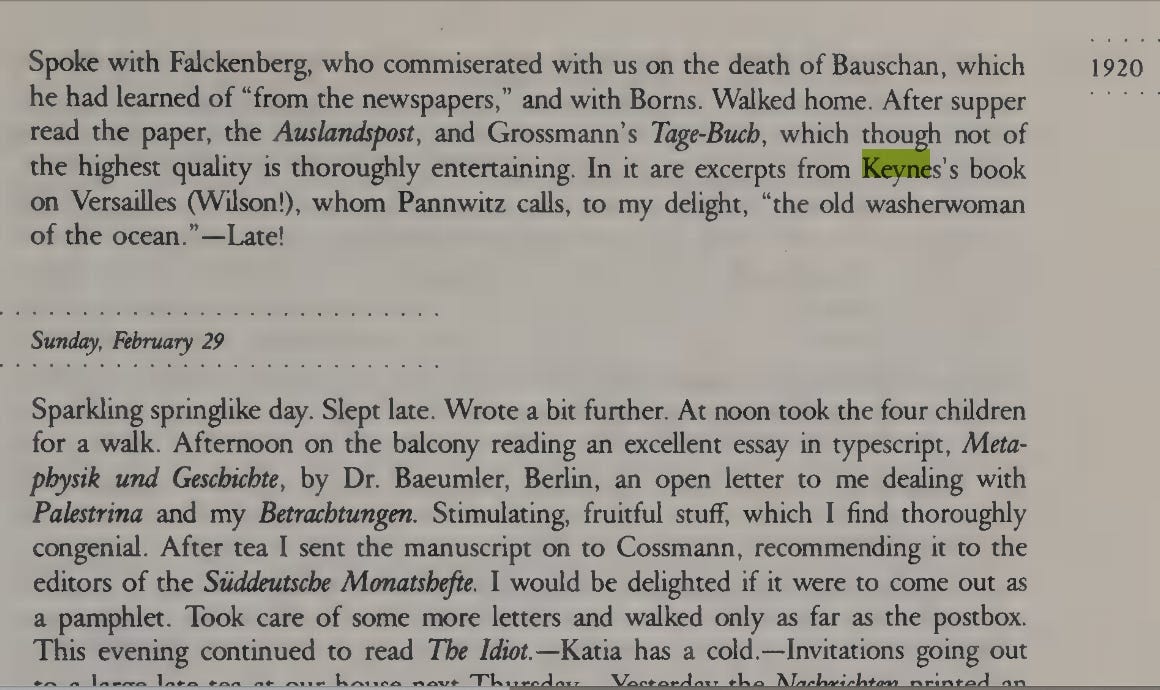
Mann can hardly have not known about Keynes. No educated German could have been ignorant of The Economic Consequences of the Peace (1919). Indeed Mann’s diary records him reading excerpts from the book in February 1920 and delighting at the portrayal of Wilson. As one would expect, Mann invokes “Keynes’s book” as a household term.
Conversely, after the critical success of Buddenbrooks (1901) and The Magic Mountain (1924), the Bloomsbury group must surely have had views about Mann, who went on to win the Nobel Prize in Literature in 1929.
And yet there is no evidence that Keynes ever read Thomas Mann. He was far more interested in Ibsen plays and Russian ballet than contemporary continental novels. It is a remarkable and perhaps telling missed connection, one that points to the relatively hermetic nature of much of middle class culture, particularly in early twentieth-century Britain.
After all, their preoccupations were deeply aligned.
Both were fundamentally interested in the fate but also the role and responsibility of the social elites inherited from the nineteenth century in the twentieth century.
Keynes’s opening to the Economic Consequences of the Peace could have come straight out of a Mann novel, except that in Mann it would have been tongue in cheek.
As Mann himself later remarked in a talk at Princeton given in 1939, Zauberberg, his great novel looking back at bourgeois life in the pre-1914 period, was only imaginable under conditions of “intact” capitalism.
For Keynes, the underlying stakes were nothing less than “civilization,” a term loaded with promise and anxiety. The force of The Economic Consequences of the Peace had after all come from treating the pre-war European order as an astonishing and fragile achievement.
In “My Early Beliefs,” the memoir Keynes read to his Bloomsbury friends in September 1938 in the midst of the Sudeten crisis, Keynes looked back on the confident rationalism of his pre-war youth and judged it “disastrously mistaken.” What he and his friends had missed was the existence of “irrational springs of wickedness in most men.” “We were not aware that civilisation was a thin and precarious crust erected by the personality and the will of a very few, and only maintained by rules and conventions skilfully put across and guilefully preserved.” It is this startling confession about the precarity of civilization that underpins Keynes’s quest for renewal and reinvention.
For the young Mann, by contrast, the same term was very nearly a slur. During World War I, and then most explicitly in his Reflections of a Nonpolitical Man (1918), he had built a whole metaphysics out of pitting “civilization” against Kultur. Civilization was the shallow, sociable, rationalizing West: epitomized by the Enlightenment, France, democracy, “literature,” even politics as such. Kultur, by contrast, was a peculiarly German thing: arising from the soul, endowed with depth, and expressed in music, form, art, indeed in the daemonic. “The difference between Geist and politics,” Mann wrote, “contains that between culture and civilization, between soul and society, between freedom and the franchise, between art and literature.” Culture was where the enchantment lived.
Having drawn this map in which enlightenment rationalism was neatly separated from the magical realm culture, within a few years he redrew it.
Already by the early 1920s Mann had dissolved the binary. In his extraordinary speech “Von deutscher Republik” (On the German Republic) given in October 1922, which startled his admirers on the right, Mann declared himself for the Weimar Republic and simultaneously insisted this was no mere recantation of his earlier beliefs. Instead, he announced by way of the unlikely duo of Novalis and Whitman “the identity of humanity and democracy,” the first being “only a classicistically old-fashioned name for the second.” Kultur and civilization, the German romantic and the American democrat. The antitheses on which his wartime Reflections had rested were now to be reconciled through the republican state and under the heading of humanity. By 1932, summoning the bourgeoisie to “guide” society into a rational new order, Mann speaks in almost exactly the civilizational register the author of the Reflections had ridiculed. That intellectual and political migration is what lets Mann’s Goethe speech begin to sound like Keynes.
By the early 1930s, theirs was thus a shared question: How do we make modern civilization work under conditions that are both affluent and yet fraught?
Like Mann, Keynes had a deep sense of inherited ideas as both powerful and out of step with the world. The profound sense that the old order was taking itself down to ruin and had to be reinvented in order to be saved, is common to both of them.
Both of them were reluctant but realistic exponents of modern democracy.
The working class as the unexpected but essential ally against bourgeois philistinism, in favor of modern intellectual and cultural progress – Mann and Keynes also agree on this.
Most fundamentally, both situated their contemporary interventions and historical reflections within a historical schema of transition.
Mann’s 1932 Goethe speech was the warrant for Georg Lukács’s claim that Mann was the “last great critical realist”. Like the modernists of his generation – Woolf, Joyce, Proust – Mann was caught up in the exploration of inner life. Under conditions of late capitalism, Lukács argued, nothing else was possible. But unlike his contemporaries, Mann remained rooted in a broader, overarching view of history, precisely the socio-economic trajectory set out in his Goethe speech: towards “(t)he new, socialized world, the world of planning and co-operation”. This meant that Mann’s Zauberberg (as argued in the last Chartbook 463) is not just a case study of subjective disorientation, but truly a structural account of the drifting apart of subjective time and objective history. This was for Lukács (and for Adorno’s btw) the essential hallmark of “realism” under conditions of late capitalism.
Taking up the Lukácsian reading, would it be too far-fetched to suggest that Keynes, in his own domain, was accomplishing something similar?
If Mann (as read by Lukács) was the last great critical realist because he accounted in grand architecture of his novels for the disintegration of the classic unity of subjective time and objective historical development, was Keynes, in his General Theory (1936), not trying to do something similar for the domain of political economy? Was Keynes not corralling the dispersed fragments of a late-nineteenth-century coherence into a new and more general framework, an intervention that was both radical and at the same time an act of preservation, not to say conservation?
Keynes’s basic diagnosis was that the old properties of a well-functioning market economy and with it the self-confident subjectivity of bourgeois identity, consumption, and personal freedom were no longer in evidence. Conservatives might insist that the only way forward was a hard-faced return to the nineteenth century. But for Keynes that amounted to a form of denial. The other great experiments of the age, the new model of 1920s Soviet civilization, as well as the distasteful centralized authoritarian regimes of Italian fascism and German Nazism, were at least able to reckon with the rupture.
But liberalism had no reason to abandon itself to this bad set of choices. If it actually occupied the space of sex-life-death – i.e. biopolitics, Mann’s preeminent domain – and at the same time situated its economic policy within an enlightened macroeconomics, framed not as a “special” case but by a “general theory” – what Mann’s novels did in narrative terms – liberalism could regain its agency and vindicate the special role of the educated elite as guiding all of society into a better and more civilized future. As both Mann and Keynes insisted, liberalism need not be shy, it need not concede the future to the fascists, so long as it put itself on the historical front foot. It must demonstrate its capacity to “guide”, as Mann put it in his Goethe speech.
That also meant accounting for one’s own vantage point in addressing a bourgeois audience. Like Keynes, Mann inhabited the contradictions of this bourgeois perspective with preternatural ease, as Lukács already observed in his essay “In Search of Bourgeois Man,” written in 1945 in honour of Mann’s seventieth birthday. Describing Mann as “the last great bourgeois writer,” Lukács highlighted his “dialectically complex attitude to the middle class.”
If we think of economics and the novel as two distinctively modern “technologies” of sense-making in bourgeois society, and if those apparatuses first took on their consolidated “classic” shape for the first time in the early nineteenth century, then both Mann and Keynes found ways to update and translate those technologies into the Age of Extremes. So, Keynes’s macroeconomic stands in relation to its Marshallian forebears, as, according to Lukács, Mann’s novels stand in relation to their nineteenth-century predecessors.
But if this parallelism is illuminating there is another deeper motif that it may unlock.
What, after all, is the pivot we are using for this speculative exercise? A speech commemorating the dominant figure of modern German culture, Johann Wolfgang von Goethe (1749-1832).
For Mann’s sense of history (and for Lukács’s reading of Mann as a historical thinker and writer) it is not just the crisis of World War I that is key. It is not by accident that in the midst of the crisis, in 1932, Mann should return to Goethe as his essential anchor point, straddling the Sattelzeit (Koselleck) between the eighteenth and nineteenth centuries. Furthermore, by way of Goethe’s own historical vista, Mann opens to the seventeenth century and the age of alchemy supposedly overcome by enlightenment rationalism. Hence the figure of Dr Faustus.
Geoff Mann (no relation) has recently given us a brilliantly illuminating reading of Keynesianism, also in terms of the Sattelzeit, but in his case by way of Hegel. This is inspired less by any specific indebtedness of Keynes to Hegel, than by Geoff Mann’s productive wrestling with Marxist readings of Keynes – above all that of Toni Negri.
In rewriting Keynes as the theorists of the thermidor, Geoff Mann gives us a tour de force in every sense of that phrase.
Our reading of Keynes in light of Thomas Mann suggests an alternative, less conservative, speculative history. On our reading, the historical depth to Mann and Keynes’s liberalism would be provided not by Hegel and his visions of the state, but by figures of bourgeois genius like Goethe and, on Keynes’s side, his great heroes of the seventeenth and early eighteenth century.
Thomas Mann’s reading of the late Goethe is worth quoting at length:
“This bold, dream-like anticipation of a new society to succeed the bourgeois order is as remarkable, as impressive, as the old man’s growing interest in engineering projects of utopian scope, his enthusiasm for undertakings like the cutting through of the Isthmus of Panama. He talks of these things insistently and goes into detail as if they were of more importance to him than all the poetry in the world, and that is true, in the last analysis. His optimistic delight in the scientific side of civilization, affecting communications particularly, need cause no surprise in view of the end of Faust, who experiences his highest moment in the realization of a utilitarian dream, the draining of a swamp—a peculiar affront, indeed, to the one-sidedly aesthetic and philosophical trend of the age! In the same way, Goethe was astonishingly indefatigable in his old age in discussing the possibilities of joining the Gulf of Mexico with the Pacific, and in expatiating on the incalculable effects of such a feat upon the whole world, civilized and uncivilized alike. He wanted the United States to undertake the work, and his fancy dwells upon the prosperous cities that would spring up one after another along the Pacific coast, where nature had so felicitously prepared the ground for man by making good harbors. He could hardly wait for that to come about—that and the joining of the Danube and the Rhine, a perfectly staggering project, to be sure, along with a third very great project, the Suez Canal for the English. “To see all that,” he exclaims, “might make it worth while to hold out on this earth for another fifty years.” He cast his eyes over the earth, refusing to stop short at the borders of his own country; his enthusiasm for the future was vast enough to take in the whole world; and the quickening of life, the joys and sorrows, of foreign nations affected him as did those of his own people. His was an imperialism of love—the imperialism of an august mind risen above barriers of nationality, a mind that cherished liberty particularly under its aspect of greatness. It is the same trait that we have already seen in his heralding of a world literature. In setting itself to create a utopia of applied science, the bourgeois outlook expands to world-wide proportions; it turns into “communism,” taking that word in a sufficiently broad, undogmatic sense. This is an enthusiasm of a sober sort. But what we need to-day is the sobering of a world that is dying from the strangle-hold of emotional survivals. Who was it who said that the Germans should be prohibited from using the word “Gemüt” for fifty years? It was Germany’s greatest poet. The middle-class man is lost and is doomed to be swept aside in the era that is approaching unless he can succeed in ridding himself of the fatal sentiment and life-sapping principles that still govern his thinking. He must bravely espouse the future. It is idle to scorn reason and hold to a stubborn cult of atavistic feeling which, in present conditions, appears utterly blind and senseless—a kind of desperate, malignant, murderous sentimentalism.”
It is as though Thomas Mann is reading Goethe by way of Keynes’s “Economic Possibilities of our Grandchildren”, which had been published in June 1930.
Which suggests the question – riffing this time on Geoff Mann rather than Thomas Mann – are all true Keynesians not so much descendants of Hegelian, as children of Goethe?
A textbook description of the Weimar classicism shaped by Goethe and Schiller in the transition from the eighteenth to the nineteenth century, would describe it as the synthesis of rationalism of the Enlightenment with the romantic, “animal spirits” of Sturm und Drang, a decidedly “Keynesian” formulation. An argument for Goethe over Hegel could be made simply on grounds of precedence and preeminence. By the late eighteenth century, Goethe was a cultural star of quite different proportions than Hegel. Whereas Hegel was an awed spectator of Napoleonic history, Goethe was on the young Bonaparte’s bedside table. As Emperor, Napoleon received Goethe for a personal audience in October 1808. Indeed, as Napoleonic historian Nicolas Broussard remarks:
“Hegel opens his lessons on Roman history by reporting the famous bit of conversation between Goethe and Napoleon: “One day he was conversing with Goethe about the nature of tragedy. He expressed then the opinion that the modern tragedy was differing from the old one essentially in that we do not have fate any more of which men will succumb and that in the place of the ancient Fatum has appeared politics. It should thus be used as the modern destiny for tragedy, as the power of circumstances to which the individual has to bend to.” (Lectures, p.215).”
Once again this is a chain of intellectual association without textual warrant in Keynes himself. The point of making it is to answer Geoff Mann’s brilliant Marxo-Hegelian reading by way of Negri with one derived from Thomas Mann by way of Georg Lukács.
Keynes, himself, might very well have been bewildered by either chain of association. After all, he situated himself self-consciously in the tradition of English political thought that descended from Hobbes and Locke. His most charged points of identification lay with figures the “nineteenth century” had flattened and which Keynes set about disinterring.
The first was Thomas Robert Malthus, almost exactly Goethe’s contemporary and, in Keynes’s insistent phrase, “the first of the Cambridge economists.” What Keynes prized in Malthus was precisely what the nineteenth century had discarded. Malthus was the road modern political economy had failed to take, defeated and buried by Ricardo. For the discipline had refused to build on Malthus the “inductive and intuitive investigator,” the mind that stayed close to the texture of experience. Instead, Ricardo’s more abstract intellectual constructions proved victorious. The triumph of the cleaner, colder system produced a science remade in the misleading image of purified reason. Keynes presented his own task as revealing why the subsequent century of Ricardian dominance had been a “disaster,” stuck in an “artificial groove.”
To recover Malthus was to reopen the groove, to insist that the ancestor the nineteenth century had buried was the richer mind who had come to economic questions “by the best of all routes,” beginning as a philosopher and moral scientist, passing through history, and only then arriving at theory, as Keynes put it the biographical essay he finally published in 1933 he made the stakes plain. To describe that arrival Keynes reached for a startling image of transformation: “from being a caterpillar of a moral scientist and a chrysalis of an historian, he could at last spread the wings of his thought and survey the world as an economist.” It is an image of magic and metamorphosis: a shapeshifting creature that leaps from one fixed form into another, unrecognisable and more alive.
This was exactly the image Keynes would reach for again, on a far grander scale, when he turned from Malthus to a stranger and even more charismatic ancestor, reaching back past the eighteenth century into the seventeenth: Isaac Newton.
In 1936, Keynes, a long admirer of Newton, purchased the scientists’ unpublished manuscripts at a Sotheby auction. He reportedly paid £3,000 or around £200,000 today adjusted for inflation. As Keynes was surprised to discover, the manuscripts he had purchased reflected Newton’s extensive interest in the subject of alchemy. By Keynes’s own estimation, Newton scribbled perhaps a million words in notes on alchemical matters. As Keynes came to realize, Newton was not just the first of the scientists, but the last of the magicians.
In the remarkable commemorative essay that he penned for December 1942 the anniversary of Newton’s birth, Keynes started by apologizing for the fact that “The war has deprived me both of leisure to treat adequately so great a theme and of opportunity to consult my library and my papers and to verify my impressions … .” He then went on:
“I believe that Newton was different from the conventional picture of him. But I do not believe he was less great. He was less ordinary, more extraordinary, than the nineteenth century cared to make him out. Geniuses are very peculiar. Let no one here suppose that my object today is to lessen, by describing, Cambridge’s greatest son. I am trying rather to see him as his own friends and contemporaries saw him. And they without exception regarded him as one of the greatest of men. In the eighteenth century and since, Newton came to be thought of as the first and greatest of the modern age of scientists, a rationalist, one who taught us to think on the lines of cold and untinctured reason. I do not see him in this light. I do not think that any one who has pored over the contents of that box which he packed up when he finally left Cambridge in 1696 and which, though partly dispersed, have come down to us, can see him like that. Newton was not the first of the age of reason. He was the last of the magicians, the last of the Babylonians and Sumerians, the last great mind which looked out on the visible and intellectual world with the same eyes as those who began to build our intellectual inheritance rather less than 10,000 years ago. Isaac Newton, a posthumous child born with no father on Christmas Day, 1642, was the last wonderchild to whom the Magi could do sincere and appropriate homage.”
What is extraordinary about this essay, as about Thomas Mann’s rereading of Goethe in 1932, is its historical creativity. Keynes summons a new Newton, one freed from the encrustations of the nineteenth century. One that is both stranger and yet also more alive, freed from the wax works and thus present in the twentieth century. As one contemporary remarked, Keynes described Newton as “Copernicus and Faustus in one, and doubtless he thought he resembled them both”.
Ultimately, this is what makes Keynes and Mann kindred spirits: the ambition not only to rethink the position of the twentieth-century bourgeoisie, and its politics of liberalism in relation to the tensions of their moment, but also to give that politics a new history in the grandest sense.
L’ultimo dei maghi: Thomas Mann, John Maynard Keynes e l’alchimia del liberalismo borghese (Chartbook 465)
Un saggio di Adam Tooze e Stefan Eich
“Il nuovo mondo socializzato, il mondo della pianificazione e della cooperazione, arriverà; l’umanità si libererà delle sofferenze inutili che sono una vergogna per l’intelligenza; e questo sarà realizzato grazie a un grande e sobrio sforzo che ha già riunito sotto la sua bandiera tutti coloro che hanno voltato le spalle a un culto di sentimenti polverosi, oscurantisti e piccolo-borghesi. Arriverà; perché un ordine esteriore razionale delle cose, in linea con l’attuale stadio dell’illuminismo umano, deve essere creato, o, se accade il peggio, sarà prodotto da violente convulsioni. Solo allora il cuore potrà riaffermare i propri diritti con buona coscienza. I grandi figli dell’età borghese, coloro la cui capacità di crescita spirituale li ha elevati al di sopra del livello della loro classe, sono la prova vivente del fatto che nella natura borghese esistono infinite potenzialità, potenzialità illimitate di autoliberazione e autoconquista. Il nostro tempo chiama la classe media a ricordare questi poteri innati e a farne tesoro a livello intellettuale ed etico. Il diritto al potere è subordinato alla convinzione di avere una missione storica da compiere. Se una qualsiasi classe si rifiuta di farlo, o è troppo debole, dovrà farsi da parte, abdicare al potere e lasciare il posto a un tipo che non conosce le inibizioni e i vincoli del sentimento atavico, il quale, non si può fare a meno di temere a volte, potrebbe rendere la classe media europea inadatta a guidare il corpo politico ed economico verso un mondo nuovo.
Senza dubbio, il credito che la storia è ancora disposta ad accordare alla repubblica borghese odierna – un credito a breve termine, in effetti – si fonda sulla fede, non ancora perduta, che anche la democrazia possieda quella capacità che i suoi nemici, sempre più potenti, rivendicano come propria: la capacità di guidarci verso la nuova era. Non è organizzando celebrazioni per i suoi grandi figli che la classe media si dimostra degna di esse. Il più grande di questi, Goethe, la celebra:
Volta le spalle alle trappole morte,
Amiamo ciò che è vivo!”
Di chi sono queste parole? Siamo nella primavera del 1932. I temi sono familiari. L’appello alla classe media istruita che si trova a un punto di svolta. L’idea di vivere con il tempo contato.
Il sospettato più ovvio è John Maynard Keynes. Eppure, questo non è chiaramente Keynes. Innanzitutto, se questo passaggio fosse di Keynes, sarebbe molto noto. Ma è anche un po’ troppo ampolloso, troppo europeo nel suo evocare categorie di classe e il riferimento a Goethe sarebbe fuori luogo.
Si tratta, infatti, del testo di un discorso scritto da Thomas Mann in occasione del centenario della morte del suo grande eroe letterario Goethe, il 22 marzo 1932 .
Tuttavia, la somiglianza nella diagnosi contemporanea tra Keynes e Mann è intrigante. Proseguendo la riflessione iniziata nel Chartbook 463 , è affascinante esplorare i parallelismi e le divergenze tra due dei più famosi intellettuali liberali del periodo che va dagli anni ’20 agli anni ’40.
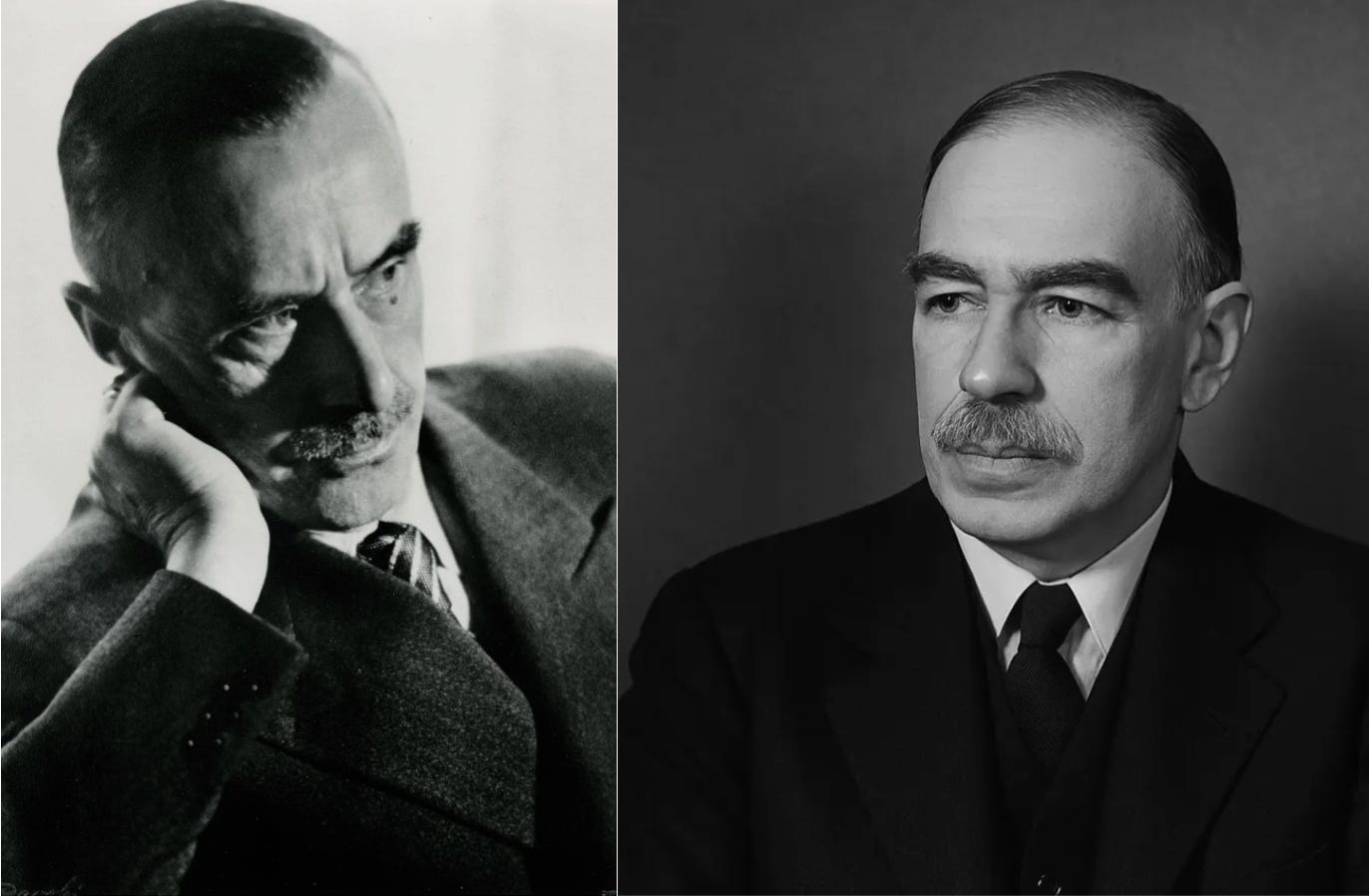
Ci furono contatti tra di loro? A quanto ne sappiamo, no, in termini diretti. Quindi ciò che segue non è storia intellettuale, bensì una giustapposizione speculativa. Ciononostante, il collegamento non è meramente immaginario.
È praticamente impossibile che Mann non conoscesse Keynes. Nessun tedesco istruito avrebbe potuto ignorare ” Le conseguenze economiche della pace” (1919). Infatti, il diario di Mann riporta che nel febbraio del 1920 lesse alcuni estratti del libro, esprimendo il suo apprezzamento per la descrizione di Wilson. Come ci si aspetterebbe, Mann usa “il libro di Keynes” come termine di uso comune.

D’altra parte, dopo il successo di critica di Buddenbrooks (1901) e La montagna incantata (1924), il gruppo di Bloomsbury doveva avere sicuramente delle opinioni su Mann, che in seguito vinse il Premio Nobel per la Letteratura nel 1929.
Eppure non ci sono prove che Keynes abbia mai letto Thomas Mann. Era molto più interessato alle opere teatrali di Ibsen e ai balletti russi che ai romanzi continentali contemporanei. Si tratta di una notevole e forse significativa occasione mancata, che mette in luce la natura relativamente ermetica di gran parte della cultura borghese, in particolare nella Gran Bretagna dei primi del Novecento.
Dopotutto, le loro preoccupazioni erano profondamente allineate.
Entrambi erano fondamentalmente interessati al destino, ma anche al ruolo e alla responsabilità delle élite sociali ereditate dal diciannovesimo secolo nel ventesimo secolo.
L’introduzione di Keynes a “Le conseguenze economiche della pace” avrebbe potuto essere tratta direttamente da un romanzo di Mann, se non fosse che in Mann sarebbe stata ironica.
Come lo stesso Mann osservò in seguito in una conferenza tenuta a Princeton nel 1939, Zauberberg , il suo grande romanzo che ripercorre la vita borghese nel periodo precedente al 1914, era immaginabile solo in un contesto di capitalismo “intatto”.
Per Keynes, la posta in gioco non era altro che la ” civiltà “, un termine carico di promesse e ansie. La forza de Le conseguenze economiche della pace derivava, dopotutto, dal considerare l’ordine europeo prebellico come una conquista straordinaria e fragile.
In “Le mie prime convinzioni”, il libro di memorie che Keynes lesse ai suoi amici di Bloomsbury nel settembre del 1938, nel pieno della crisi dei Sudeti, Keynes ripercorse il razionalismo fiducioso della sua giovinezza prebellica e lo giudicò “disastrosamente errato”. Ciò che lui e i suoi amici non avevano colto era l’esistenza di “fonti irrazionali di malvagità nella maggior parte degli uomini”. “Non eravamo consapevoli che la civiltà fosse una crosta sottile e precaria, eretta dalla personalità e dalla volontà di pochissimi, e mantenuta solo da regole e convenzioni abilmente trasmesse e astutamente preservate”. È questa sorprendente confessione sulla precarietà della civiltà che sta alla base della ricerca di rinnovamento e reinvenzione di Keynes.
Per il giovane Mann, al contrario, lo stesso termine era quasi un insulto. Durante la Prima Guerra Mondiale, e poi in modo più esplicito nelle sue Riflessioni di un uomo apolitico (1918), aveva costruito un’intera metafisica contrapponendo “civiltà” a Kultur . La civiltà era l’Occidente superficiale, socievole e razionalista: incarnato dall’Illuminismo, dalla Francia, dalla democrazia, dalla “letteratura”, persino dalla politica in quanto tale. Kultur, al contrario, era una cosa tipicamente tedesca: nata dall’anima, dotata di profondità ed espressa nella musica, nella forma, nell’arte, persino nel demoniaco. “La differenza tra Geist e politica”, scrisse Mann, “contiene quella tra cultura e civiltà, tra anima e società, tra libertà e diritto di voto, tra arte e letteratura”. La cultura era il luogo in cui risiedeva l’incanto.
Dopo aver tracciato questa mappa in cui il razionalismo illuminista era nettamente separato dalla cultura del regno magico, nel giro di pochi anni la ridisegnò.
Già all’inizio degli anni ’20 Mann aveva dissolto la dicotomia. Nel suo straordinario discorso ” Von deutscher Republik ” (Sulla Repubblica tedesca), pronunciato nell’ottobre del 1922, che sconvolse i suoi ammiratori di destra, Mann si dichiarò a favore della Repubblica di Weimar, insistendo al contempo sul fatto che non si trattava di una semplice ritrattazione delle sue precedenti convinzioni. Annunciò invece, attraverso l’improbabile duo di Novalis e Whitman, “l’identità tra umanità e democrazia”, la prima essendo “solo un nome classicista e antiquato per la seconda”. Cultura e civiltà, il romantico tedesco e il democratico americano. Le antitesi su cui si fondavano le sue Riflessioni del periodo bellico dovevano ora essere conciliate attraverso lo stato repubblicano e sotto il nome di umanità. Nel 1932, esortando la borghesia a “guidare” la società verso un nuovo ordine razionale, Mann si esprime in un registro quasi identico a quello civilizzazionista che l’autore delle Riflessioni aveva deriso. È questa migrazione intellettuale e politica che fa sì che il discorso di Mann su Goethe inizi a suonare come quello di Keynes.
All’inizio degli anni ’30, la loro domanda era dunque condivisa: come possiamo far funzionare la civiltà moderna in condizioni che sono al tempo stesso di benessere e di difficoltà?
Come Mann, Keynes nutriva una profonda consapevolezza del fatto che le idee ereditate fossero al contempo potenti e anacronistiche. La convinzione, profondamente radicata, che il vecchio ordine si stesse autodistruggendo e dovesse essere reinventato per essere salvato, è comune a entrambi.
Entrambi erano, seppur riluttanti, sostenitori realistici della democrazia moderna.
La classe operaia come alleata inattesa ma essenziale contro il filisteismo borghese, a favore del progresso intellettuale e culturale moderno: su questo concordano anche Mann e Keynes.
Fondamentalmente, entrambi hanno collocato i loro interventi contemporanei e le loro riflessioni storiche all’interno di uno schema storico di transizione.
Il discorso di Mann a Goethe del 1932 fu la giustificazione per l’affermazione di Georg Lukács secondo cui Mann era “l’ ultimo grande realista critico “. Come i modernisti della sua generazione – Woolf, Joyce, Proust – Mann era immerso nell’esplorazione della vita interiore. Nelle condizioni del tardo capitalismo, sosteneva Lukács, non era possibile altro. Ma a differenza dei suoi contemporanei, Mann rimase ancorato a una visione più ampia e onnicomprensiva della storia, precisamente alla traiettoria socio-economica delineata nel suo discorso a Goethe: verso “il nuovo mondo socializzato, il mondo della pianificazione e della cooperazione”. Ciò significava che lo Zauberberg di Mann (come sostenuto nell’ultimo Chartbook 463) non è solo un caso di studio di disorientamento soggettivo, ma una vera e propria analisi strutturale della divergenza tra tempo soggettivo e storia oggettiva. Questo era per Lukács (e anche per Adorno, tra l’altro) il segno distintivo essenziale del “realismo” nelle condizioni del tardo capitalismo.
Partendo dall’interpretazione lukácsiana, sarebbe troppo azzardato ipotizzare che Keynes, nel suo ambito, stesse realizzando qualcosa di simile?
Se Mann (nell’interpretazione di Lukács) è stato l’ultimo grande realista critico perché ha saputo spiegare, nella grandiosa architettura dei suoi romanzi, la disgregazione dell’unità classica tra tempo soggettivo e sviluppo storico oggettivo, Keynes, nella sua Teoria generale (1936), non ha forse cercato di fare qualcosa di simile per il campo dell’economia politica? Keynes non ha forse cercato di ricondurre i frammenti dispersi di una coerenza di fine Ottocento in una nuova e più generale cornice, un intervento che è stato al tempo stesso radicale e un atto di preservazione, per non dire di conservazione?
La diagnosi fondamentale di Keynes era che le vecchie caratteristiche di un’economia di mercato ben funzionante, e con esse la sicura soggettività dell’identità borghese, del consumo e della libertà personale, non fossero più presenti. I conservatori avrebbero potuto insistere sul fatto che l’unica via da seguire fosse un ritorno intransigente al XIX secolo. Ma per Keynes ciò equivaleva a una forma di negazione. Gli altri grandi esperimenti dell’epoca, il nuovo modello di civiltà sovietica degli anni ’20, così come gli sgradevoli regimi autoritari centralizzati del fascismo italiano e del nazismo tedesco, furono perlomeno in grado di fare i conti con la rottura.
Ma il liberalismo non aveva motivo di abbandonarsi a questa serie di scelte sbagliate. Se avesse effettivamente occupato lo spazio della sessualità, della vita e della morte – ovvero la biopolitica, dominio preminente di Mann – e al contempo avesse collocato la sua politica economica all’interno di una macroeconomia illuminata, inquadrata non come un caso “speciale” ma da una “teoria generale” – ciò che i romanzi di Mann facevano in termini narrativi – il liberalismo avrebbe potuto riacquistare la sua capacità di agire e rivendicare il ruolo speciale dell’élite colta come guida dell’intera società verso un futuro migliore e più civile. Come insistevano sia Mann che Keynes, il liberalismo non doveva essere timido, non doveva cedere il futuro ai fascisti, purché si ponesse in prima linea nella storia. Doveva dimostrare la sua capacità di “guidare”, come disse Mann nel suo discorso a Goethe.
Ciò significava anche tenere conto del proprio punto di vista nell’affrontare un pubblico borghese. Come Keynes, Mann si muoveva con una disinvoltura straordinaria tra le contraddizioni di questa prospettiva borghese, come già osservava Lukács nel suo saggio “Alla ricerca dell’uomo borghese”, scritto nel 1945 in onore del settantesimo compleanno di Mann. Descrivendo Mann come “l’ultimo grande scrittore borghese”, Lukács ne sottolineava l'”atteggiamento dialetticamente complesso nei confronti della classe media”.
Se consideriamo l’economia e il romanzo come due “tecnologie” distintamente moderne per dare un senso alla realtà nella società borghese, e se questi apparati hanno assunto la loro forma “classica” consolidata per la prima volta all’inizio del XIX secolo, allora sia Mann che Keynes hanno trovato il modo di aggiornare e adattare queste tecnologie all’Età degli Estremi. Pertanto, la macroeconomia di Keynes si pone in relazione ai suoi predecessori marshalliani, così come, secondo Lukács, i romanzi di Mann si pongono in relazione ai loro predecessori ottocenteschi.
Ma se questo parallelismo è illuminante, potrebbe svelare un altro motivo più profondo.
Qual è, in definitiva, il punto di partenza di questo esercizio speculativo? Un discorso in memoria della figura dominante della cultura tedesca moderna, Johann Wolfgang von Goethe (1749-1832).
Per la concezione storica di Mann (e per l’interpretazione di Lukács di Mann come pensatore e scrittore storico) non è solo la crisi della Prima Guerra Mondiale a essere fondamentale. Non è un caso che, nel pieno della crisi, nel 1932, Mann ritorni a Goethe come suo punto di riferimento essenziale, a cavallo tra il periodo di transizione (Koselleck) tra il XVIII e il XIX secolo. Inoltre, attraverso la prospettiva storica di Goethe, Mann si apre al XVII secolo e all’epoca dell’alchimia, presumibilmente superata dal razionalismo illuminista. Da qui la figura del Dottor Faust.
Geoff Mann (nessuna parentela) ci ha recentemente offerto un’interpretazione brillantemente illuminante del keynesismo, anch’esso in termini di Sattelzeit , ma nel suo caso attraverso la via di Hegel. Questa interpretazione è ispirata meno da un debito specifico di Keynes nei confronti di Hegel, quanto piuttosto dalla proficua riflessione di Geoff Mann sulle interpretazioni marxiste di Keynes, soprattutto quella di Toni Negri .
Nel reinterpretare Keynes come i teorici del termidoro, Geoff Mann ci offre un tour de force in ogni senso di questa espressione.
La nostra interpretazione di Keynes alla luce di Thomas Mann suggerisce una storia alternativa, meno conservatrice e speculativa. Secondo la nostra lettura, la profondità storica del liberalismo di Mann e Keynes non sarebbe fornita da Hegel e dalle sue visioni dello Stato, bensì da figure di genio borghese come Goethe e, per quanto riguarda Keynes, dai suoi grandi eroi del XVII e dell’inizio del XVIII secolo.
Vale la pena citare per esteso l’interpretazione che Thomas Mann dà del tardo Goethe:
“Questa audace, quasi onirica, anticipazione di una nuova società destinata a succedere all’ordine borghese è tanto notevole e impressionante quanto il crescente interesse del vecchio per progetti ingegneristici di portata utopica, il suo entusiasmo per imprese come il taglio dell’istmo di Panama. Ne parla insistentemente e ne descrive i dettagli come se fossero per lui più importanti di tutta la poesia del mondo, e in fin dei conti è vero. Il suo ottimistico entusiasmo per il lato scientifico della civiltà, in particolare per le comunicazioni, non dovrebbe sorprendere alla luce del finale del Faust, che raggiunge il suo apice nella realizzazione di un sogno utilitaristico, il prosciugamento di una palude – un affronto singolare, in effetti, alla tendenza estetica e filosofica unilaterale dell’epoca! Allo stesso modo, Goethe, nella sua vecchiaia, si dimostrò incredibilmente instancabile nel discutere le possibilità di unire il Golfo del Messico al Pacifico e nell’estendere le incalcolabili conseguenze di una simile impresa sul mondo intero, civilizzato e incivile. Desiderava che fossero gli Stati Uniti a intraprendere l’opera, e la sua immaginazione si soffermava sulle prospere città che sarebbero sorte una dopo l’altra lungo la costa del Pacifico, dove la natura aveva così felicemente preparato il terreno per l’uomo creando buoni porti. Non vedeva l’ora che ciò accadesse – questo e l’unione del Danubio e del Reno, un progetto davvero sbalorditivo, senza dubbio, insieme a un terzo grandissimo progetto, il Canale di Suez per gli inglesi. “Vedere tutto ciò”, esclamava, “potrebbe valere la pena di resistere su questa terra per altri cinquant’anni”. Volgeva lo sguardo al mondo intero, rifiutandosi di fermarsi ai confini della propria patria; il suo entusiasmo per il futuro era così vasto da abbracciare il mondo intero; e il fermento della vita, le gioie e i dolori delle nazioni straniere lo toccavano tanto quanto quelli del suo popolo. Il suo era un imperialismo d’amore – l’imperialismo di una mente augusta elevata al di sopra delle barriere nazionali, una mente che apprezzava la libertà soprattutto nella sua forma di grandezza. È lo stesso tratto che abbiamo già visto nella sua proclamazione di una letteratura mondiale. Nel tentativo di creare un’utopia della scienza applicata, la prospettiva borghese si espande a proporzioni mondiali; si trasforma in “comunismo”, intendendo questa parola in un senso sufficientemente ampio e non dogmatico. Questo è un entusiasmo di tipo sobrio. Ma ciò di cui abbiamo bisogno oggi è il risveglio di un mondo che sta morendo per la morsa della sopravvivenza emotiva. Chi fu a dire che ai tedeschi si dovesse proibire di usare la parola “Gemüt” [2] per cinquant’anni? Fu il più grande poeta tedesco. L’uomo della classe media è perduto ed è condannato a essere spazzato via nell’era che si avvicina, a meno che non riesca a liberarsi del sentimento fatale e dei principi che prosciugano la vita che ancora governano il suo pensiero. Deve abbracciare coraggiosamente il futuro. È inutile disprezzare la ragione e aggrapparsi a un ostinato culto del sentimento atavico che,Nelle condizioni attuali, appare del tutto cieco e insensato: una sorta di sentimentalismo disperato, maligno e omicida.”
È come se Thomas Mann leggesse Goethe attraverso la lente di “Le possibilità economiche dei nostri nipoti” di Keynes, pubblicato nel giugno del 1930.
Il che suggerisce la domanda – rifacendosi questa volta a Geoff Mann anziché a Thomas Mann – se tutti i veri keynesiani non siano tanto discendenti di Hegel, quanto figli di Goethe.
Una descrizione da manuale del classicismo di Weimar, plasmato da Goethe e Schiller nel passaggio dal XVIII al XIX secolo, lo definirebbe come la sintesi del razionalismo dell’Illuminismo con gli “spiriti animali” romantici dello Sturm und Drang, una formulazione decisamente “keynesiana”. Un argomento a favore di Goethe rispetto a Hegel potrebbe essere semplicemente basato su precedenti e preminenza. Alla fine del XVIII secolo, Goethe era una star culturale di ben altra portata rispetto a Hegel. Mentre Hegel era uno spettatore ammirato della storia napoleonica, Goethe sedeva sul comodino del giovane Bonaparte. Da imperatore, Napoleone ricevette Goethe in udienza personale nell’ottobre del 1808. Infatti, come osserva lo storico napoleonico Nicolas Broussard:
“Hegel apre le sue lezioni di storia romana riportando il famoso scambio di battute tra Goethe e Napoleone: «Un giorno, mentre conversava con Goethe sulla natura della tragedia, espresse l’opinione che la tragedia moderna si differenziasse da quella antica essenzialmente perché non esiste più il destino al quale gli uomini soccombono e che al posto dell’antico Fatum è subentrata la politica. Essa dovrebbe quindi essere intesa come il destino moderno della tragedia, come la forza delle circostanze alla quale l’individuo deve piegarsi» (Lezioni, p. 215).”
Ancora una volta si tratta di una catena di associazioni intellettuali priva di fondamento testuale nello stesso Keynes. Lo scopo di questa interpretazione è quello di rispondere alla brillante lettura marxo-hegeliana di Geoff Mann, attraverso Negri, con una derivata da Thomas Mann, a sua volta attraverso Georg Lukács.
Keynes stesso avrebbe potuto benissimo rimanere disorientato da entrambe le catene di associazioni. Dopotutto, si collocava consapevolmente nella tradizione del pensiero politico inglese che discendeva da Hobbes e Locke. I suoi punti di identificazione più significativi erano legati a figure che il “Ottocento” aveva appiattito e che Keynes si era proposto di riportare alla luce.
Il primo fu Thomas Robert Malthus, quasi esattamente contemporaneo di Goethe e, per usare l’insistente espressione di Keynes, “il primo degli economisti di Cambridge”. Ciò che Keynes apprezzava in Malthus era proprio ciò che il diciannovesimo secolo aveva scartato. Malthus rappresentava la strada che l’economia politica moderna non era riuscita a percorrere, sconfitta e sepolta da Ricardo. La disciplina, infatti, si era rifiutata di sviluppare ulteriormente il pensiero di Malthus, quello dell'”investigatore induttivo e intuitivo”, la mente che rimaneva vicina alla concretezza dell’esperienza. Al contrario, le costruzioni intellettuali più astratte di Ricardo si erano dimostrate vincenti. Il trionfo di un sistema più pulito e freddo aveva prodotto una scienza rimodellata a immagine ingannevole della ragione purificata. Keynes presentò il suo compito come quello di svelare perché il successivo secolo di dominio ricardiano fosse stato un “disastro”, bloccato in un “solco artificiale”.
Riscoprire Malthus significava riaprire il solco, insistere sul fatto che l’antenato che il diciannovesimo secolo aveva seppellito fosse la mente più ricca, giunta alle questioni economiche “attraverso la migliore di tutte le vie”, iniziando come filosofo e studioso di morale, passando per la storia, e solo allora approdando alla teoria, come disse Keynes nel saggio biografico che pubblicò infine nel 1933, rendendo chiara la posta in gioco. Per descrivere questo approdo, Keynes ricorse a un’immagine sorprendente di trasformazione: “da bruco di studioso di morale e crisalide di storico, poté finalmente spiegare le ali del suo pensiero e osservare il mondo come economista”. È un’immagine di magia e metamorfosi : una creatura mutaforma che balza da una forma fissa a un’altra, irriconoscibile e più viva.
Questa era esattamente l’immagine a cui Keynes si sarebbe rifatto, su una scala ben più ampia, quando, dopo aver studiato Malthus, si rivolse a un antenato ancora più sconosciuto e carismatico, spingendosi indietro nel tempo, oltre il XVIII secolo, fino al XVII: Isaac Newton.
Nel 1936, Keynes, da sempre ammiratore di Newton, acquistò i manoscritti inediti dello scienziato a un’asta di Sotheby’s. Si dice che li abbia pagati 3.000 sterline, l’equivalente di circa 200.000 sterline odierne, tenendo conto dell’inflazione. Come Keynes scoprì con sorpresa, i manoscritti acquistati riflettevano il profondo interesse di Newton per l’alchimia. Secondo le stime dello stesso Keynes, Newton avrebbe annotato forse un milione di parole su argomenti alchemici. Come Keynes comprese in seguito, Newton non fu solo il primo degli scienziati, ma anche l’ultimo dei maghi.
Nel notevole saggio commemorativo che scrisse per il dicembre del 1942, anniversario della nascita di Newton, Keynes iniziò scusandosi per il fatto che “la guerra mi ha privato sia del tempo libero per trattare adeguatamente un tema così importante, sia dell’opportunità di consultare la mia biblioteca e i miei documenti e di verificare le mie impressioni…”. Proseguì poi:
““Credo che Newton fosse diverso dall’immagine convenzionale che se ne ha. Ma non credo che fosse meno grande. Era meno ordinario, più straordinario, di quanto il diciannovesimo secolo volesse farlo apparire. I geni sono molto peculiari. Nessuno qui pensi che il mio scopo oggi sia quello di sminuire, descrivendo, il più grande figlio di Cambridge. Sto cercando piuttosto di vederlo come lo vedevano i suoi amici e contemporanei. E loro, senza eccezione, lo consideravano uno dei più grandi uomini. Nel diciottesimo secolo e da allora, Newton è giunto a essere considerato il primo e il più grande dell’era moderna degli scienziati, un razionalista, uno che ci ha insegnato a pensare secondo le linee della ragione fredda e pura. Io non lo vedo sotto questa luce. Non credo che chiunque abbia esaminato il contenuto di quella scatola che impacchettò quando lasciò definitivamente Cambridge nel 1696 e che, sebbene in parte dispersa, è giunta fino a noi, possa vederlo in questo modo. Newton non fu il primo dell’era della ragione. Fu l’ultimo dei maghi, l’ultimo dei babilonesi e I Sumeri, l’ultima grande mente che guardò al mondo visibile e intellettuale con gli stessi occhi di coloro che iniziarono a costruire il nostro patrimonio intellettuale meno di 10.000 anni fa. Isaac Newton, nato postumo senza padre il giorno di Natale del 1642, fu l’ultimo bambino prodigio a cui i Magi poterono rendere un omaggio sincero e appropriato.”
Ciò che rende straordinario questo saggio, così come la rilettura di Goethe operata da Thomas Mann nel 1932, è la sua creatività storica. Keynes evoca un nuovo Newton, liberato dalle incrostazioni del diciannovesimo secolo. Un Newton che è al tempo stesso più strano e più vivo, svincolato dalle statue di cera e quindi presente nel ventesimo secolo. Come osservò un suo contemporaneo, Keynes descrisse Newton come “Copernico e Faustus in uno, e senza dubbio pensava di assomigliare a entrambi”.
In definitiva, è questo che rende Keynes e Mann anime affini: l’ambizione non solo di ripensare la posizione della borghesia del ventesimo secolo e la sua politica liberal-conservatrice in relazione alle tensioni del suo tempo, ma anche di dare a quella politica una nuova storia nel senso più ampio del termine.
[1] Questo testo che pubblichiamo è la seconda parte di un saggio iniziato il 2 agosto (“La Montagna Incantata – come la storia si concluse a Davos … intorno al settembre del 1907”.
(Stefan Eich – coautore di questo secondo testo – è un politologo e docente di teoria politica, attualmente Associate Professor of Government presso la Georgetown University. La sua attività di ricerca si concentra principalmente sulla storia del pensiero politico, la teoria della moneta e il capitalismo finanziario.)
[2] Gemüt è una parola tedesca intraducibile con un unico termine in italiano, che indica l’insieme della sfera emotiva, dell’animo, dell’indole e della sensibilità di una persona
By mm
E' possibile commentare l'articolo nell'area "Commenti del Mese"