


Altri Economisti » Saggi in evidenza » Saggi, articoli su riviste. Krugman ed altri » Selezione del Mese
Leoni di oggi, pecore di domani Recensione di “The Coming Storm” di Odd Arne Westad. Di BRANKO MILANOVIC (da Global Inequality and more, 1 settembre 2026)
Sep 01, 2026
Lions of today, sheep of tomorrow
Review of Odd Arne Westad’s “The Coming Storm”
 Odd Arne Westad’s recently released book The Coming Storm: Power, Conflict, and Warnings from History is the product of Westad’s The Great Strategy Seminar held at Yale University. (Arne very kindly gifted the book to me at a conference.) The book’s principal objective is to look at great power behavior in a multipolar world (that is, in a world with more than two superpowers) and to draw lessons from the First World War. This rather short book (220 pages) can be broadly divided into three parts. The first describes today’s multipolar world and how it succeeded to, what is now seen as, the episode of unipolarity when the United States was the only “hyperpower” militarily, politically, and not least importantly, ideologically. The second part goes over the well-trodden path of the causes for the First World War, but with an eye to the present situation. The third part looks at the possible flashpoints in the months or years to come that could produce a conflict between at least two great powers and drag the world into a world war. (The last part of less than a dozen pages is a very powerful plea (a plaidoyer) for a world without great power wars; wars that might, before we engage in them, sometime mislead us to believe that they could provide clean and neat solutions which, Westad writes, is almost never the case. Wars between great powers are to be avoided—almost at any cost. These last dozen pages should be, I hope, distributed to all the members of the UN Security Council—just as a reminder.)
Westad believe that the main conflict today is between China and the United States. And that the most important region of the world is East Asia. That conflict, as many people have noted, is similar to the conflict between Great Britain and Germany at the time when the most important part of the world was Europe. Without going into all the details, which have been written about extensively, as to why Germany and England on the one hand, and China and the US on the other, are “pre-destined” for hegemonic conflict, let us note that, according to Westad, China’s main problem is being surrounded by unfriendly powers (“encirclement’), and the US main problem is overstretch. Indeed, China, in Westad’s view, is hemmed in from all sides: from the North by Japan and South Korea, in the middle by the Philippines, and most importantly from the South and South East by Indonesia (a country of almost 300 million people that shares uneasy past with China), Vietnam with whom China fought its last war some 50 years ago, and India, which in Westad’s view, is China’s implacable enemy and with whom China shares a disputed border in the Himalayas. And this leaves out the most likely flashpoint, Taiwan—which indeed is not a military threat to China but could early be the cause of a war with the United States.
Continuing with the WW1 analogy, Russia is seen as Austria-Hungary: a senescent multi-ethnic power whose influence and strength are on the wane but which uses war to convince itself and others that it is still a force to be reckoned with. It relies, the way that Austria-Hungary relied on Germany, on China. Both China and Germany are to some extent reluctant allies with whom respectively Russia and Austria-Hungary, only a couple of decades earlier fought short wars (Austria vs Germany in 1866, and China vs. Russia in 1969), but the Great Power politics leave neither to Germany then, nor to China today any other option but to support Austria and Russia. As a Chinese political scientist once told me, “Putin has hijacked China’s foreign policy.”
One would think at this moment that Ukraine must, by analogy, be today’s Serbia. And indeed the analogy works rather well: Europe, on that reading, becomes the France of 1914. But Westad does not take that path, mainly, I believe, because of his idea that the key area of contest between China and the US is not in Europe but in East Asia. (Of course, one could counter-argue that the key area of contest between England and Germany was naval and that the Balkans thus accidentally turned out to the place where the conflict flared up, but as I said, Westad does not accept that.).
In his analogy, the France of today is India. India is a country for which Westad sees a very bright future (“India seems to be in a better position to advance than any other Major Power”, p. 87): its population is the largest in the world, its growth rate is relatively high, it is a global power in new technologies, it is a resilient if imperfect democracy, and its political system is not as brittle as Chinese may be when the issues of succession arise. In Modi India has a nationalist leader who like Bismarck in Prussia, Meiji in Japan or Louis Napoleon in France promotes nationalism (actually, Hinduism) and delivers strong economic growth.
With India being the new France, the coalition becomes US plus India vs. China and Russia with the key trigger in East Asia. Of course, Westad’s approach is not so mechanical; he does not push the analogy too far, to an unreasonable length, but there are several factors that lead him to the conclusion that the most dangerous area today for a Great Power conflict is East Asia: it is economically the fastest growing region in the world, it is the home of the key challenger (China), it is the area of interest to the emerging major power, India, and the place where the United States is politically committed but may also be overstretched.
If we agree on this assumption, we have to look at the most likely candidates to trigger a big war. Taiwan easily wins that race. Here Westad supports US policy of strategic ambiguity. On the one hand, US cannot fully commit to the defense of Taiwan because it may lead Taiwan to act recklessly and unilaterally; on the other hand, it has to read the Shanghai communiqué sufficiently vaguely not to give the carte blanche to China. The same policy, Westad writes, was that of England before WW1. It did not have a formal military alliance with Russia and its alliance with France was sufficiently vague that England could decide, on the spot, whether to go to war or not. (The only firm commitment England gave was to Belgium regarding its neutrality). So far, so good. But then Westad does criticize English policy for not unambiguously stating to Germany that it will support France and Russia: “The only factor that could have prevented a world war after Austria’s attack [on Serbia] would have been a clear and public British commitment to support the Franco-Russian alliance” (p 156). Yet there is a problem here. When events happen one after another with high speed, as they did in the Summer of 1914, and they would even more so in a run-up to a future war, the time left within which a big nation can readjust its policies is extraordinarily short. The window of opportunity during which, according to Westad, England could have prevented the outbreak of the War, by giving Germany the signal that the ambiguity was over, was 48 hours—if that. Similarly, in a war for Taiwan that window of opportunity for the United States could be an hour—if that. One then wonders if the policy of “strategic ambiguity” which, as Westad argues, has a lot to commend itself, may not also be ultimately self-defeating—in the sense that rather than preventing the war it becomes simply irrelevant, overtaken by the events rather than driving them.
The book was released in 2026 but the manuscript was probably completed in the first half of 2025. It shows how rapidly the current situation is evolving. The role of Iran is discussed in passing in the way it was usually done before the second US/Israel attack on Iran: as a regional annoyance. The problem of the Straits of Hormuz is not mentioned. Very few people expected that Trump would light-heartedly start another war, and even fewer expected that Iran would respond with such a strength that the strategic initiative –not unlike in the Ukraine-Russia war—would be on the side of the defenders. Not on the side of the attackers as the World War I doctrine almost unanimously held. Perhaps another case where WW1 analogy may not hold.
The book also shows how marginal are the areas of Africa and Latin America. The great power wars are likely to be fought again on the Eurasian continent (including its islands) with the participation of the United States. Africa and Latin Ameca are hardly mentioned, except as possible sources of raw materials. The only (mild) exception to that is Brazil that Westad considers as a potential South American hegemon and as a country that has recently, especially within BRICS, taken a recognizable and more assertive international role.
There is another omission which is made (but only to some extent) good in the last chapter of the book: NATO expansion is almost ignored—except, as I mentioned, at the end of the book (pp. 207-8) where its role in stimulating fear among the Russian elite is acknowledged. That reckless expansion is particularly dangerous because it lacks an end point. Nobody could (nor can) tell where NATO ends. It surely has nothing to do any more with the geographical area of the North Atlantic as it is difficult to see how Bulgaria, North Macedonia and Romania fit into that geography. But if it is open-ended, why could it not extend to Kazakhstan and Mongolia after having planned to expand to Ukraine and Georgia? Would China like to be fully encircled by NATO on its West and QUAD on its South and East? It seems obvious that, for the purposes of peace between Great Powers, NATO should have then, or today, defined its end-point. Strategic ambiguity here too seems of dubious value.
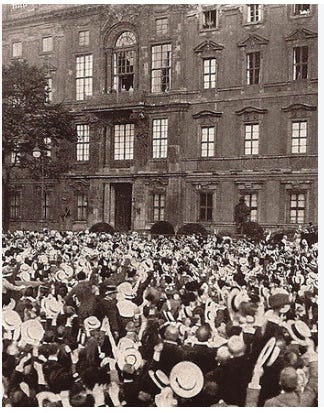
It is a quick read, an excellent book whose main virtue is not, in my opinion, direct analogy with the World War I, but a treatment of how in a multipolar world relatively small international events, misunderstandings, idiosyncratic fits of leaders, “hubris and fear” (as Westad often writes), resentment of the elite and of the public prodded by the media, can produce colossal miscalculations which then produce even more colossal wars and, in the era of the weapons of mass destruction, may end the civilization. We must not forget that WW1 was greeted with enthusiasm by leaders, almost all political parties, workers, and ordinary populace from all sides.
Leoni di oggi, pecore di domani
Recensione di “La tempesta in arrivo ” di Odd Arne Westad
Il libro di Odd Arne Westad, ” The Coming Storm: Power, Conflict, and Warnings from History”, pubblicato di recente , è il frutto del seminario “The Great Strategy” tenuto da Westad all’Università di Yale. (Arne mi ha gentilmente regalato il libro durante una conferenza). L’obiettivo principale del libro è analizzare il comportamento delle grandi potenze in un mondo multipolare (ovvero, in un mondo con più di due superpotenze) e trarre insegnamenti dalla Prima Guerra Mondiale. Questo libro piuttosto breve (220 pagine) può essere suddiviso in tre parti principali. La prima descrive il mondo multipolare odierno e come sia riuscito ad andare oltre quello che oggi viene considerato l’episodio di unipolarità, quando gli Stati Uniti erano l’unica “iperpotenza” sul piano militare, politico e, non ultimo, ideologico. La seconda parte ripercorre il percorso, ormai noto, delle cause della Prima Guerra Mondiale, ma con uno sguardo alla situazione attuale. La terza parte esamina i possibili punti critici nei mesi o negli anni a venire che potrebbero sfociare in un conflitto tra almeno due grandi potenze e trascinare il mondo in una guerra mondiale. (L’ultima parte, di meno di dodici pagine, è un appello molto forte (un plaidoyer [1] ) per un mondo senza guerre tra grandi potenze; guerre che, prima di essere intraprese, potrebbero talvolta indurci a credere di poter fornire soluzioni semplici e pulite, cosa che, scrive Westad, non accade quasi mai. Le guerre tra grandi potenze vanno evitate, quasi a qualsiasi costo. (Spero che queste ultime dodici pagine vengano distribuite a tutti i membri del Consiglio di Sicurezza delle Nazioni Unite, giusto per monito.)
Westad ritiene che il conflitto principale odierno sia tra Cina e Stati Uniti e che la regione più importante del mondo sia l’Asia orientale. Questo conflitto, come molti hanno notato, è simile a quello tra Gran Bretagna e Germania all’epoca in cui la parte più importante del mondo era l’Europa. Senza entrare nei dettagli, già ampiamente trattati, sul perché Germania e Inghilterra da un lato, e Cina e Stati Uniti dall’altro, siano “predestinate” a un conflitto egemonico, osserviamo che, secondo Westad, il problema principale della Cina è l’essere circondata da potenze ostili (“accerchiamento”), mentre il problema principale degli Stati Uniti è l’eccessiva espansione territoriale. In effetti, secondo Westad, la Cina è accerchiata da ogni lato: a nord da Giappone e Corea del Sud, al centro dalle Filippine e, soprattutto, a sud e sud-est dall’Indonesia (un paese di quasi 300 milioni di abitanti che condivide un passato difficile con la Cina), dal Vietnam, con cui la Cina ha combattuto la sua ultima guerra circa 50 anni fa, e dall’India, che secondo Westad è un nemico implacabile della Cina e con cui quest’ultima condivide un confine conteso sull’Himalaya. E questo senza considerare il punto critico più probabile, Taiwan, che in effetti non rappresenta una minaccia militare per la Cina, ma potrebbe presto essere la causa di una guerra con gli Stati Uniti.
Proseguendo con l’analogia della Prima Guerra Mondiale, la Russia viene vista come l’Austria-Ungheria: una potenza multietnica in declino, la cui influenza e forza sono in declino, ma che usa la guerra per convincere se stessa e gli altri di essere ancora una forza da non sottovalutare. Si affida, così come l’Austria-Ungheria si affidava alla Germania, alla Cina. Sia la Cina che la Germania sono, in una certa misura, alleati riluttanti con cui, rispettivamente, la Russia e l’Austria-Ungheria, solo un paio di decenni prima, avevano combattuto brevi guerre (Austria contro Germania nel 1866 e Cina contro Russia nel 1969), ma le dinamiche della politica delle grandi potenze non lasciano alla Germania di allora, né alla Cina di oggi, altra scelta se non quella di sostenere Austria e Russia. Come mi disse una volta un politologo cinese: “Putin ha sequestrato la politica estera cinese”.
A questo punto si potrebbe pensare che l’Ucraina, per analogia, sia la Serbia odierna. E in effetti l’analogia funziona piuttosto bene: l’Europa, in quest’ottica, diventa la Francia del 1914. Ma Westad non segue questa strada, principalmente, credo, a causa della sua idea che il principale campo di scontro tra Cina e Stati Uniti non sia l’Europa, bensì l’Asia orientale. (Naturalmente, si potrebbe obiettare che il principale campo di scontro tra Inghilterra e Germania fosse quello navale e che i Balcani si siano quindi accidentalmente rivelati il luogo in cui il conflitto è divampato, ma, come ho detto, Westad non accetta questa tesi).
Nella sua analogia, la Francia di oggi è l’India. L’India è un paese per il quale Westad vede un futuro molto promettente (“L’India sembra essere in una posizione migliore per progredire rispetto a qualsiasi altra grande potenza”, p. 87): la sua popolazione è la più numerosa al mondo, il suo tasso di crescita è relativamente alto, è una potenza globale nelle nuove tecnologie, è una democrazia resiliente, seppur imperfetta, e il suo sistema politico non è così fragile come potrebbe esserlo quello cinese quando si presentano questioni di successione. In Modi, l’India ha un leader nazionalista che, come Bismarck in Prussia, Meiji in Giappone o Luigi Napoleone in Francia, promuove il nazionalismo (in realtà, l’induismo) e garantisce una forte crescita economica.
Con l’India che si configura come la nuova Francia, la coalizione si trasforma in Stati Uniti più India contro Cina e Russia, con il fattore scatenante principale nell’Asia orientale. Naturalmente, l’approccio di Westad non è così meccanico; non spinge l’analogia troppo oltre, fino a limiti irragionevoli, ma diversi fattori lo portano alla conclusione che l’area più pericolosa oggi per un conflitto tra grandi potenze sia l’Asia orientale: è la regione economicamente in più rapida crescita al mondo, è la patria del principale sfidante (la Cina), è l’area di interesse per la potenza emergente, l’India, e il luogo in cui gli Stati Uniti sono politicamente impegnati ma potrebbero anche essere eccessivamente spinti.
Se accettiamo questa ipotesi, dobbiamo esaminare i candidati più probabili a scatenare una guerra su vasta scala. Taiwan vince facilmente questa corsa. In questo caso, Westad appoggia la politica statunitense di ambiguità strategica. Da un lato, gli Stati Uniti non possono impegnarsi pienamente nella difesa di Taiwan perché ciò potrebbe indurre Taiwan ad agire in modo avventato e unilaterale; dall’altro, devono interpretare il comunicato di Shanghai in modo sufficientemente vago da non dare carta bianca alla Cina. La stessa politica, scrive Westad, era quella dell’Inghilterra prima della Prima Guerra Mondiale. Non aveva un’alleanza militare formale con la Russia e la sua alleanza con la Francia era sufficientemente vaga da permettere all’Inghilterra di decidere, sul momento, se entrare in guerra o meno. (L’unico impegno fermo che l’Inghilterra assunse fu nei confronti del Belgio riguardo alla sua neutralità). Fin qui tutto bene. Ma poi Westad critica la politica inglese perché non dichiarò in modo inequivocabile alla Germania il proprio sostegno a Francia e Russia: “L’unico fattore che avrebbe potuto impedire una guerra mondiale dopo l’attacco austriaco [alla Serbia] sarebbe stato un chiaro e pubblico impegno britannico a sostenere l’alleanza franco-russa” (p. 156). Eppure qui c’è un problema. Quando gli eventi si susseguono rapidamente, come accadde nell’estate del 1914, e ancor più in vista di una futura guerra, il tempo a disposizione di una grande nazione per riadattare le proprie politiche è straordinariamente breve. La finestra di opportunità durante la quale, secondo Westad, l’Inghilterra avrebbe potuto impedire lo scoppio della guerra, dando alla Germania il segnale che l’ambiguità era finita, era di 48 ore, se non meno. Allo stesso modo, in una guerra per Taiwan, quella finestra di opportunità per gli Stati Uniti potrebbe essere di un’ora, se non meno. Ci si chiede quindi se la politica dell'”ambiguità strategica”, che, come sostiene Westad, ha molti pregi, non possa in definitiva rivelarsi controproducente, nel senso che anziché prevenire la guerra, diventa semplicemente irrilevante, sopraffatta dagli eventi anziché guidarli.
Il libro è stato pubblicato nel 2026, ma il manoscritto è stato probabilmente completato nella prima metà del 2025. Ciò dimostra la rapidità con cui si sta evolvendo la situazione attuale. Il ruolo dell’Iran viene discusso di sfuggita, come si faceva di solito prima del secondo attacco statunitense/israeliano all’Iran: come un fastidio regionale. Il problema dello Stretto di Hormuz non viene menzionato. Pochissimi si aspettavano che Trump avrebbe iniziato con leggerezza un’altra guerra, e ancor meno si aspettavano che l’Iran avrebbe risposto con una tale forza da far sì che l’iniziativa strategica – non diversamente dalla guerra tra Ucraina e Russia – si trovasse dalla parte dei difensori. Non dalla parte degli attaccanti, come sosteneva quasi unanimemente la dottrina della Prima Guerra Mondiale. Forse un altro caso in cui l’analogia con la Prima Guerra Mondiale non regge.
Il libro mostra anche quanto marginali siano le aree dell’Africa e dell’America Latina. È probabile che le guerre tra le grandi potenze si combattano di nuovo nel continente eurasiatico (incluse le sue isole) con la partecipazione degli Stati Uniti. L’Africa e l’America Latina sono a malapena menzionate, se non come possibili fonti di materie prime. L’unica (lieve) eccezione è il Brasile, che Westad considera un potenziale egemone sudamericano e un paese che, soprattutto all’interno dei BRICS, ha recentemente assunto un ruolo internazionale riconoscibile e più assertivo.
C’è un’altra omissione che viene (ma solo in parte) colmata nell’ultimo capitolo del libro: l’espansione della NATO viene quasi completamente ignorata, tranne, come ho già detto, alla fine del libro (pp. 207-208) dove viene riconosciuto il suo ruolo nell’alimentare la paura tra l’élite russa. Questa espansione sconsiderata è particolarmente pericolosa perché non ha un punto di arrivo. Nessuno potrebbe (né può) dire dove finisca la NATO. Di certo non ha più nulla a che fare con l’area geografica dell’Atlantico settentrionale, dato che è difficile immaginare come Bulgaria, Macedonia del Nord e Romania possano inserirsi in tale contesto. Ma se è un’espansione senza limiti, perché non potrebbe estendersi al Kazakistan e alla Mongolia, dopo aver pianificato di espandersi in Ucraina e Georgia? La Cina vorrebbe essere completamente accerchiata dalla NATO a ovest e dal QUAD a sud e a est? Sembra ovvio che, ai fini della pace tra le Grandi Potenze, la NATO avrebbe dovuto, allora come oggi, definire il proprio punto di arrivo. Anche in questo caso, l’ambiguità strategica sembra di dubbia utilità.
È una lettura scorrevole, un libro eccellente il cui pregio principale non è, a mio avviso, l’analogia diretta con la Prima Guerra Mondiale, bensì l’analisi di come in un mondo multipolare eventi internazionali relativamente piccoli, incomprensioni, sbalzi d’umore dei leader, “arroganza e paura” (come scrive spesso Westad), risentimento dell’élite e dell’opinione pubblica aizzata dai media, possano produrre errori di valutazione colossali che a loro volta generano guerre ancora più colossali e, nell’era delle armi di distruzione di massa, possono porre fine alla civiltà. Non dobbiamo dimenticare che la Prima Guerra Mondiale fu accolta con entusiasmo dai leader, da quasi tutti i partiti politici, dai lavoratori e dalla gente comune di ogni schieramento.
[1] Il termine francese plaidoyer (pronuncia: plɛdwaje) indica un discorso, un testo o un’azione coordinata volti a difendere una causa, a sostenere un’idea o a promuovere un cambiamento. Una ‘arringa’, o un ‘appello accorato’.
By mm
E' possibile commentare l'articolo nell'area "Commenti del Mese"