


Altri Economisti » Saggi in evidenza » Saggi, articoli su riviste. Krugman ed altri » Selezione del Mese
Secondo una importante stratega di Washington, le basi statunitensi in Asia rappresentano “solo rischi e pochi benefici”. Di ARNAUD BERTRAND (dal sito di Bertrand, 2 ottobre 2026).
Oct 02, 2026
Top Washington strategist says U.S. bases in Asia are “all risk and little reward”
 It’s exceedingly rare when a policy paper from a Washington think tank sets off a firestorm on both sides of the Pacific, but it’s exactly what happened with Jennifer Kavanagh’s “A Second Island Chain Strategy for Asia”, published by Defense Priorities on September 10.
Even today, some 3 weeks after publication, it’s still being argued over: this week a professor of strategic deterrence at the U.S. Naval War College weighed in on “the commotion” around it. You also had coverage from Seoul’s Chosun Ilbo and Tokyo’s Japan Times to Germany’s Deutsche Welle, which reported that it had “alarmed U.S. allies in Asia.” Stars and Stripes, the U.S. military’s own newspaper, gave it a long write-up quoting experts saying the proposal amounted to nothing less than “the dismantling of the post-1951 American security architecture in East Asia.”
To be fair, Kavanagh has quite the resume so it’s no surprise her words carry weight: before becoming director of military analysis at Defense Priorities, she was a senior political scientist at the RAND Corporation – the Pentagon’s semi-official think tank – where she ran the Army Strategy program for three years, and then a senior fellow at the Carnegie Endowment for International Peace. She also teaches security studies at Georgetown and is a member of the Council on Foreign Relations. Hard to think of a more mainstream Washington CV.
And what she proposes in the report is indeed radical, especially coming from someone with such an establishment pedigree. She proposes that every single mutual defense treaty in Asia be terminated, including those with Japan, South Korea, the Philippines and Australia, and that U.S. forces should withdraw to the second island chain, far away from China’s coast.
As such, it’s no exaggeration to say that her proposal does in fact amount to undoing the entire security order the U.S. has built in the region over three quarters of a century.
Which all raises the question: is Kavanagh just an outlier, or is she the canary in the coal mine, the first mainstream voice to say out loud what Washington’s strategic establishment will soon have no choice but to admit about U.S. presence in Asia?
The military reality: the first island chain has become a trap
This is one of the big taboos of U.S. strategy in Asia: the entire American posture is built around defending the first island chain, yet military experts increasingly believe it can no longer be defended.
I wrote earlier this year about an interview that John Culver, a former top CIA analyst (he was national intelligence officer for East Asia) and one of the world’s foremost authorities on the Chinese military, gave to the Washington Post in which he said this: “I think some of the thinking in the Pentagon, and it may have evolved since I retired, is that when we think there’s going to be a war, we need to get our high-value naval assets out of the theater, and then we would have to fight our way back in. From where, it’s not clear. Guam is no bastion either.”
In other words, what Culver is saying is that – as far as he is aware – the Pentagon’s plan in case of war over Taiwan is… flee!
Why? Because, as he explains, any high-value U.S. assets would be sitting ducks in the entire area in which “there’s really no safe spaces.” China can strike U.S. forces deployed to Japan, Australia, or South Korea “in a way that Iran really can’t” and, given that – as per his words in the interview – Iran has hit at least 228 targets across U.S. bases in the Middle East, that’s saying something.
Kavanagh, in her report, is essentially arguing the same thing: China’s missiles and drones now put U.S. bases near its coast within easy reach, which in her words makes them “vulnerabilities not assets, all risk and little reward.”
Like Culver, she also draws on the lessons of Iran: “The United States has not been able to defend against drone attacks during the 2026 Iran war and would almost certainly fare worse against China, the global leader in drone production.”
For Taiwan specifically, the central feature of the first island chain, she calls the “cost-benefit calculation [very] lopsided,” where “a denial campaign would come at exorbitant cost for the United States, far in excess of any benefits at stake.”
Interestingly, she directly tackles the conventional wisdom that Taiwan would even have strategic importance in the first place, writing that neither the military nor the economic argument “holds up to scrutiny.”
The standard military argument is that seizing Taiwan would hand China a springboard into the Pacific, with submarines hiding in the deep waters off the island’s east coast and missiles and radars on its mountains. Kavanagh’s response is that these advantages would be temporary anyway since “China will eventually be able to evade U.S. sensors even without access to Taiwan, and fighting a war with China over an expiring advantage makes little strategic sense.”
Same thing for the argument that seizing Taiwan “would be a difference maker for any bid at Chinese regional hegemony”: she says that Taiwan isn’t significantly closer to Japan’s southernmost islands than the rest of China, and that while “controlling Taiwan could make it easier for China to restrict access to nearby waters in the South China Sea,” it could also do this now without controlling Taiwan if it chose to.
In fact, she argues that a seizure of Taiwan might even make China’s military position more challenging in the region as “China’s neighbors would react by arming themselves to the teeth, strengthening their position.”
As for the economic argument, she acknowledges that a loss of Taiwan’s advanced semiconductors could be a big problem for the U.S. but not one that military power can really solve anyway: in a war, Taiwan’s fabs would likely be damaged, and if China took them intact, the U.S. itself would probably cut off the intellectual property they need to produce the most advanced chips. Either way, she argues, the answer is for the U.S. to decouple itself from Taiwan and build chip manufacturing at home, not to rely on the U.S. military to protect a supply chain it couldn’t save in a war anyway.
There is another way in which Kavanagh argues that the first island chain has become a trap: not only in the literal sense where, in case of war, U.S. military assets there would be sitting ducks, but also in the tripwire sense, where the very presence of these U.S. military assets makes war more likely in the first place.
She gives the example of the long-range fire system (the Typhon, which the U.S. fired for the first time in a military exercise earlier this year), currently located in the Philippines which she calls “highly escalatory,” since it is “capable of firing long-range missiles at targets in mainland China.” She also points out that the Philippines treaty covers claimed features in the South China Sea, which means “the United States could easily be dragged into a direct war with China over what some have called ‘rocks and reefs’”.
On the latter, she writes that “to warrant such a tremendous risk [i.e. war with China], defense of the Philippines and its outlying claims would need to clearly advance U.S. interests in a significant and sustained way” but “this is simply not the case.”
She argues that there is a circular logic going on: the alliance with the Philippines is justified by the U.S. military bases present there, but these bases exist mainly to prepare for a war over Taiwan, which is precisely the kind of war their presence makes more likely.
Hard to find a better definition of a trap: we’ve arrived in a situation where America’s military posture in Asia is both too exposed to fight a war with China and too provocative to help avoid one. Which raises the obvious next question: what is this posture for and is it still worth it?
The strategic logic: what exactly is America defending?
That’s probably the most interesting aspect of Kavanagh’s report: she really goes back to first principles, asking a question almost everyone takes for granted: what, concretely, are U.S. interests in Asia, and does its current posture actually serve them?
To her, the U.S. has really two core overarching interests: 1) defending the American homeland, and 2) keeping access to the region’s markets and trade routes. Everything, alliances included, has to justify itself against those two goals.
Which is what leads her to recommend dropping out of virtually every single mutual defense treaty in Asia (see her table below): in her assessment, none of them pass the test.
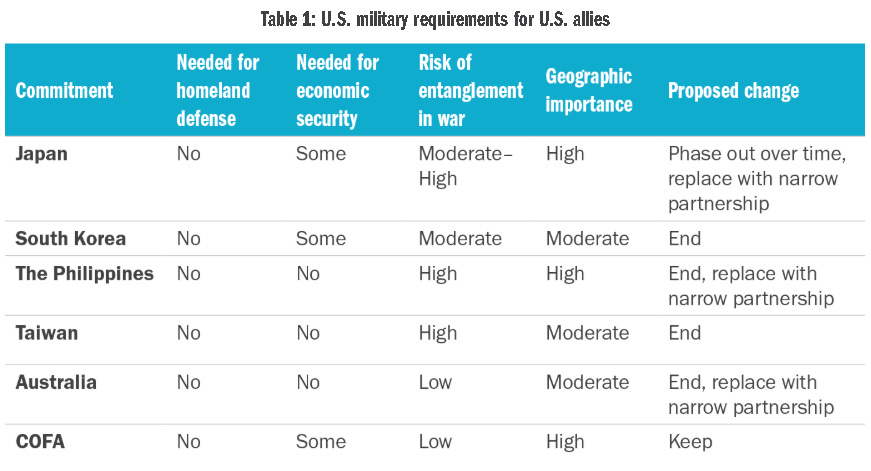
Let’s take a look at what she says about South Korea, for instance. Of all U.S. treaty commitments, she writes, it’s the alliance that “offers the fewest benefits to the United States”, especially when weighed against its costs and risks. By one estimate she cites, the U.S. spends around $5 billion a year on its presence there, even after Seoul’s contribution (South Korea partially covers the cost of hosting U.S. troops), and, as she points out, it’s an unnecessary expense since “South Korea is already capable of defending itself against conventional military threats from North Korea, the primary basis for the relationship between Seoul and Washington.”
She acknowledges that the U.S. alliance with South Korea may serve a role in U.S. competition with China, but that it is a role Seoul never really signed up for and is “unwilling” to perform. In fact, in quite the stunning admission in such a report, she points out that whenever the U.S. does something aimed at China in South Korea, it has tended to “move ahead unilaterally… often without permission from (and even without informing) South Korean authorities.” Which makes this aspect of the relationship inherently unsustainable.
Her recommendation is therefore to end the alliance altogether, making South Korea the very first commitment to go: all US ground combat units and permanently stationed air forces would be withdrawn within two years.
Somewhat similarly, for Japan, she concludes that the security treaty that defines the alliance is “counterproductive and unnecessary”, though she advises unwinding it more gradually than elsewhere given Japan’s importance in the regional balance of power.
Her problem with the current commitment is threefold:
- It extends to outlying claims like the Senkaku/Diaoyu islands, which have no bearing on the balance of power, and unnecessarily expose the U.S. to a war with China over islands whose sovereignty Washington itself officially takes no position on
- It gives a wealthy, technologically advanced country little incentive to spend properly on its own defense
- It protects Japan against threats that it could largely handle on its own, since its main islands, surrounded by water and far from China, are easily defensible
The main reason she advises against a sudden withdrawal like with South Korea is because she wants to ensure that “Japan remains outside of China’s orbit.” Her worry is that an abrupt US exit, by leaving Tokyo no time to build up its own defenses, could push it to accommodate Beijing instead, which she considers unlikely but can’t rule out. Hence her idea of a phased drawdown giving Japan just enough reassurance to choose rearmament over accommodation, with full self-sufficiency targeted for around 2035.
Which, admittedly, is a deeply cynical way to approach a region, ensuring its division. But it is also realist geopolitics 101: you keep the local powers busy balancing each other so that none of them can dominate the region, and you only step in yourself if one of them is about to. It’s what realists call “offshore balancing“, and that’s essentially what Kavanagh is proposing for Asia.
As such, what Kavanagh is recommending here is far from handing Asia over to China: she is fully aligned with the notion that only the U.S. should be allowed to be dominant in its own region, and that the U.S.’s job elsewhere is to make sure that no one else ever becomes so in theirs.
What she very much isn’t aligned with is the notion that, to achieve this, the US has to be the dominant power in Asia itself, with tens of thousands of troops on China’s doorstep and treaty obligations that could drag it into a war it seeks to avoid.
In her view, a modest presence along the second island chain, combined with neighbors strong enough to stand up to China themselves, does the job better, at a fraction of the cost and risk.
Critics will rightly point out that the second island chain isn’t exactly safe either: as Culver put it, “Guam is no bastion either.” Jonathan Hunt, the Naval War College professor I mentioned in the introduction, argues that the missile balance “can’t be re-established from Guam, Tinian, etc.” since there simply isn’t enough land, roads, ports or airfields there to deploy and disperse forces.
But these objections assume the second island chain is meant to do what the first was supposed to: deter or fight China near its own coast. Kavanagh gives it a far more modest mission: hedging against the unlikely scenario of China disrupting regional trade routes, which requires survivable bases rather than a winning hand in a missile duel. She does propose dispersing forces and hardening bases, but the real protection comes from staying away from the flashpoints, since, as she notes, these islands have only become contested because of the role they might play in a war closer to China’s coast.
The Asia that comes after
By now, you’re hopefully pretty clear on what Kavanagh thinks America should stop doing in Asia. So let’s now look at what she expects to follow if her recommendations are adopted: what would Asia look like were the U.S. to stop guaranteeing regional security and tell its allies, in effect, that they’re now on their own?
Firstly, she doesn’t exactly write it in as many words, but she expects some form of Taiwan reunification as the logical end point of her plan. Taiwan, she writes, “is the only real instance where retrenchment by the United States might drive true political accommodation.” But, she argues, “this outcome is manageable for U.S. interests and will not dramatically shift the balance of power in the region.” As such she believes that “Washington should accept this possibility and focus on protecting U.S. interests no matter what Taiwan chooses.”
Which is also, incidentally, why she wants the U.S. out of the way fast: she ranks Taiwan, along with the guarantees covering the Philippines’ South China Sea claims, among the “higher priorities” to unwind because of the “risk of entanglement to the United States.” According to her, since she doesn’t see Taiwan as consequential for the region’s balance of power, the only thing a slow exit would achieve is to prolong the risk of war with China over interests that just aren’t worth it.
Second prediction: she expects countries across Asia to adjust their positions toward China the way countries without US protection already do, and she sees this as healthy.
In her view, US security guarantees “distort the behavior and incentives of states” that benefit from them, and she contrasts Vietnam with the Philippines to make the point: Vietnam, which has no U.S. guarantee, isn’t a Chinese vassal but makes its security decisions with an eye to avoiding conflict with Beijing, while the Philippines, under a US guarantee, makes very different calculations and, as we all know, constantly provokes China. In her words, this kind of recalibration is “a good thing” because it reduces the overall risk of conflict.
The big question mark here is Japan. Kavanagh expects it to also adopt “a more cautious policy toward Beijing” once on its own, but there’s a strong case that the opposite could just as well happen. For decades, part of the rationale for US troops in Japan was precisely to keep a lid on Japanese militarism: in 1990, the commander of US Marines in Japan famously described the American presence as “a cap in the bottle.” Take the cap off, and a Japan led by nationalists like current Prime Minister Sanae Takaichi might well respond to its newfound insecurity with hyper-nationalism rather than caution.
Then again, the reverse argument also holds: some of Tokyo’s most hawkish moves arguably happen because of US backing, as when Takaichi declared last November that a war over Taiwan could be “a survival-threatening situation” for Japan that may force it to go to war. Would she have dared say so without America behind her, and would Japan indeed really go to war with China over Taiwan if it knew it would be fighting alone?
Kavanagh’s plan is essentially a bet that caution wins out over nationalism, which, when it comes to Japan, has not exactly proven historically correct. Which, to her credit, she seems at least partly aware of: the slower drawdown she recommends for Japan is explicitly meant to guard against both risks (from a U.S. perspective), Japan bandwagoning with China and an insecure Japan making rash decisions. Given the history, it’s probably the right instinct.
Last but not least, she predicts the end of America’s nuclear umbrella over Asia, which, without US troops to back it up, would in her words become “little more than a bluff.” The logical consequence, which she openly accepts, is that Japan and South Korea, both within reach of a bomb, may decide to build one.
She does acknowledge the dangers, calling the risk of a Chinese preventive strike on Japan, or a North Korean strike on the South before Seoul completes a program, “reasonable concerns.” But she never really explains how they’d be avoided: her answer pivots to proliferation itself, which she expects to be limited and slow, and which she judges a lesser risk than keeping the current posture that she sees as far more dangerous for America.
I personally wouldn’t be as confident as her that China would accept a nuclear Japan so easily. Even the mere talk of it is enough to set off alarm bells in Beijing: when a senior aide to Takaichi said last December that Japan should possess nuclear weapons, China’s foreign ministry declared itself “shocked,” called it “a blatant challenge to the postwar international order,” and warned that if Japan continued to “test the bottom line” China’s response would be “a firm ‘No’.” And just this week, after Defense Minister Shinjiro Koizumi said discussing nuclear weapons shouldn’t be ruled out, Beijing replied that “there is no room for negotiation” over Japan’s non-nuclear-weapon status.
That doesn’t exactly sound like the kind of thing Beijing would shrug off as one of the manageable costs of U.S. retrenchment.
Still, taken as a whole, Kavanagh’s proposal can only be warmly welcomed by China as it’s essentially Beijing’s own wish list for the region: an end to U.S. alliances on its periphery, no more U.S. missiles aimed at its mainland, and a hands-off U.S. policy that allows for reunification with Taiwan. For as long as he’s been President, Xi Jinping has been saying that “it is for the people of Asia to run the affairs of Asia, solve the problems of Asia and uphold the security of Asia” (a quote from a 2014 speech): Kavanagh’s report is about as close to this vision as anything that’s ever come out of Washington.
And this is what’s striking about this report: it’s clearly written with U.S. interests in mind, a strong desire to preserve American power for the long haul, and it still lands almost exactly where Beijing would want it to. Which suggests that, in Asia at least, U.S. and Chinese interests have come to overlap far more than they used to.
It also suggests, more subtly, that this may well be the most successful modern application of Sun Tzu’s most famous maxim, 不战而屈人之兵 (bù zhàn ér qū rén zhī bīng), which Lionel Giles translated as “breaking the enemy’s resistance without fighting”.
Kavanagh’s entire case rests on the premise that the first island chain has become indefensible, and the reason it has is that China spent decades making it so: building the missiles that now put US bases near its coast at risk, a navy rapidly closing the gap with America’s, and an industrial base that, as Culver pointed out, produces advanced munitions in quantities the US can’t hope to match. In other words, it is because China is making U.S. primacy on its doorstep prohibitively costly and risky that Kavanagh is recommending retrenchment.
So no, Kavanagh isn’t an outlier: she’s simply the first in Washington to put two and two together. And the surest sign a strategy has worked is when your rival concludes, in its own interest, that it should do what you wanted all along.
Secondo una importante stratega di Washington, le basi statunitensi in Asia rappresentano “solo rischi e pochi benefici”.
È estremamente raro che un documento programmatico di un think tank di Washington scateni una tempesta di polemiche su entrambe le sponde del Pacifico, ma è esattamente ciò che è accaduto con ” A Second Island Chain Strategy for Asia ” di Jennifer Kavanagh, pubblicato da Defense Priorities il 10 settembre.
Ancora oggi, a circa tre settimane dalla pubblicazione, il documento è oggetto di dibattito: questa settimana un professore di deterrenza strategica del Naval War College statunitense ha espresso la sua opinione sul “tumulto” che lo circonda. La notizia è stata ripresa anche dal Chosun Ilbo di Seul, dal Japan Times di Tokyo e dalla Deutsche Welle tedesca, che ha riportato come il documento avesse “allarmato gli alleati degli Stati Uniti in Asia”. Stars and Stripes , il giornale ufficiale delle forze armate statunitensi, ha dedicato un lungo articolo citando esperti secondo i quali la proposta equivaleva a “smantellare l’architettura di sicurezza americana post-1951 in Asia orientale”.
A dire il vero, Kavanagh ha un curriculum di tutto rispetto, quindi non sorprende che le sue parole abbiano peso: prima di diventare direttrice dell’analisi militare presso Defense Priorities, è stata politologa senior presso la RAND Corporation, il think tank semi-ufficiale del Pentagono, dove ha diretto il programma di strategia dell’esercito per tre anni, e successivamente senior fellow presso la Carnegie Endowment for International Peace. Insegna anche studi sulla sicurezza alla Georgetown University ed è membro del Council on Foreign Relations. Difficile immaginare un curriculum più convenzionale per un politico di Washington.
E ciò che propone nel rapporto è davvero radicale, soprattutto considerando il suo pedigree nell’establishment. Propone la rescissione di tutti i trattati di mutua difesa in Asia, compresi quelli con Giappone, Corea del Sud, Filippine e Australia, e il ritiro delle forze statunitensi verso la seconda catena di isole, lontana dalle coste cinesi.
Pertanto, non è esagerato affermare che la sua proposta equivale di fatto a smantellare l’intero ordine di sicurezza che gli Stati Uniti hanno costruito nella regione in oltre tre quarti di secolo.
Tutto ciò solleva un interrogativo: Kavanagh è solo un caso isolato, oppure è il canarino nella miniera di carbone, la prima voce autorevole a dire ad alta voce ciò che l’establishment strategico di Washington sarà presto costretto ad ammettere riguardo alla presenza statunitense in Asia?
La realtà militare: la prima catena di isole si è trasformata in una trappola
Questo è uno dei grandi tabù della strategia statunitense in Asia: l’intera impostazione americana è costruita attorno alla difesa della prima catena di isole, eppure gli esperti militari sono sempre più convinti che non sia più possibile difenderla.
All’inizio di quest’anno ho scritto di un’intervista che John Culver, ex analista di alto livello della CIA (era responsabile dell’intelligence nazionale per l’Asia orientale) e una delle massime autorità mondiali in materia di forze armate cinesi, aveva rilasciato al Washington Post , nella quale affermava: “Credo che al Pentagono si pensi, e forse la situazione si è evoluta da quando sono andato in pensione, che quando si prevede una guerra, sia necessario ritirare le nostre risorse navali di maggior valore dal teatro operativo, per poi dover combattere per rientrarvi. Da dove, non è chiaro. Guam non è certo una roccaforte“.
In altre parole, ciò che Culver sta dicendo è che, per quanto ne sa lui, il piano del Pentagono in caso di guerra per Taiwan è… fuggire!
Perché? Perché, come spiega, qualsiasi risorsa statunitense di alto valore sarebbe un bersaglio facile in tutta l’area, dove “non ci sono zone veramente sicure”. La Cina può colpire le forze statunitensi schierate in Giappone, Australia o Corea del Sud “in un modo che l’Iran non può fare” e, considerando che – come ha affermato nell’intervista – l’Iran ha colpito almeno 228 obiettivi nelle basi statunitensi in Medio Oriente, questo la dice lunga.
Nel suo rapporto, Kavanagh sostiene essenzialmente la stessa tesi: i missili e i droni cinesi mettono ora le basi statunitensi vicino alla costa cinese a portata di mano, il che, a suo dire, le rende “vulnerabili anziché risorse, tutto rischio e ben poco profitto”.
Come Culver, anche lei trae insegnamento dalla guerra con l’Iran: “Gli Stati Uniti non sono stati in grado di difendersi dagli attacchi dei droni durante la guerra con l’Iran del 2026 e quasi certamente se la caverebbero peggio contro la Cina, leader mondiale nella produzione di droni”.
Per quanto riguarda Taiwan nello specifico, l’isola centrale del primo arcipelago, la studiosa definisce il “calcolo costi-benefici [molto] sbilanciato”, in quanto “una campagna di negazione comporterebbe costi esorbitanti per gli Stati Uniti, di gran lunga superiori a qualsiasi beneficio in gioco”.
È interessante notare che l’autrice affronta direttamente la convinzione comune secondo cui Taiwan avrebbe un’importanza strategica, scrivendo che né l’argomentazione militare né quella economica “reggono a un esame più approfondito”.
La tesi militare standard è che la conquista di Taiwan fornirebbe alla Cina un trampolino di lancio nel Pacifico, con sottomarini nascosti nelle acque profonde al largo della costa orientale dell’isola e missili e radar sulle sue montagne. La risposta di Kavanagh è che questi vantaggi sarebbero comunque temporanei, poiché “la Cina alla fine sarà in grado di eludere i sensori statunitensi anche senza accesso a Taiwan, e combattere una guerra con la Cina per un vantaggio destinato a svanire ha poco senso strategico”.
Lo stesso vale per l’argomentazione secondo cui la conquista di Taiwan “farebbe la differenza per qualsiasi tentativo cinese di egemonia regionale”: afferma che Taiwan non è significativamente più vicina alle isole più meridionali del Giappone rispetto al resto della Cina e che, sebbene “controllare Taiwan potrebbe facilitare alla Cina la limitazione dell’accesso alle acque vicine nel Mar Cinese Meridionale”, la Cina potrebbe farlo anche ora, senza controllare Taiwan, se lo desiderasse.
Sostiene infatti che la conquista di Taiwan potrebbe addirittura rendere più difficile la posizione militare della Cina nella regione, poiché “i paesi vicini alla Cina reagirebbero armandosi fino ai denti, rafforzando la propria posizione”.
Per quanto riguarda l’argomentazione economica, riconosce che la perdita dei semiconduttori avanzati di Taiwan potrebbe rappresentare un grosso problema per gli Stati Uniti, ma non un problema che la forza militare possa realmente risolvere: in caso di guerra, gli stabilimenti di produzione di Taiwan verrebbero probabilmente danneggiati e, se la Cina li conquistasse intatti, gli Stati Uniti stessi probabilmente interromperebbero l’accesso alla proprietà intellettuale necessaria per produrre i chip più avanzati. In entrambi i casi, sostiene, la soluzione per gli Stati Uniti è quella di sganciarsi da Taiwan e sviluppare la produzione di chip in patria, anziché affidarsi all’esercito per proteggere una catena di approvvigionamento che non sarebbero comunque in grado di salvare in caso di guerra.
Kavanagh sostiene inoltre che la prima catena di isole si sia trasformata in una trappola in un altro modo: non solo in senso letterale, poiché in caso di guerra le risorse militari statunitensi presenti sarebbero facili bersagli, ma anche in senso simbolico, in quanto la stessa presenza di queste risorse militari rende la guerra più probabile.
Cita come esempio il sistema missilistico a lungo raggio (il Typhon, che gli Stati Uniti hanno utilizzato per la prima volta in un’esercitazione militare all’inizio di quest’anno ), attualmente dislocato nelle Filippine, che definisce “altamente in grado di innescare un’escalation”, poiché “capace di lanciare missili a lungo raggio contro obiettivi nella Cina continentale”. Sottolinea inoltre che il trattato con le Filippine riguarda le isole rivendicate nel Mar Cinese Meridionale, il che significa che “gli Stati Uniti potrebbero facilmente essere trascinati in una guerra diretta con la Cina per quelle che alcuni hanno definito “niente altro che scogli'”.
A proposito di quest’ultimo punto, scrive che “per giustificare un rischio così enorme [ovvero una guerra con la Cina], la difesa delle Filippine e delle sue rivendicazioni territoriali dovrebbe promuovere chiaramente gli interessi degli Stati Uniti in modo significativo e duraturo”, ma “questo semplicemente non è il caso”.
Sostiene che si tratti di un circolo vizioso: l’alleanza con le Filippine è giustificata dalla presenza di basi militari statunitensi sul territorio, ma queste basi esistono principalmente per preparare una guerra per Taiwan, un tipo di guerra che la loro stessa presenza rende più probabile.
È difficile trovare una definizione migliore di trappola: ci troviamo in una situazione in cui la presenza militare americana in Asia è al tempo stesso troppo esposta per poter combattere una guerra con la Cina e troppo provocatoria per contribuire a evitarla. Il che solleva l’ovvia domanda successiva: a cosa serve questa posizione e ne vale ancora la pena?
La logica strategica: cosa sta difendendo esattamente l’America?
Questo è probabilmente l’aspetto più interessante del rapporto di Kavanagh: torna davvero ai principi fondamentali, ponendosi una domanda che quasi tutti danno per scontata: quali sono, concretamente, gli interessi degli Stati Uniti in Asia e il loro attuale atteggiamento li serve effettivamente?
Per lei, gli Stati Uniti hanno essenzialmente due interessi fondamentali: 1) difendere il territorio americano e 2) mantenere l’accesso ai mercati e alle rotte commerciali della regione. Ogni azione, alleanze comprese, deve essere giustificata in funzione di questi due obiettivi.
Ed è proprio questo che la porta a raccomandare l’uscita da praticamente tutti i trattati di mutua difesa in Asia (si veda la tabella qui sotto): a suo parere, nessuno di essi supera la prova.

Analizziamo, ad esempio, cosa dice a proposito della Corea del Sud. Tra tutti gli impegni assunti dagli Stati Uniti tramite trattati, scrive, è l’alleanza che “offre i minori benefici agli Stati Uniti”, soprattutto se rapportata ai costi e ai rischi. Secondo una stima da lei citata, gli Stati Uniti spendono circa 5 miliardi di dollari all’anno per la loro presenza in Corea del Sud, anche dopo il contributo di Seul (la Corea del Sud copre parzialmente i costi di ospitalità delle truppe statunitensi) e, come sottolinea, si tratta di una spesa superflua poiché “la Corea del Sud è già in grado di difendersi dalle minacce militari convenzionali della Corea del Nord, che è il fondamento principale del rapporto tra Seul e Washington”.
Riconosce che l’alleanza tra Stati Uniti e Corea del Sud può avere un ruolo nella competizione statunitense con la Cina, ma che si tratta di un ruolo che Seul non ha mai realmente accettato e che non è disposta a svolgere. Anzi, in un’ammissione a dir poco sorprendente in un rapporto di questo tipo, sottolinea che ogni volta che gli Stati Uniti intraprendono azioni contro la Cina in Corea del Sud, tendono a farlo “unilateralmente… spesso senza il permesso (e persino senza informare) le autorità sudcoreane”. Il che rende questo aspetto della relazione intrinsecamente insostenibile.
La sua raccomandazione è quindi quella di porre fine all’alleanza in toto, rendendo la Corea del Sud il primo Paese a ritirarsi: tutte le unità di combattimento terrestri statunitensi e le forze aeree permanentemente di stanza verrebbero ritirate entro due anni.
Analogamente, per quanto riguarda il Giappone, giunge alla conclusione che il trattato di sicurezza che definisce l’alleanza è “controproducente e superfluo”, pur consigliando uno smantellamento più graduale rispetto ad altri Paesi, data l’importanza del Giappone nell’equilibrio di potere regionale.
Il suo problema con l’impegno attuale è triplice:
- Si estende a rivendicazioni periferiche come le isole Senkaku/Diaoyu, che non hanno alcuna rilevanza per gli equilibri di potere e espongono inutilmente gli Stati Uniti a una guerra con la Cina per isole sulla cui sovranità Washington stessa non prende ufficialmente posizione.
- Ciò offre a un paese ricco e tecnologicamente avanzato pochi incentivi a investire adeguatamente nella propria difesa.
- Protegge il Giappone dalle minacce che potrebbe gestire in gran parte da solo, poiché le sue isole principali, circondate dall’acqua e lontane dalla Cina, sono facilmente difendibili
Il motivo principale per cui sconsiglia un ritiro improvviso come nel caso della Corea del Sud è la volontà di garantire che “il Giappone rimanga al di fuori dell’orbita cinese”. La sua preoccupazione è che un’uscita brusca degli Stati Uniti, non lasciando a Tokyo il tempo di rafforzare le proprie difese, possa spingerla ad assecondare Pechino, un’ipotesi che lei considera improbabile ma non può escludere. Da qui la sua idea di un ritiro graduale, che dia al Giappone la sicurezza necessaria per scegliere il riarmo rispetto alla conciliazione, con l’obiettivo della piena autosufficienza intorno al 2035.
Certo, è un approccio profondamente cinico a una regione, che ne garantisce la divisione. Ma è anche un principio base della geopolitica realista: si tengono occupate le potenze locali, che si bilanciano a vicenda in modo che nessuna possa dominare la regione, e si interviene solo se una di esse sta per farlo. È ciò che i realisti chiamano ” bilanciamento offshore “, ed è essenzialmente ciò che Kavanagh propone per l’Asia.
Pertanto, ciò che Kavanagh sta raccomandando è ben lungi dal consegnare l’Asia alla Cina: ella condivide pienamente l’idea che solo gli Stati Uniti debbano essere autorizzati a dominare nella propria regione e che il loro compito altrove sia quello di assicurarsi che nessun altro possa mai raggiungere tale posizione nelle rispettive aree geografiche.
Ciò che lei non condivide affatto è l’idea che, per raggiungere questo obiettivo, gli Stati Uniti debbano essere la potenza dominante in Asia, con decine di migliaia di soldati alle porte della Cina e obblighi derivanti da trattati che potrebbero trascinarli in una guerra che cercano di evitare.
A suo avviso, una presenza modesta lungo la seconda catena di isole, unita a vicini abbastanza forti da opporsi alla Cina stessa, è più efficace, a un costo e a un rischio decisamente inferiori.
I critici giustamente faranno notare che neanche la seconda catena di isole è esattamente sicura: come ha detto Culver, “nemmeno Guam è un baluardo”. Jonathan Hunt, il professore del Naval War College che ho menzionato nell’introduzione, sostiene che l’equilibrio missilistico “non può essere ristabilito da Guam, Tinian, ecc.” poiché semplicemente non ci sono abbastanza terre, strade, porti o aeroporti per schierare e disperdere le forze.
Ma queste obiezioni presuppongono che il secondo arcipelago debba svolgere la stessa funzione del primo: scoraggiare o contrastare la Cina vicino alle sue coste. Kavanagh gli attribuisce una missione ben più modesta: proteggersi dall’improbabile scenario di un’interruzione delle rotte commerciali regionali da parte della Cina, il che richiede basi resistenti piuttosto che la vittoria in un duello missilistico. Propone di disperdere le forze e di rafforzare le basi, ma la vera protezione deriva dall’evitare le zone critiche, poiché, come osserva, queste isole sono diventate contese solo per il ruolo che potrebbero svolgere in una guerra più vicina alle coste cinesi.
L’Asia che viene dopo
A questo punto, spero che abbiate ben chiaro cosa pensa Kavanagh che gli Stati Uniti dovrebbero smettere di fare in Asia. Vediamo quindi cosa si aspetta che accada se le sue raccomandazioni venissero adottate: come sarebbe l’Asia se gli Stati Uniti smettessero di garantire la sicurezza regionale e dicessero, di fatto, ai loro alleati che ora devono cavarsela da soli?
Innanzitutto, pur non esprimendolo esplicitamente, la studiosa prevede una qualche forma di riunificazione di Taiwan come logico epilogo del suo piano. Taiwan, scrive, “è l’unico caso reale in cui un disimpegno da parte degli Stati Uniti potrebbe portare a un vero compromesso politico”. Tuttavia, sostiene, “questo esito è gestibile per gli interessi statunitensi e non modificherà drasticamente gli equilibri di potere nella regione”. Pertanto, ritiene che “Washington dovrebbe accettare questa possibilità e concentrarsi sulla tutela degli interessi statunitensi, indipendentemente dalla scelta di Taiwan”.
Questo è anche, incidentalmente, il motivo per cui vuole che gli Stati Uniti si facciano da parte al più presto: considera Taiwan, insieme alle garanzie a copertura delle rivendicazioni filippine nel Mar Cinese Meridionale, tra le “priorità più importanti” da smantellare a causa del “rischio di coinvolgimento degli Stati Uniti”. Secondo lei, poiché non ritiene Taiwan rilevante per gli equilibri di potere regionali, l’unico risultato di un lento ritiro sarebbe quello di prolungare il rischio di una guerra con la Cina per interessi che non ne valgono la pena.
Seconda previsione: si aspetta che i paesi asiatici modifichino le proprie posizioni nei confronti della Cina, come già fanno i paesi non protetti dagli Stati Uniti, e considera questo un fatto positivo.
A suo avviso, le garanzie di sicurezza statunitensi “distorcono il comportamento e gli incentivi degli Stati” che ne beneficiano, e per illustrare questo concetto mette a confronto il Vietnam con le Filippine: il Vietnam, che non gode di alcuna garanzia statunitense, non è un vassallo della Cina, ma prende le sue decisioni in materia di sicurezza con l’obiettivo di evitare un conflitto con Pechino, mentre le Filippine, sotto la garanzia statunitense, fanno calcoli ben diversi e, come ben sappiamo, provocano costantemente la Cina. A suo dire, questo tipo di ricalibrazione è “un bene” perché riduce il rischio complessivo di conflitto.
Il grande punto interrogativo qui è il Giappone. Kavanagh prevede che anche il Giappone adotterà “una politica più cauta nei confronti di Pechino” una volta che sarà indipendente, ma ci sono validi motivi per credere che potrebbe accadere anche il contrario. Per decenni, parte della giustificazione della presenza delle truppe statunitensi in Giappone era proprio quella di tenere a bada il militarismo giapponese: nel 1990, il comandante dei Marines statunitensi in Giappone descrisse la presenza americana come “un tappo nella bottiglia”. Togliendo il tappo, un Giappone guidato da nazionalisti come l’attuale Primo Ministro Sanae Takaichi potrebbe benissimo rispondere alla sua ritrovata insicurezza con un iper-nazionalismo anziché con cautela.
D’altra parte, vale anche l’argomentazione inversa: alcune delle mosse più aggressive di Tokyo avvengono probabilmente grazie al sostegno degli Stati Uniti, come quando Takaichi ha dichiarato lo scorso novembre che una guerra per Taiwan potrebbe rappresentare “una situazione di sopravvivenza” per il Giappone, tale da costringerlo a entrare in guerra. Avrebbe osato dirlo senza l’appoggio americano? E il Giappone entrerebbe davvero in guerra con la Cina per Taiwan se sapesse di dover combattere da solo?
Il piano di Kavanagh è essenzialmente una scommessa sulla prudenza, che, nel caso del Giappone, non si è dimostrata storicamente corretta. A suo merito, sembra esserne almeno in parte consapevole: il ritiro più graduale che raccomanda per il Giappone ha lo scopo esplicito di scongiurare entrambi i rischi (dal punto di vista statunitense): che il Giappone si allinei alla Cina e che un Giappone insicuro prenda decisioni avventate. Visti i fatti, è probabilmente l’istinto giusto.
Infine, prevede la fine dell’ombrello nucleare americano sull’Asia, che, senza le truppe statunitensi a sostenerlo, diventerebbe, a suo dire, “poco più di un bluff”. La conseguenza logica, che lei stessa ammette apertamente, è che il Giappone e la Corea del Sud, entrambi a portata di bomba atomica, potrebbero decidere di costruirne una.
Riconosce i pericoli, definendo “ragionevoli preoccupazioni” il rischio di un attacco preventivo cinese contro il Giappone, o di un attacco nordcoreano contro il Sud prima che Seul completi un programma nucleare. Tuttavia, non spiega mai concretamente come questi rischi verrebbero evitati: la sua risposta si concentra sulla proliferazione stessa, che prevede sarà limitata e lenta, e che giudica un rischio minore rispetto al mantenimento dell’attuale strategia, che ritiene di gran lunga più pericolosa per gli Stati Uniti.
Personalmente non sarei così fiducioso come lei che la Cina accetterebbe così facilmente un Giappone dotato di armi nucleari. Anche solo parlarne è sufficiente a far scattare l’allarme a Pechino: quando un alto funzionario del governo Takaichi ha affermato lo scorso dicembre che il Giappone dovrebbe possedere armi nucleari, il Ministero degli Esteri cinese si è dichiarato “scioccato”, definendola “una palese sfida all’ordine internazionale del dopoguerra” e avvertendo che se il Giappone avesse continuato a “mettere alla prova i limiti”, la risposta della Cina sarebbe stata “un fermo ‘No'”. E proprio questa settimana, dopo che il Ministro della Difesa Shinjiro Koizumi ha affermato che non si dovrebbe escludere la possibilità di discutere di armi nucleari, Pechino ha replicato che “non c’è spazio per negoziazioni” sullo status non nucleare del Giappone.
Non sembra proprio il tipo di cosa che Pechino liquiderebbe come uno dei costi gestibili del disimpegno statunitense.
Tuttavia, nel suo complesso, la proposta di Kavanagh non può che essere accolta con favore dalla Cina, poiché rappresenta essenzialmente la lista dei desideri di Pechino per la regione: la fine delle alleanze statunitensi ai suoi confini, nessun missile americano puntato contro il suo territorio continentale e una politica statunitense di non interferenza che consenta la riunificazione con Taiwan. Da quando è presidente, Xi Jinping ripete che “spetta ai popoli dell’Asia gestire gli affari dell’Asia, risolvere i problemi dell’Asia e garantire la sicurezza dell’Asia” (citazione da un discorso del 2014 ): il rapporto di Kavanagh è quanto di più vicino a questa visione sia mai uscito da Washington.
Ed è questo l’aspetto più sorprendente di questo rapporto: è chiaramente redatto tenendo conto degli interessi statunitensi, con un forte desiderio di preservare il potere americano a lungo termine, e si colloca quasi esattamente dove Pechino vorrebbe. Il che suggerisce che, almeno in Asia, gli interessi statunitensi e cinesi si sovrappongono molto più di quanto non accadesse in passato.
Suggerisce inoltre, in modo più sottile, che questa potrebbe essere l’applicazione moderna di maggior successo della massima più famosa di Sun Tzu, 不战而屈人之兵 (bù zhàn ér qū rén zhī bīng), che Lionel Giles ha tradotto come “spezzare la resistenza del nemico senza combattere”.
L’intera tesi di Kavanagh si basa sulla premessa che la prima catena di isole sia diventata indifendibile, e il motivo è che la Cina ha impiegato decenni per renderla tale: costruendo i missili che ora mettono a rischio le basi statunitensi vicino alle sue coste, con una marina che sta rapidamente colmando il divario con quella americana e una base industriale che, come ha sottolineato Culver, produce munizioni avanzate in quantità che gli Stati Uniti non possono sperare di eguagliare. In altre parole, è perché la Cina sta rendendo il primato statunitense alle sue porte proibitivamente costoso e rischioso che Kavanagh raccomanda un ridimensionamento.
Quindi no, Kavanagh non è un caso isolato: è semplicemente la prima a Washington ad aver unito i puntini. E il segno più sicuro che una strategia ha funzionato è quando il tuo rivale giunge alla conclusione, nel proprio interesse, che dovrebbe fare ciò che tu volevi fin dall’inizio.
[1] Cosa è il COFA (da Wikipedia): “Il Trattato di Libera Associazione (in inglese: Compact of Free Association, COFA) è un accordo internazionale che stabilisce e governa le relazioni di libera associazione tra gli Stati Uniti d’America e tre nazioni insulari dell’Oceano Pacifico: gli Stati Federati di Micronesia, le Isole Marshall e la Repubblica di Palau. Queste nazioni erano un tempo parte, assieme al Commonwealth delle Isole Marianne Settentrionali, del Territorio fiduciario delle Isole del Pacifico, un’amministrazione fiduciaria delle Nazioni Unite amministrata dalla marina militare degli Stati Uniti d’America dal 1947 al 1951 e dal ministero degli interni statunitense dal 1951 al 1986 (1994 nel caso di Palau)”.
By mm
E' possibile commentare l'articolo nell'area "Commenti del Mese"