


Saggi in evidenza » Saggi, articoli su riviste. Krugman ed altri » Selezione del Mese
Tra la Corea del Sud e il Vietnam del Sud Recensione del libro di Volodymyr Ishchenko “Verso l’abisso: l’Ucraina da Maidan alla guerra”. Di BRANKO MILANOVIC (da Global Inequality and more, 27 ottobre 2026)
Oct. 27, 2026
Between South Korea and South Vietnam
A review of Volodymyr Ishchenko’s “Towards the Abyss: Ukraine from Maidan to War”
 As some people who follow my Substack might have been noticed I have been reading this Summer several books about the current Ukraine-Russia war. I find it very instructive and useful to read books that to some extent go back to the less well known origins of the conflict, that is to the breakup of the Russian Empire and the Civil War which followed rather than the presently published books. In fact, during that time the same forces that have led to the current war became quite obvious including an extraordinary heterogeneity of political and ethnic forces in Ukraine.
I have so far reviewed two of the books that deal with that period: Richard Pipes’ “The Foundation of the Soviet Union” and an extraordinary memoir by Viktor Shklovsky covering the two Russian Revolutions in 1917 and the years of the Civil War 1918-21. Both are excellent books and they treat of the same events but from a very different perspective. Pipes has a historian’s point of view and Shklovsky that of a participant, witness to these events as well as of a litterateur. I have also read recently two books that deal, in broad brushes, with the history of Russia: the first by Vladislav Inozemtsev entitled (in Russian) “A non-modern country”, a very critical look at today’s Russia (for a nice summary of Inozemtsev’s views see here), and a more recent book by Sergei Medvedev “A War Made in Russia” that is, among other things, superficial in its treatment of the economic catastrophe of the 1990s which brought to power Putin and led to the popular acceptance of his “vertical of power.”
I have just finished reading “Towards the Abyss” by Ukrainian political scientist and political activist Volodomir Ishchenko. I have read a number of his pieces before. They are always distinguished by not being simplistic analytically, and by taking the political economy of the Russo-Ukrainian, at first conflict, and ultimately war, seriously. Ishchenko takes a clear class attitude in the explanation of interests of different political factions in Ukraine. “Towards the Abyss” collects Ishchenko’s articles written from the Orange Revolution (2004) through the 2014 Maidan uprising (or the coup; or both as Ishchenko argues), all the way to 2023 when the Russian war against Ukraine had already entered the second year.
It is not the discussion of the war that I found most remarkable but the fact that it is the first, or surely one of the first, books about the post-socialist societies that tries to define the class structure of such societies and to take it as an explanatory tool in order to better understand political and economic coalitions. Ivan Szelenyi had a somewhat similar approach in a book and several articles published in the late 1990s and early 2000s, but that type of analysis has since become rare. It is a striking fact, for example, that no article or book treats of the Wars of the Yugoslav Succession from the class or social perspective. All, or almost all, deal only with ethnicity and religions. When economics is present it is always in the form of each republic complaining to have been exploited by others. Clearly, again, an ethnic point of view.
The post-Soviet scene does look different from the parties and coalitions and political classes that exist in post-socialist Eastern Europe. The post-Soviet, and especially the Ukrainian, scene is more complex because economic interests mingle with ethnic and language issues creating a tapestry of overlapping interests and identities, and thus conflicts. In ethnically homogeneous countries (as almost all post-partition communist countries had become), things are much simpler precisely because the two variables that play such a big role in Ukrainian politics, ethnicity and language (the latter being totally a variable of its own since it does not necessarily coincide with ethnicity), are much less important.
Reading Ishchenko’s reflections collected over the years one is inevitably reminded of similar articles that were collected in Marx’s “Civil War in France” and “The Eighteenth Brumaire”. Marx was likewise confronted with the difficulty of putting the French society at the time, with its numerous classes, within the straight jacket of English political economy that he inherited from Smith and Ricardo. It was difficult for Marx to see where he would put, for example, French peasant small-holders who represented about 30% of the population and were basically non-existent in England. They were neither capitalists, nor hired workers and because of their size and political influence could not be simply ignored. Marx ultimately produced two masterpieces of sociological and political analysis. Pro memoria, here is Marx’s class structure as defined in the articles that were assembled in “Civil War in France, 1848-1850”, and in the last Chapter of Capital (volume III), unfinished and published after his death.

Note: from my “Visions of Inequality”.
Ishchenko’s class structure is much simpler. Before the war with Russia, Ukrainian society consistent of three large classes. The first was urban bourgeoisie that tended, by its own political preferences and material interests, to look towards Western Europe as a “civilizational project”, whereby Ukraine would become more developed socially and economically. Urban bourgeoisie was often supported by European or American money that came through various educational, technological, or social projects, or more simply, the urbanites had business and professional interests shared with Western Europeans. Thus the urban bourgeoisie had both a material interest and ideological preference for closer relations with Europe and in particular for the membership of the European Union. It is not clear at all that before the war that attitude extended to the membership of NATO. Ishchenko provides numbers on the support for NATO membership that never encompassed the majority of the population, and often not even the plurality. Until the Russian invasion, the membership of NATO was desired by 15 to 20 percent of the population whereas the membership of the European Union generally had the support of more than 50% of the population.
The second large class were extreme right-wingers and nationalists who mostly come from the western part of Ukraine and were instrumental in the overthrow of Yanukovich. As one of their leaders is quoted, “We were one-tenth of the people there but we did nine-tenth of the job”. The popular insurrection that lasted several months and involved many twists eventually led to Parliament (in a dubious way) impeaching Yanukovich who then fled to Russia, relinquishing all presidential powers. It is not very clear from Ishchenko’s essays what is the economic basis of these right-wing groups. Their political views together with their thuggishness, remind one most closely of the German SA. In fact, Ishchenko compares them implicitly so when he says that they are military wings of political parties. There are several of them, operationally independent, linked to various rightist parties. Among these groups the best known is the Azov brigade that participates very importantly in the war, providing the backbone of Ukrainian armed forces. It is an all-encompassing organization: “a unit with a political agenda affiliated to a political party, to a paramilitary organization, to summer camps training children.” (p. 116). There were also other groups that played the role in in the Euromaidan as, for example, the Right Block that originally was an association of soccer hooligans, similar to what exists in many East European countries. But it is not at all clear what social groups they represent nor what is their economic interest other than some form of corrupt political capitalism.
The third group in Ukraine before 2014—that is when Ukraine was still a unified country—were people in eastern Ukraine where big oligarchs, having gotten rich on fraudulent privatizations of Soviet industrial companies, controlled the political life “ruling” over a rather passive workforce. ”These oligarchic parties were structured around a ‘big man’, on patron-client relation, [and] lacking any other model they reproduced the worst features of the Communist Party of the Soviet Union—heavy handed paternalism, popular passivity—voided of its legitimizing modernity project” (p. 111). Unlike the urban bourgeoisie, here both the oligarchs and the population looked towards Russia with whom they had economic and ethnic ties. They were keen to maintain privileges in that trade and were fearful of economic competition from the Western countries if Ukraine were to become an associate or full member of the EU. They represented what one might call conservative interests—what in Yeltsin’s era used to be called the “Red Directors” who have been transformed into oligarchs–but their support was, Ishchenko argues, rather shallow in that it depended on passivity of the workers rather than on their enthusiastic support.
The “Eastern oligarchs” appealed to the media and to the rest of the population than the “Western oligarchs” and the urban bourgeoisie because the latter were more sophisticated and included many highly educated professionals. Media scene in Kiev and other large cities was dominated by what Ishchenko calls national-liberal urban middle classes, paid very often by Western business contracts and Western NGOs. They could be also seen as a comprador bourgeoisie.
The “Western oligarchs”, who also got rich through fraudulent privatizations but in their businesses were Western-oriented, played a complex role whereby at times they sided with the extreme right-wing and at other times with national-liberal coalition. Petro Poroshenko may be the best known case. He became the president of Ukraine after Yanukovich’s ouster; oligarch himself he shifted from a national liberal position toward extreme right which allowed Zelensky in the next election to present himself as a peace candidate and to win with a landslide (with 73% of the vote in the second round). Ishchenko argues that the main reason for this ambivalent positioning of Western oligarchs was the issue of corruption. Getting closer to the European Union was in principle something they supported, but not when it involved greater scrutiny of their contracts and tighter rein on corruption. Greater transparency and control over corruption that would come with closer European relations was for them always an issue, and at time, it would lead them to move closer to extreme nationalists who were uninterested in such trivial topics like corruption.
What happened with the 2014 limited war and the rebellion in the Donbass was that the third group (“Eastern oligarchs” and workers) became totally excluded from the domestic polity because they either joined separatist or Russian forces, or they were cut off because the territory was occupied by Russia or anti-Maidan Ukrainian forces. That left on the ground only two social classes, namely the national liberal urban bourgeoisie and the right-wingers with their armed battalions. The latter carried a brunt of the war and I do not think there can be any doubt that when the war is over they would aspire to get top positions in government.
One group that has been totally eliminated during the past decade (and Ishchenko in the Introduction alludes to the fact that he and his family belong to it) are the so-called “wrong Ukrainians” or “Soviet Ukrainians”. They were (and one needs to speak of them in the past tense) the Sovietized urban middle class, whether technical or liberal intelligentsia, that shared socialist values while rejecting Soviet conformism; they accepted the progressive values brought up with the Soviet Union including not seeing the language as a marker of nationalism but as a tool for communication. As Ivashchenko rhetorically asks in the Introduction, “Did the Ukrainian speakers in my family feel oppressed when they spoke in Russian? On the contrary, it was the language of their loving partners, of the big cities, of higher education, the language spoken by most of their peers and colleagues in the technical intelligentsia. For them, it was not the language of oppression, but of advancement, as for millions of other Ukrainian families.” As in all wars that pit one extremist group against another, those in the middle get squeezed out. They are eliminated socially, and at times physically.
On top of that the party that was possibly closest to them, the Ukrainian Communist Parry (with 13% of the vote in 2012 elections), was banned in 2019 when the process of so-called decommunization was in the full swing. The “wrong Ukrainians” were first destroyed through the deliberate government action against any group that advocated a peaceful cohabitation of Ukrainians and Russians. Then they were additionally destroyed when Russia attacked Ukraine and, as Ishchenko points out, no group or party (outside of Donbas) –however close to Russia it might have been considered before the aggression—came out in support of the invasion.
The two main groups, national liberal bourgeoisie and right-wing nationalists, would thus remain after the war. The latter would probably prefer a type of political capitalism and clientelism that would dispense favors to their members. It is a general occurrence that after the war former soldiers and warriors believe that they should be especially rewarded for the sacrifices they made. It would not be surprising if the nationalists set their sights to controlling the top power. If they do so they would do it with a very clear agenda that would be based on revenge over Russia (l’armée de la revanche), return of the occupied territories, all of which would (as I think Zelensky once remarked) make Ukraine turn into an armed camp ready to pounce on Russia at any moment. A very optimistic version of what Ukraine might become is South Korea that under Western protection developed into a very prosperous country with advanced technology and thriving arts. A bad version of what could happen to Ukraine is that it looks like South Vietnam: lots of political instability, short-lived government, high levels of corruption, loss of population, and perhaps a general breakdown of representative institutions. If this were to happen the post-war Ukraine might resemble the pre-war Ukraine (four presidents, seven prime ministers, and five general elections between 2000 and 2022) even if one source of instability—difference in political preferences between the West and the East—would have disappeared due to the partition of the country.
In the late 1940s, British historian AJP Taylor, after studying the Habsburg dynasty from 1809 to 1916 and reviewing all failed attempts to create a functional multi-ethnic society in Central and Eastern Europe, asked a rhetorical question whether such a society is at all possible in Central and Eastern Europe. He thought that Tito’s Yugoslavia, if it survives, would provide an answer. I read Taylor’s book during the violent break-up of Yugoslavia and I thought that, indirectly, it was the most useful book to explain why such a nation cannot exist in Central and Eastern Europe. I never thought that I would have to go back to AJP Taylor to understand the break-up of Ukraine, but in reality the same pattern existed there too and it is not impossible to think that it may spread further East, to the Russian Federation.
Tra la Corea del Sud e il Vietnam del Sud
Recensione del libro di Volodymyr Ishchenko “Verso l’abisso: l’Ucraina da Maidan alla guerra”
Come alcuni di voi che seguono il mio Substack avranno notato, quest’estate ho letto diversi libri sulla guerra tra Ucraina e Russia. Trovo molto istruttivo e utile leggere libri che, in qualche modo, risalgono alle origini meno note del conflitto, ovvero alla dissoluzione dell’Impero russo e alla successiva guerra civile, piuttosto che ai libri pubblicati di recente. Infatti, già in quel periodo emersero chiaramente le stesse forze che hanno portato alla guerra attuale, tra cui una straordinaria eterogeneità di forze politiche ed etniche in Ucraina.
Ho finora recensito due libri che trattano di quel periodo: “La fondazione dell’Unione Sovietica ” di Richard Pipes e una straordinaria autobiografia di Viktor Shklovsky che copre le due rivoluzioni russe del 1917 e gli anni della guerra civile dal 1918 al 1921. Entrambi sono libri eccellenti e trattano gli stessi eventi, ma da una prospettiva molto diversa. Pipes ha il punto di vista di uno storico, mentre Shklovsky quello di un partecipante, testimone di questi eventi, nonché di uno scrittore. Ho letto di recente anche due libri che trattano, a grandi linee, la storia della Russia: il primo di Vladislav Inozemtsev, intitolato (in russo) “Un paese non moderno”, un’analisi molto critica della Russia odierna (per un buon riassunto delle opinioni di Inozemtsev, vedi qui ), e un libro più recente di Sergei Medvedev, ” Una guerra fatta in Russia “, che, tra le altre cose, è superficiale nel suo trattamento della catastrofe economica degli anni ’90 che ha portato al potere Putin e all’accettazione popolare della sua “verticale del potere”.
Ho appena finito di leggere ” Verso l’abisso ” del politologo e attivista politico ucraino Volodomir Ishchenko. Avevo già letto alcuni suoi articoli. Si distinguono sempre per la loro capacità di analisi non semplicistica e per la serietà con cui prendono in esame l’economia politica del conflitto russo-ucraino, inizialmente e poi trasformatosi in guerra. Ishchenko adotta una chiara prospettiva di classe nell’analizzare gli interessi delle diverse fazioni politiche in Ucraina. “Verso l’abisso” raccoglie gli articoli di Ishchenko scritti dalla Rivoluzione Arancione (2004) fino alla rivolta di Maidan del 2014 (o al colpo di stato; o a entrambi, come sostiene Ishchenko), arrivando al 2023, quando la guerra tra Russia e Ucraina era già entrata nel secondo anno.
Non è tanto la trattazione della guerra che ho trovato più notevole, quanto il fatto che si tratti del primo, o certamente uno dei primi, libri sulle società post-socialiste che tenta di definire la struttura di classe di tali società e di utilizzarla come strumento esplicativo per comprendere meglio le coalizioni politiche ed economiche. Ivan Szelenyi aveva adottato un approccio in qualche modo simile in un libro e in diversi articoli pubblicati tra la fine degli anni ’90 e l’inizio degli anni 2000, ma da allora questo tipo di analisi è diventato raro. È sorprendente, ad esempio, che nessun articolo o libro tratti le guerre di successione jugoslave da una prospettiva di classe o sociale. Tutti, o quasi tutti, si occupano solo di etnia e religione. Quando l’economia è presente, lo è sempre nella forma di una repubblica che si lamenta di essere stata sfruttata dalle altre. Chiaramente, ancora una volta, un punto di vista etnico.
Il panorama post-sovietico si presenta diverso da quello dei partiti, delle coalizioni e delle classi politiche che esistono nell’Europa orientale post-socialista. Il contesto post-sovietico, e in particolare quello ucraino, è più complesso perché gli interessi economici si intrecciano con le questioni etniche e linguistiche, creando un arazzo di interessi e identità sovrapposti, e quindi di conflitti. Nei paesi etnicamente omogenei (come lo erano quasi tutti i paesi comunisti post-partizione), le cose sono molto più semplici proprio perché le due variabili che giocano un ruolo così importante nella politica ucraina, l’etnia e la lingua (quest’ultima essendo una variabile a sé stante, poiché non necessariamente coincide con l’etnia), sono molto meno rilevanti.
Leggendo le riflessioni di Ishchenko raccolte nel corso degli anni, si viene inevitabilmente richiamati alla mente articoli simili raccolti in “La guerra civile in Francia” e “Il diciotto Brumaio” di Marx. Anche Marx si trovò ad affrontare la difficoltà di inquadrare la società francese dell’epoca, con le sue numerose classi, nei rigidi schemi dell’economia politica inglese ereditati da Smith e Ricardo. Per Marx era difficile immaginare, ad esempio, dove collocare i piccoli proprietari terrieri francesi, che rappresentavano circa il 30% della popolazione ed erano praticamente inesistenti in Inghilterra. Non erano né capitalisti né salariati e, per la loro importanza e influenza politica, non potevano essere semplicemente ignorati. Marx produsse infine due capolavori di analisi sociologica e politica. In memoria di Marx, ecco la struttura di classe definita negli articoli raccolti in “La guerra civile in Francia, 1848-1850″ e nell’ultimo capitolo del Capitale (volume III), incompiuto e pubblicato postumo.
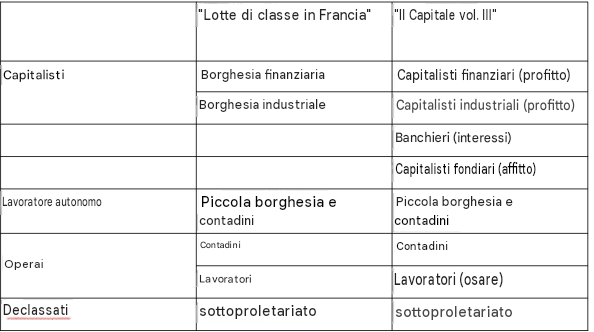
Nota: tratto dal mio libro “Visioni di disuguaglianza”.
La struttura di classe descritta da Ishchenko è molto più semplice. Prima della guerra con la Russia, la società ucraina era composta da tre grandi classi. La prima era la borghesia urbana che, per le proprie preferenze politiche e interessi materiali, tendeva a guardare all’Europa occidentale come a un “progetto di civiltà”, attraverso il quale l’Ucraina si sarebbe sviluppata socialmente ed economicamente. La borghesia urbana era spesso sostenuta da capitali europei o americani provenienti da vari progetti educativi, tecnologici o sociali, o più semplicemente, i suoi membri condividevano interessi commerciali e professionali con gli europei occidentali. Pertanto, la borghesia urbana nutriva sia un interesse materiale che una preferenza ideologica per relazioni più strette con l’Europa e in particolare per l’adesione all’Unione Europea. Non è affatto chiaro se, prima della guerra, tale atteggiamento si estendesse anche all’adesione alla NATO. Ishchenko fornisce dati sul sostegno all’adesione alla NATO che non hanno mai coinvolto la maggioranza della popolazione, e spesso nemmeno la maggioranza relativa. Fino all’invasione russa, l’adesione alla NATO era auspicata dal 15 al 20% della popolazione, mentre l’adesione all’Unione Europea godeva generalmente del sostegno di oltre il 50% della popolazione.
La seconda grande classe era composta da estremisti di destra e nazionalisti, provenienti principalmente dalla parte occidentale dell’Ucraina, che ebbero un ruolo determinante nel rovesciamento di Yanukovich. Come affermò uno dei loro leader: “Eravamo un decimo della popolazione, ma abbiamo fatto nove decimi del lavoro”. L’insurrezione popolare, durata diversi mesi e caratterizzata da numerosi colpi di scena, portò infine il Parlamento (in modo discutibile) a mettere sotto accusa Yanukovich, che fuggì in Russia, rinunciando a tutti i poteri presidenziali. Dai saggi di Ishchenko non emerge chiaramente la base economica di questi gruppi di destra. Le loro idee politiche, unite alla loro brutalità, ricordano da vicino le SA tedesche. Di fatto, Ishchenko li paragona implicitamente a queste ultime quando afferma che si tratta di ali militari di partiti politici. Ne esistono diversi, operativamente indipendenti, legati a vari partiti di destra. Tra questi gruppi, il più noto è la Brigata Azov, che ha svolto un ruolo di primaria importanza nella guerra, costituendo la spina dorsale delle forze armate ucraine. Si tratta di un’organizzazione onnicomprensiva: “un’unità con un programma politico affiliata a un partito politico, a un’organizzazione paramilitare, a campi estivi di addestramento per bambini” (p. 116). C’erano anche altri gruppi che hanno avuto un ruolo nell’Euromaidan, come ad esempio il Blocco di Destra, che in origine era un’associazione di hooligan del calcio, simile a quelle esistenti in molti paesi dell’Europa orientale. Ma non è affatto chiaro quali gruppi sociali rappresentino né quale sia il loro interesse economico, se non una qualche forma di capitalismo politico corrotto.
Il terzo gruppo in Ucraina prima del 2014 – quando l’Ucraina era ancora un paese unificato – era costituito dalla popolazione dell’Ucraina orientale, dove i grandi oligarchi, arricchitisi con le privatizzazioni fraudolente di aziende industriali sovietiche, controllavano la vita politica “governando” una forza lavoro piuttosto passiva. “Questi partiti oligarchici erano strutturati attorno a un ‘uomo forte’, basati su un rapporto di patronato e clientelismo, [e] in mancanza di altri modelli, riproducevano i peggiori aspetti del Partito Comunista dell’Unione Sovietica – un paternalismo autoritario, la passività popolare – svuotati del suo progetto di modernità legittimante” (p. 111). A differenza della borghesia urbana, qui sia gli oligarchi che la popolazione guardavano alla Russia, con la quale avevano legami economici ed etnici. Erano desiderosi di mantenere i privilegi in tali scambi e temevano la concorrenza economica dei paesi occidentali qualora l’Ucraina fosse diventata membro associato o a pieno titolo dell’UE. Essi rappresentavano quelli che si potrebbero definire interessi conservatori – quelli che all’epoca di Eltsin venivano chiamati i “Direttori Rossi”, trasformatisi in oligarchi – ma il loro sostegno, sostiene Ishchenko, era piuttosto superficiale, in quanto si basava sulla passività dei lavoratori piuttosto che sul loro entusiasmo.
Gli “oligarchi orientali” esercitavano maggiore attrattiva sui media e sul resto della popolazione rispetto agli “oligarchi occidentali” e alla borghesia urbana, poiché questi ultimi erano più sofisticati e includevano molti professionisti altamente qualificati. Il panorama mediatico di Kiev e di altre grandi città era dominato da quella che Ishchenko definisce la classe media urbana nazional-liberale, spesso finanziata da contratti con aziende e ONG occidentali. Questa classe potrebbe essere considerata anche una borghesia compradora.
Gli “oligarchi occidentali”, che si sono arricchiti anche attraverso privatizzazioni fraudolente ma le cui attività erano orientate verso l’Occidente, hanno svolto un ruolo complesso, schierandosi a volte con l’estrema destra e altre volte con la coalizione nazional-liberale. Petro Poroshenko è forse il caso più noto. Divenuto presidente dell’Ucraina dopo la destituzione di Yanukovich, egli stesso oligarca, passò da una posizione nazional-liberale all’estrema destra, consentendo a Zelensky di presentarsi alle elezioni successive come candidato pacifista e di vincere con una schiacciante maggioranza (con il 73% dei voti al secondo turno). Ishchenko sostiene che la ragione principale di questo atteggiamento ambivalente degli oligarchi occidentali sia stata la questione della corruzione. L’avvicinamento all’Unione Europea era in linea di principio un obiettivo che condividevano, ma non quando implicava un maggiore controllo sui loro contratti e un controllo più rigoroso sulla corruzione. Per loro, una maggiore trasparenza e un maggiore controllo sulla corruzione, che sarebbero derivati da relazioni europee più strette, sono sempre stati un tema centrale e, a volte, li hanno spinti ad avvicinarsi a nazionalisti estremisti disinteressati a questioni così futili come la corruzione.
Con la guerra limitata del 2014 e la ribellione nel Donbass, il terzo gruppo (gli “oligarchi dell’Est” e i lavoratori) è stato completamente escluso dalla vita politica interna, perché si è unito alle forze separatiste o russe, oppure è stato isolato perché il territorio era occupato dalla Russia o dalle forze ucraine anti-Maidan. Questo ha lasciato sul campo solo due classi sociali: la borghesia urbana nazional-liberale e gli estremisti di destra con i loro battaglioni armati. Questi ultimi hanno sopportato il peso maggiore della guerra e non credo ci siano dubbi sul fatto che, una volta terminata, aspireranno a ricoprire le posizioni di vertice nel governo.
Un gruppo che è stato completamente eliminato nel corso dell’ultimo decennio (e Ishchenko, nell’introduzione, allude al fatto che lui e la sua famiglia ne facciano parte) è quello dei cosiddetti “ucraini sbagliati” o “ucraini sovietici”. Essi erano (ed è necessario parlarne al passato) la classe media urbana sovietizzata, sia essa composta da intellettuali tecnici o liberali, che condivideva i valori socialisti pur rifiutando il conformismo sovietico; accettavano i valori progressisti promossi dall’Unione Sovietica, tra cui il non considerare la lingua come un segno di nazionalismo, bensì come uno strumento di comunicazione. Come Ishchenko chiede retoricamente nell’introduzione: “I membri della mia famiglia che parlavano ucraino si sentivano oppressi quando parlavano russo? Al contrario, era la lingua dei loro partner, delle grandi città, dell’istruzione superiore, la lingua parlata dalla maggior parte dei loro coetanei e colleghi dell’intellighenzia tecnica. Per loro non era la lingua dell’oppressione, ma del progresso, come per milioni di altre famiglie ucraine”. Come in tutte le guerre che contrappongono un gruppo estremista a un altro, chi si trova nel mezzo viene emarginato. Viene eliminato socialmente e, a volte, anche fisicamente.
Oltretutto, il partito che forse era loro più vicino, il Partito Comunista Ucraino (con il 13% dei voti alle elezioni del 2012), è stato messo al bando nel 2019, quando il processo di cosiddetta de-comunistizzazione era in pieno svolgimento. Gli “ucraini sbagliati” sono stati prima eliminati attraverso l’azione deliberata del governo contro qualsiasi gruppo che propugnasse una convivenza pacifica tra ucraini e russi. Poi sono stati ulteriormente eliminati quando la Russia ha attaccato l’Ucraina e, come sottolinea Ishchenko, nessun gruppo o partito (al di fuori del Donbass) – per quanto vicino alla Russia potesse essere considerato prima dell’aggressione – si è schierato a favore dell’invasione.
I due gruppi principali, la borghesia nazional-liberale e i nazionalisti di destra, rimarrebbero dunque anche dopo la guerra. Questi ultimi probabilmente preferirebbero una forma di capitalismo politico e di clientelismo che elargisca favori ai propri membri. È un fenomeno comune che, dopo la guerra, ex soldati e combattenti ritengano di dover essere ricompensati in modo particolare per i sacrifici compiuti. Non sarebbe sorprendente se i nazionalisti puntassero a controllare il potere supremo. In tal caso, lo farebbero con un programma ben preciso, basato sulla vendetta contro la Russia ( l’esercito della rivincita ), sulla restituzione dei territori occupati, il che (come credo abbia osservato Zelensky) trasformerebbe l’Ucraina in un campo armato pronto ad attaccare la Russia in qualsiasi momento. Una versione molto ottimistica di ciò che l’Ucraina potrebbe diventare è quella della Corea del Sud che, sotto la protezione occidentale, si è sviluppata in un paese molto prospero con tecnologia avanzata e un fiorente panorama artistico. Uno scenario pessimistico per l’Ucraina è che assomigli al Vietnam del Sud: forte instabilità politica, governi di breve durata, alti livelli di corruzione, calo demografico e forse un generale collasso delle istituzioni rappresentative. Se ciò dovesse accadere, l’Ucraina del dopoguerra potrebbe assomigliare all’Ucraina prebellica (quattro presidenti, sette primi ministri e cinque elezioni generali tra il 2000 e il 2022), anche se una delle fonti di instabilità – la differenza di preferenze politiche tra Occidente e Oriente – sarebbe venuta meno con la divisione del paese.
Alla fine degli anni Quaranta, lo storico britannico A.J.P. Taylor, dopo aver studiato la dinastia degli Asburgo dal 1809 al 1916 e aver analizzato tutti i tentativi falliti di creare una società multietnica funzionale nell’Europa centro-orientale, si pose la domanda retorica se una tale società fosse effettivamente possibile in quelle regioni. Riteneva che la Jugoslavia di Tito, se fosse sopravvissuta, avrebbe fornito una risposta. Lessi il libro di Taylor durante la violenta dissoluzione della Jugoslavia e pensai che, indirettamente, fosse il libro più utile per spiegare perché una nazione del genere non possa esistere nell’Europa centro-orientale. Non avrei mai immaginato di dover tornare ad A.J.P. Taylor per comprendere la disgregazione dell’Ucraina, ma in realtà lo stesso schema si è ripresentato anche lì e non è impossibile pensare che possa estendersi ulteriormente verso est, fino alla Federazione Russa.
By mm
E' possibile commentare l'articolo nell'area "Commenti del Mese"