


Blog di Krugman
Trump sta perdendo una seconda guerra. La debacle iraniana sta accelerando la transizione dai combustibili fossili. Di PAUL KRUGMAN (dal nuovo blog di Krugman, 5 maggio 2026)
May 05, 2026
Trump Is Losing a Second War
The Iran debacle is accelerating the shift away from fossil fuels

Last month, out of more than 11,000 new passenger vehicles registered in Norway, only around 150 had internal consumption engines. The rest were fully electric. In mainland Europe as a whole, EV sales are up 51 percent from a year ago.
The global energy transition — the shift from fossil fuels to electrotech, which uses solar, wind and batteries to power an electrified economy — is accelerating. It’s now clear that the closure of the Strait of Hormuz marks an inflection point: the global green energy curve, which was already on a rapidly rising trajectory, has suddenly become even steeper. “Investors,” reports the Financial Times, “are piling into clean energy funds.”
This acceleration isn’t just a consequence of soaring fossil fuel prices. It is also the result of the worldwide realization that, with the end of Pax Americana, depending on imported hydrocarbons is a risk not worth taking. The United States cannot be relied on to keep sea lanes open when cheap drones can take out an oil tanker or a major pipeline. Even relying on oil and gas from America itself is dangerous, since one never knows when an erratic U.S. government – now under the control of a twice-elected malignant narcissist — will try to use energy as a tool of coercion.
Despite the perversity of its causes, the current acceleration of electrotech is overwhelmingly positive for the world as a whole. It will slow climate change and reduce pollution. It will diminish the power of anti-democratic petrostates and limit the vulnerability of the world economy to disruptions at choke points like Hormuz. It will democratize access to cheap energy sources in places like Africa.
There is another positive consequence of the clean energy boom: the diminishment of the carbon coalition — the interest groups and ideologues who hate renewable energy and want the world to keep burning fossil fuels. That coalition currently controls the Trump administration’s energy policy. But this is only the latest stage in the corruption of U.S. politics by fossil fuel interests. When we decry the Supreme Court’s destruction of the Voting Rights Act, we should always remember that the Koch brothers and other fossil fuel oligarchs essentially created the Roberts court.
And now we have petrostate oligarchs making naked corruption great again by lining the pockets of the Trump family.
Trump’s own views about energy are defined by petulance and delusions. Wind power kills birds and drives whales crazy! China — which last year added three times as much wind capacity as the rest of the world combined — doesn’t actually use the turbines it has installed! (It does.)
But Trump’s energy officials are barely less delusional than their boss. Last month Chris Wright, Trump’s energy secretary, dismissed the rise of renewable energy as a failed project:
“The result has been 10 or 20 years of just massive investment in energy that wasn’t helpful in better energizing the world. Wasn’t helpful in lifting people out of poverty. Wasn’t helpful in expanding access to energy. In fact, I believe it’ll go down as the greatest malinvestment in history.”
Meanwhile, last year solar and wind power accounted for 99 percent of the growth in world electricity supply, while generation using fossil fuels declined:

Let’s not pretend that hostility to the energy transition has anything to do with faith in free markets or the desire to keep energy cheap. Trump and his minions are actively trying to stop the expansion of green energy even when it’s profitable. In the latest development, the administration is using bogus national security concerns to block the development of wind power:
“Now the administration has held up a large number of onshore wind projects under development on private land, citing national security concerns. These wind farms typically have to undergo a review by the Pentagon before being built to ensure that their turbines won’t interfere with military radar or flight paths. In the past, those reviews have been fairly straightforward, but they have ground to a halt in recent weeks, and the Pentagon has canceled some meetings with developers.”
Fortunately, America is not the world. We account for less than 20 percent of world electricity generation. So Trump’s policies can’t stop the global energy transition. Indeed, as a result of the Iran debacle, Trump’s presidency has been a net positive for the global green energy revolution.
Trump and the fossil-fuel cabal may be able to extract a few billion dollars in profits by keeping America stuck in a dirty-energy past. But in so doing they will also ensure that the United States is left behind, and that the future belongs to China.
Trump sta perdendo una seconda guerra.
La debacle iraniana sta accelerando la transizione dai combustibili fossili.
Il mese scorso, su oltre 11.000 nuove autovetture immatricolate in Norvegia, solo circa 150 erano dotate di motore a combustione interna. Le restanti erano completamente elettriche. Nell’Europa continentale nel suo complesso, le vendite di veicoli elettrici sono aumentate del 51% rispetto a un anno fa.
La transizione energetica globale – il passaggio dai combustibili fossili all’elettrotecnica , che utilizza energia solare, eolica e batterie per alimentare un’economia elettrificata – sta accelerando. È ormai chiaro che la chiusura dello Stretto di Hormuz segna un punto di svolta: la curva globale dell’energia verde, che era già in rapida ascesa, è improvvisamente diventata ancora più ripida. “Gli investitori”, riporta il Financial Times , “stanno investendo massicciamente nei fondi per le energie pulite”.
Questa accelerazione non è solo una conseguenza dell’impennata dei prezzi dei combustibili fossili. È anche il risultato della consapevolezza a livello mondiale che, con la fine della Pax Americana, dipendere dagli idrocarburi importati è un rischio che non vale la pena correre. Non ci si può fidare degli Stati Uniti per mantenere aperte le rotte marittime quando droni a basso costo possono distruggere una petroliera o un importante oleodotto. Anche fare affidamento sul petrolio e sul gas provenienti dagli Stati Uniti stessi è pericoloso, poiché non si sa mai quando un governo statunitense imprevedibile – ora sotto il controllo di un narcisista malefico eletto due volte – cercherà di usare l’energia come strumento di coercizione.
Nonostante la perversità delle sue cause, l’attuale accelerazione dell’elettrotecnica è complessivamente molto positiva per il mondo intero. Rallenterà il cambiamento climatico e ridurrà l’inquinamento. Diminuirà il potere degli stati petroliferi antidemocratici e limiterà la vulnerabilità dell’economia mondiale alle interruzioni in punti strategici come Hormuz. Democratizzerà l’accesso a fonti energetiche a basso costo in luoghi come l’Africa.
C’è un’altra conseguenza positiva del boom delle energie pulite: l’indebolimento della coalizione del carbonio, ovvero i gruppi di interesse e gli ideologi che odiano le energie rinnovabili e vogliono che il mondo continui a bruciare combustibili fossili. Questa coalizione controlla attualmente la politica energetica dell’amministrazione Trump. Ma questa è solo l’ultima fase della corruzione della politica statunitense da parte degli interessi legati ai combustibili fossili. Quando condanniamo la distruzione del Voting Rights Act da parte della Corte Suprema, dovremmo sempre ricordare che i fratelli Koch e altri oligarchi dei combustibili fossili hanno di fatto creato la Corte (Suprema) di Roberts [2].
E ora abbiamo gli oligarchi del settore petrolifero che riportano in auge la corruzione più sfrenata, riempiendo le tasche della famiglia Trump.
Le opinioni di Trump sull’energia sono caratterizzate da petulanza e deliri. L’energia eolica uccide gli uccelli e fa impazzire le balene! La Cina, che l’anno scorso ha aggiunto una capacità eolica tre volte superiore a quella del resto del mondo messo insieme, in realtà non utilizza le turbine che ha installato! (Invece sì.)
Ma i funzionari di Trump responsabili del settore energetico non sono molto meno illusi del loro capo. Il mese scorso Chris Wright , segretario all’energia di Trump, ha liquidato l’ascesa delle energie rinnovabili come un progetto fallimentare:
“Il risultato è stato un periodo di 10 o 20 anni di ingenti investimenti nel settore energetico che non hanno contribuito a migliorare l’approvvigionamento energetico mondiale. Non hanno contribuito a sollevare le persone dalla povertà. Non hanno contribuito ad ampliare l’accesso all’energia. Anzi, credo che passeranno alla storia come il più grande cattivo investimento di sempre.”
Nel frattempo, lo scorso anno l’energia solare ed eolica hanno rappresentato il 99% della crescita dell’offerta mondiale di elettricità, mentre la produzione basata sui combustibili fossili è diminuita:
Non fingiamo che l’ostilità alla transizione energetica abbia qualcosa a che fare con la fiducia nei mercati liberi o con il desiderio di mantenere l’energia a basso costo. Trump e i suoi scagnozzi stanno attivamente cercando di fermare l’espansione delle energie rinnovabili, anche quando sono redditizie. L’ultimo sviluppo riguarda l’amministrazione che sta usando pretestuose preoccupazioni per la sicurezza nazionale per bloccare lo sviluppo dell’energia eolica : [4]
“Ora l’amministrazione ha bloccato un gran numero di progetti eolici terrestri in fase di sviluppo su terreni privati, adducendo motivi di sicurezza nazionale. Questi parchi eolici, in genere, devono essere sottoposti a una revisione da parte del Pentagono prima di essere costruiti, per garantire che le turbine non interferiscano con i radar militari o le rotte di volo. In passato, tali revisioni sono state piuttosto semplici, ma si sono bloccate nelle ultime settimane e il Pentagono ha annullato alcuni incontri con gli sviluppatori.”
Fortunatamente, l’America non è il mondo. Il nostro Paese produce meno del 20% dell’elettricità mondiale. Pertanto, le politiche di Trump non possono fermare la transizione energetica globale. Anzi, a seguito della crisi iraniana, la presidenza Trump ha avuto un impatto complessivamente positivo sulla rivoluzione globale dell’energia verde.
Trump e la cricca dei combustibili fossili potrebbero riuscire a ricavare qualche miliardo di dollari di profitti mantenendo l’America ancorata a un passato basato sulle energie inquinanti. Ma così facendo, garantiranno anche che gli Stati Uniti rimarranno indietro e che il futuro apparterrà alla Cina.
[1] Il titolo del diagramma è: “Il solare cinese in un mese raddoppia per raggiungere nel marzo del 2026 il massimo storico, nel mezzo della crisi energetica e di un cambiamento delle riduzioni fiscali cinesi”.
[2] Roberts è da anni il principale giudice di indirizzo repubblicano alla guida della Corte Suprema.
[3] Se ben capisco, e mi pare davvero sensazionale, la tabella mostra come le varie fonti di produzione di energia elettrica hanno soddisfatto l’intera nuova domanda di elettricità nell’anno 2025. Tutti questi valori esprimono la differenza nell’anno 2025 rispetto all’anno 2024, ovvero cosa sta accadendo di nuovo nella produzione di elettricità.
Il segmento finale in grigio rappresenta la stima totale di tale nuova domanda; il segmento in verde chiaro la parte di nuova produzione di energia con il solare; il segmento in verde scuro la parte soddisfatta con l’eolico; quello in blu la parte del nucleare; quello in celeste la parte di altre rinnovabili a basso contenuto di carbonio (idrico, bioenergie, geotermico). Il dato negativo (colore marrone) dei combustibili fossili indica un decremento rispetto all’anno precedente.
[4] La connessione (nel testi inglese) è con un articolo del New York Times del 4 maggio 2026. L’articolo di DiBrad Plumer racconta le vicende delle varie iniziative della Amministrazione Trump per impedire o ritardare 150 progetti di energia eolica. Il resto in corsivo è tratto dall’articolo.
La società elettrotecnica cinese è la grande vincitrice della guerra con l’Iran. Di Paul Krugman (dal blog di Krugman, 14 aprile 2026)
aprile 15, 2026
Apr 14, 2026
Chinese Electrotech is the Big Winner in the Iran War
An energy-hungry world is being pushed away by America and into China’s arms

 Donald Trump wants to stop the renewable energy revolution. But he can’t — it will continue to advance around the world because the economics and the science are compelling. Trump can, however, ensure that the revolution passes us by. And the big geopolitical winner from Trump’s hostility to the energy revolution will be China, which dominates the production of renewable-energy infrastructure.
Furthermore, the China-led energy future will arrive ahead of schedule thanks to the debacle in Iran.
Soaring oil and gas prices, combined with the threat of shortages, have driven home the riskiness of relying on fossil fuels. The New York Times had a striking graphic about electricity prices in Europe:

France and Spain, which mostly generate electricity from non-fossil sources (including nuclear power in France), have been partially insulated from the war’s side effects. Italy, heavily reliant on gas, has suffered badly.
Also, Trump’s decision to counter Iran’s blockade of the Strait of Hormuz by blockading the Strait of Hormuz surely adds to the perception that relying on U.S. oil and LNG, which is what countries will have to do if they don’t turn to solar and wind, isn’t safe. Who can guarantee that an erratic America won’t try to weaponize other countries’ dependence on our energy?
So Trump’s adventurism in Iran has sparked a global rush to invest in solar power, wind power, and the batteries that make renewable energy work 24/7.
And where will the world procure most of the renewable energy equipment it seeks? From China. China is the workshop of the world. Its manufacturing sector is larger than those of the U.S., Japan, Germany and South Korea combined.
While China is strong in many industries, it is utterly dominant in electrotech, the cluster of industries — solar panels, wind turbines, batteries and electric vehicles — at the heart of the renewables revolution. Or as the Wall Street Journal puts it, China’s “green industrial complex” rules. China accounts for more than 80 percent of global production in all these sectors with the exception of wind turbines. In the wind turbine sector, China’s share is “only” 60 percent because Europe retains a significant role.
Why does China dominate electrotech? Industrial policy — deliberate government promotion of these industries — is part of the answer. But a key driver of China’s success has been the speed with which the Chinese themselves have been adopting renewable energy, creating a huge domestic market that provides their electrotech industries with big advantages even in foreign markets.
There’s a widespread, completely erroneous belief among opponents of renewable energy that China produces electrotech equipment but doesn’t use the stuff itself. Speaking at the World Economic Forum three months ago, Trump declared that
“China makes almost all of the windmills and yet I haven’t been able to find any wind farms in China. Did you ever think of that? That’s a good way of looking at it. They’re smart, China’s very smart. They make them, they sell them for a fortune. They sell them to the stupid people that buy them, but they don’t use them themselves. They put up a couple of big wind farms, but they don’t use them, they just put them up to show people what they could look like. They don’t spin; they don’t do anything. They use a thing called coal mostly.”
China does, in fact, still burn a lot of coal. But its use of wind and solar power is rising rapidly. The demand for solar panels, wind turbines and batteries depends on the increase in renewable generation rather than its level. And China’s growth in renewable energy, both wind and solar, has been larger than that of the rest of the world combined:

Source: Our World in Data
China also accounts for more than 60 percent of world sales of electric cars:

Source: Our World in Data
And electrotech is exactly the kind of industry in which a large domestic market translates into success at exporting into other markets. For all of the component industries of electrotech are marked by steep learning curves: the more a country produces, the better it gets at producing. By dominating electrotech now, China is gaining experience and know-how that no other country can match. It is also creating an industrial ecosystem of specialized suppliers that, again, no other nation will be able to rival. And the low costs generated by this industrial ecosystem gives China a huge advantage in global markets.
Under President Biden the United States took much needed steps toward developing its own electrotech sectors, notably batteries and electric vehicles. It also sought to accelerate the growth of renewable energy in general. But not only has the Trump administration canceled all of Biden’s renewable energy programs, it is also actively trying to block private commercial investments in renewable energy.
By the time America frees itself from Trump’s fossil fuel obsession, if it ever does, China’s lead in the manufacture of renewables will probably be insurmountable.
Now, a world that relies on China for solar panels and batteries isn’t necessarily a bad thing. It’s certainly less risky for most nations, politically and economically, than relying on LNG imports from Qatar — or, at this point, the United States.
Furthermore, although the Trump administration is full of climate denialists, climate change is continuing. March was a record warm month in the United States:

Given the rate at which the planet is warming, a shift away from fossil fuels can’t come fast enough. Where the equipment needed to make that shift happen was manufactured is a secondary issue.
Yet it’s sad to watch this country sabotage itself and cede the most important industry of the future to China. In doing so, we make ourselves poorer, technologically backward, and less influential in a world that is speeding towards the energy revolution. In the end, we aren’t just burning fossil fuels; we’re also burning our future.
La società elettrotecnica cinese è la grande vincitrice della guerra con l’Iran.
Un mondo affamato di energia viene spinto via dall’America e gettato tra le braccia della Cina.
Donald Trump vuole fermare la rivoluzione delle energie rinnovabili. Ma non può : continuerà ad avanzare in tutto il mondo perché i vantaggi economici e scientifici sono innegabili. Trump può però fare in modo che questa rivoluzione ci sfugga. E il grande vincitore geopolitico dell’ostilità di Trump nei confronti della rivoluzione energetica sarà la Cina, che domina la produzione di infrastrutture per le energie rinnovabili.
Inoltre, il futuro energetico guidato dalla Cina arriverà prima del previsto grazie alla debacle in Iran.
L’impennata dei prezzi del petrolio e del gas, unita alla minaccia di carenze, ha messo in luce la rischiosità di dipendere dai combustibili fossili. Il New York Times ha pubblicato un grafico eloquente sui prezzi dell’elettricità in Europa:
Francia e Spagna, che producono energia elettrica principalmente da fonti non fossili (tra cui l’energia nucleare in Francia), sono state parzialmente protette dagli effetti collaterali della guerra. L’Italia, fortemente dipendente dal gas, ha subito gravi danni.
Inoltre, la decisione di Trump di rispondere al blocco iraniano dello Stretto di Hormuz bloccando a sua volta lo Stretto di Hormuz, contribuisce sicuramente alla percezione che dipendere dal petrolio e dal GNL statunitensi, cosa che i Paesi dovranno fare se non si orienteranno verso l’energia solare ed eolica, non sia sicuro. Chi può garantire che un’America imprevedibile non cercherà di strumentalizzare la dipendenza energetica di altri Paesi?
L’avventurismo di Trump in Iran ha quindi scatenato una corsa globale agli investimenti nell’energia solare, nell’energia eolica e nelle batterie che consentono alle energie rinnovabili di funzionare 24 ore su 24, 7 giorni su 7.
E da dove il mondo si procurerà la maggior parte delle apparecchiature per le energie rinnovabili di cui ha bisogno? Dalla Cina. La Cina è l’officina del mondo. Il suo settore manifatturiero è più grande di quelli di Stati Uniti, Giappone, Germania e Corea del Sud messi insieme .
Sebbene la Cina sia forte in molti settori, domina incontrastata nell’elettrotecnica , il complesso industriale – pannelli solari, turbine eoliche, batterie e veicoli elettrici – che è al centro della rivoluzione delle energie rinnovabili. Ovvero, come afferma il Wall Street Journal, il ” complesso industriale verde ” cinese regna sovrano. La Cina rappresenta oltre l’80% della produzione globale in tutti questi settori, con l’eccezione delle turbine eoliche. Nel settore eolico, la quota cinese è “solo” del 60%, poiché l’Europa conserva un ruolo significativo.
Perché la Cina domina il settore elettrotecnico? La politica industriale – la promozione deliberata di questi settori da parte del governo – è parte della risposta. Ma un fattore chiave del successo cinese è stata la rapidità con cui gli stessi cinesi hanno adottato le energie rinnovabili, creando un enorme mercato interno che offre alle loro industrie elettrotecniche grandi vantaggi anche sui mercati esteri.
Tra gli oppositori delle energie rinnovabili è diffusa la convinzione, del tutto errata, che la Cina produca apparecchiature elettrotecniche ma non le utilizzi. Parlando al World Economic Forum tre mesi fa, Trump ha dichiarato che:
“La Cina produce quasi tutte le pale eoliche, eppure non sono riuscito a trovare nessun parco eolico in Cina. Ci avevi mai pensato? È un buon modo di vedere le cose. Sono intelligenti, la Cina è molto intelligente. Le producono, le vendono a prezzi esorbitanti. Le vendono agli ingenui che le comprano, ma non le usano loro stessi. Costruiscono un paio di grandi parchi eolici, ma non li utilizzano, li costruiscono solo per mostrare alla gente come potrebbero essere. Non girano; non fanno niente. Usano principalmente una cosa chiamata carbone.”
La Cina, in effetti, continua a bruciare molto carbone. Tuttavia, il suo utilizzo di energia eolica e solare è in rapida crescita. La domanda di pannelli solari, turbine eoliche e batterie dipende dall’aumento della produzione di energia rinnovabile, piuttosto che dal suo livello . E la crescita della Cina nel settore delle energie rinnovabili, sia eolica che solare, è stata superiore a quella del resto del mondo messo insieme.
[1] Fonte: Il nostro mondo nei dati
La Cina rappresenta inoltre oltre il 60% delle vendite mondiali di auto elettriche:
Fonte: Il nostro mondo nei dati
L’elettrotecnica è proprio quel tipo di settore in cui un ampio mercato interno si traduce in successo nell’esportazione verso altri mercati. Tutti i settori che compongono l’elettrotecnica sono caratterizzati da una ripida curva di apprendimento : più un Paese produce, più diventa bravo a produrre. Dominando il settore elettrotecnico, la Cina sta acquisendo esperienza e know-how che nessun altro Paese può eguagliare. Sta inoltre creando un ecosistema industriale di fornitori specializzati che, ancora una volta, nessun’altra nazione sarà in grado di replicare. E i bassi costi generati da questo ecosistema industriale conferiscono alla Cina un enorme vantaggio sui mercati globali.
Sotto la presidenza Biden, gli Stati Uniti hanno compiuto passi fondamentali per lo sviluppo dei propri settori elettrotecnici, in particolare batterie e veicoli elettrici. Hanno inoltre cercato di accelerare la crescita delle energie rinnovabili in generale. Tuttavia, l’amministrazione Trump non solo ha cancellato tutti i programmi di Biden in materia di energie rinnovabili, ma sta anche attivamente cercando di bloccare gli investimenti commerciali privati in questo settore.
Quando l’America si libererà dall’ossessione di Trump per i combustibili fossili, se mai ci riuscirà, il vantaggio della Cina nella produzione di energie rinnovabili sarà probabilmente insormontabile.
Ora, un mondo che dipende dalla Cina per i pannelli solari e le batterie non è necessariamente un male. È certamente meno rischioso per la maggior parte delle nazioni, sia politicamente che economicamente, rispetto alla dipendenza dalle importazioni di GNL dal Qatar o, a questo punto, dagli Stati Uniti.
Inoltre, sebbene l’amministrazione Trump sia piena di negazionisti del cambiamento climatico, quest’ultimo è in atto. Marzo è stato un mese record per le temperature negli Stati Uniti:
Considerato il ritmo con cui il pianeta si sta riscaldando, il passaggio dai combustibili fossili non può avvenire abbastanza rapidamente. Il luogo di produzione delle attrezzature necessarie per realizzare questa transizione è una questione secondaria.
Eppure è triste vedere questo Paese autosabotarsi e cedere alla Cina il settore industriale più importante del futuro. Così facendo, ci impoveriamo, diventiamo tecnologicamente arretrati e meno influenti in un mondo che si sta rapidamente avviando verso la rivoluzione energetica. In definitiva, non stiamo solo bruciando combustibili fossili; stiamo bruciando anche il nostro futuro.
[1] Il terawattora (simbolo TWh) è un’unità di misura dell’energia elettrica pari a un trilione di wattora. Rappresenta la quantità di energia prodotta o consumata su larghissima scala, equivalente a un miliardo di kilowattora (kWh). Viene usato principalmente per misurare il consumo energetico annuale di un intero paese.
Nel diagramma, in blu gli incrementi di produzione elettrica nell’anno 2024 derivanti dall’eolico, in celeste quelli derivanti dal solare. La prima riga mostra i dati cinesi, la seconda quelli del resto del mondo.
[2] La Cina vende 11,3 milioni di veicoli elettrici, contro 1,5 milioni degli Stati Uniti (e 6,2 milioni del resto del mondo).
[3] La tabella mostra a marzo del 2026 gli andamenti delle temperature medie negli Stati Uniti. Il confronto è con le temperature medie dal 1895 al 2026. Il colore marrone indica gli incrementi massimi (temperature medie caldissime), soprattutto nell’America sud-occidentale, compresa la California. Il marrone chiaro – quasi tutto il resto dell’America – indica temperature molto superiori alle medie. Negli stati settentrionali, il colore rosa indica comunque temperature superiori alle medie.
Ignoranza e ignominia La nostra umiliazione a Hormuz non è stata un incidente. Di PAUL KRUGMAN (dal blog di Krugman, 8 aprile 2026)
aprile 9, 2026
Apr 08, 2026
Ignorance and Ignominy
Our Hormuz humiliation was not an accident
 So the world’s greatest military power went to war with a poor, medievalist theocracy. It was an incredibly uneven match. Here’s are the GDPs of Iran and the United States in 2024:

Yet Iran won. The Iranian regime has emerged far stronger than it was before, controlling the Strait of Hormuz and having demonstrated its ability to inflict damage on both its neighbors and the world economy. The U.S. has emerged far weaker, having demonstrated the limitations of its military technology, its strategic ineptitude and, when push comes to shove, its cowardice.
We’ve also destroyed our moral credibility: Trump may have TACOed at the last minute, but he threatened to commit gigantic war crimes — and for all practical purposes our political and civil institutions gave him permission to do so.
How did this happen? Naturally, the Iranian Minister of War credited divine intervention, declaring that “God deserves all the glory.” His nation, he said, fought with the “protection of divine providence. A massive effort with miraculous protection.”
Well, theocrats gonna theocrat.
But I lied. That wasn’t a quote from an Iranian official. That’s what Pete Hegseth, our self-proclaimed Secretary of War, said while claiming that one of the worst strategic defeats in American history was a great victory.
There will be many analyses by military and strategic experts of the Iran debacle. But let’s not lose sight of the larger picture: We were led to disaster by the boastful ignorance of men like Trump and Hegseth — boastful ignorance made even worse by claims that God supports whatever they want to do.
With men like that running America, major disasters were just a matter of time. I’d like to think that they have been chastened by this debacle, that they have learned something. But I don’t believe that for a minute.
God help us.
Ignoranza e ignominia
La nostra umiliazione a Hormuz non è stata un incidente
Quindi la più grande potenza militare del mondo è entrata in guerra con una teocrazia povera e medievale. È stata una battaglia incredibilmente impari. Ecco i PIL dell’Iran e degli Stati Uniti nel 2024:
Eppure l’Iran ha vinto. Il regime iraniano è emerso molto più forte di prima, controllando lo Stretto di Hormuz e avendo dimostrato la sua capacità di infliggere danni sia ai paesi vicini che all’economia mondiale. Gli Stati Uniti sono emersi molto più deboli, avendo dimostrato i limiti della loro tecnologia militare, la loro inettitudine strategica e, quando la situazione si fa critica, la loro codardia.
Abbiamo anche distrutto la nostra credibilità morale: Trump potrà anche aver fatto il TACO [1] all’ultimo minuto, ma ha minacciato di commettere crimini di guerra giganteschi e, a tutti gli effetti, le nostre istituzioni politiche e civili gli hanno dato il permesso di farlo.
Come è potuto succedere? Naturalmente, il Ministro della Guerra iraniano ha attribuito la vittoria all’intervento divino, dichiarando che “Dio merita tutta la gloria”. La sua nazione, ha affermato, ha combattuto con la “protezione della divina provvidenza. Uno sforzo immane con una protezione miracolosa”.
Beh, i teocrati sono pur sempre teocrati.
Sennonché … ho detto una bugia. Non era una citazione di un funzionario iraniano. È quello che ha detto Pete Hegseth, il nostro autoproclamato Segretario alla Guerra, quando ha affermato che una delle peggiori sconfitte strategiche della storia americana era in realtà una grande vittoria.
Ci saranno molte analisi da parte di esperti militari e strategici sulla debacle iraniana. Ma non perdiamo di vista il quadro generale: siamo stati condotti al disastro dall’ignoranza spaccona di uomini come Trump e Hegseth, un’ignoranza spaccona resa ancora più grave dalle loro affermazioni secondo cui Dio appoggia qualsiasi cosa vogliano fare.
Con uomini del genere al governo dell’America, le grandi catastrofi erano solo questione di tempo. Mi piacerebbe pensare che questa debacle li abbia messi a tacere, che abbiano imparato qualcosa. Ma non ci credo nemmeno per un minuto.
Dio ci aiuti.
[1] “Trump Always Chickens Out”. Questo il significato dell’acronimo TACO. Tradotto letteralmente: Trump torna sempre sui suoi passi all’ultimo minuto per paura. Il riferimento è ai continui cambi di passo del presidente statunitense sui dazi, prima annunciati e poi lasciati in stand by. A chiamare “Taco Trade” la politica commerciale del numero uno della Casa Bianca è stato un giornalista del Financial Times che ha ironizzato in merito al tira e molla tra gli Usa, la Cina e l’Unione europea.
La psicologia dell’incompetenza militare. Come si è persa la guerra con l’Iran. Di PAUL KRUGMAN (dal blog di Krugman, 1 aprile 2026)
aprile 1, 2026
Apr 01, 2026
The Psychology of Military Incompetence
How the Iran War was lost
 Transcript
So the world’s greatest military power went to war against a fourth rate nation whose military budget would be rounding error in our defense spending. And it appears that we lost.
Hi, Paul Krugman with a late night, well, evening update, which I don’t usually do, but I wanted to get this in before who knows what happens in the news tomorrow.
It’s Tuesday. It’s the day that the stock market rallied enormously, that the futures price of oil dropped precipitously, all on the happy news that the United States, at least based on Trump’s Truth Social, appears to be surrendering. Trump put up a Truth Social post saying that, you know, we don’t need to open the Strait of Hormuz. If the Europeans think they need it, they should go ahead and do it. And it’s up to them. And this is pretty amazing.
Of course, the idea that it only matters to the Europeans, that it doesn’t matter to us, is all wrong. And that will be a subject of a Substack post shortly. But it is pretty much a confession. Although it’s framed as we won, now let somebody else do the cleanup, the reality is it’s effectively a confession that, well, we lost. We can’t do this.
How the hell did we manage to do this? I mean, the objective reality is that this was never going to be… Maybe it wasn’t even going to be doable. There were reasons why we didn’t go to war with Iran, particularly why we didn’t go to war in a way that basically became an existential threat for the regime so that they have no compunction about creating lots of damage because the alternative result is annihilation for them personally. But everybody who thought about it even for a couple of minutes, anyone who knew anything, particularly anyone who’d been paying attention to four years of war in Ukraine … we know something about what modern war looks like and about the inability of countries that have conventional superior forces to avoid major damage from drones and missiles. So this was completely, unbelievably stupid.
How did we get there? Well, there was a very good article by Tobin Harshaw in Bloomberg, and mostly I’m just riffing off what he wrote, but I think that it deserves wider circulation. He resurrected a book I had forgotten about, a 1976 book by Norman Dixon called The Psychology of Military Incompetence. It was very British oriented, but the lessons apply; Dixon looked at the great military disasters of British history.
You might think there were many reasons why really bad decisions were made, but he actually said there was a kind of consistent pattern. That what happened was that you had military leaders, or people making military decisions, who for the most part shared two things. First, they believed, they had this atavistic, anachronistic belief that warfare is all about muscles and not about minds. which hasn’t been true for a very long time. And second, he argued that they are just generally anti-intellectual, anti-education.
So in some sense, it’s all about muscles and don’t give me all of these smarty-pants intellectuals who are telling me about why I’m doing it wrong. It’s an uncannily accurate portrait of Pete Hegseth, down to even seemingly minor details. Muscular Christianity is among the defining symptoms of the bad British military leaders that Dixon analyzed. So this is what happened.
This is not about specific bad judgments. It’s not, in a way, about the specifics of the case. It is that we were led into war by people who exemplified in the classic way how really bad military decisions are made. And it all comes down to believing in brute force and toughness and muscles — muscles in the age of drone warfare! — and hate intellectuals, hate learning.
What really gets me is that in a war where the deciding factor is having some intellectual understanding of what you’re doing, that a theocratic regime in Iran, which basically wants to bring back the Middle Ages, mostly got it right.
And the world’s leading haven of scientific thought, or we were at least until the current administration, got it completely wrong. It’s humiliating. It’s awful. And, you know, we will all be paying the price for this incredible defeat for probably for the rest of our lives.
Enjoy the evening.
La psicologia dell’incompetenza militare
Come si è persa la guerra con l’Iran
Trascrizione [1]
Quindi la più grande potenza militare del mondo è andata in guerra contro una nazione di quarto livello il cui budget militare sarebbe una cifra irrisoria rispetto alle nostre spese per la difesa. E a quanto pare abbiamo perso.
Salve, sono Paul Krugman e vi presento un aggiornamento a tarda notte, anzi, a tarda sera, cosa che di solito non faccio, ma volevo pubblicarlo prima che chissà cosa succederà domani nelle notizie.
È martedì. È il giorno in cui la borsa ha registrato un’impennata enorme, mentre il prezzo dei futures sul petrolio è crollato vertiginosamente, tutto grazie alla lieta notizia che gli Stati Uniti, almeno stando a quanto riportato da Trump su Truth Social, sembrano arrendersi. Trump ha pubblicato un post su Truth Social dicendo che, sapete, non abbiamo bisogno di aprire lo Stretto di Hormuz. Se gli europei pensano di averne bisogno, che lo facciano pure. È una loro scelta. E questo è davvero incredibile.
Certo, l’idea che importi solo agli europei e che non importi a noi è completamente sbagliata. E questo sarà l’argomento di un prossimo post su Substack. Ma è praticamente una confessione. Anche se viene presentata come se avessimo vinto e ora lasciamo che qualcun altro si occupi della pulizia, la realtà è che si tratta a tutti gli effetti di una confessione del fatto che, ebbene, abbiamo perso. Non ce la facciamo.
Come diavolo ci siamo riusciti? Voglio dire, la realtà oggettiva è che non sarebbe mai stato possibile… Forse non sarebbe nemmeno stato fattibile. C’erano dei motivi per cui non eravamo entrati in guerra con l’Iran, in particolare per cui non eravamo entrati in guerra in un modo che rappresentasse una minaccia esistenziale per il regime, in modo che non avessero scrupoli a causare danni ingenti, perché l’alternativa sarebbe stata la loro annientamento personale. Ma chiunque ci abbia pensato anche solo per un paio di minuti, chiunque ne sapesse qualcosa, in particolare chiunque avesse seguito i quattro anni di guerra in Ucraina … sa qualcosa di come funzioni la guerra moderna e dell’incapacità dei paesi che possiedono forze convenzionali superiori nell’evitare gravi danni da droni e missili. Quindi è stata una cosa completamente, incredibilmente stupida.
Come ci siamo arrivati? Beh, c’era un ottimo articolo di Tobin Harshaw su Bloomberg, e in gran parte mi limito a riprendere quello che ha scritto, ma penso che meriti una diffusione più ampia. Ha riportato alla luce un libro che avevo dimenticato, un libro del 1976 di Norman Dixon intitolato “La psicologia dell’incompetenza militare”. Era molto incentrato sulla storia britannica, ma le lezioni sono applicabili; Dixon analizzava i grandi disastri militari della storia britannica.
Si potrebbe pensare che ci siano state molte ragioni per cui venivano prese decisioni davvero sbagliate, ma in realtà lui sostenne che esisteva una sorta di schema ricorrente. Ciò che accadeva era che i leader militari, o le persone che prendevano decisioni militari, condividevano per lo più due caratteristiche. In primo luogo, credevano, nutrivano questa convinzione atavica e anacronistica, che la guerra si basasse solo sulla forza bruta e non sull’intelligenza, il che non è più vero da molto tempo. In secondo luogo, sosteneva che fossero generalmente anti-intellettuali e contrari all’istruzione.
In un certo senso, è tutta una questione di muscoli, e non rifilatemi tutto quello che questi intellettuali saccenti mi stanno spiegando perché sbaglio. È un ritratto incredibilmente accurato di Pete Hegseth [2], fin nei minimi dettagli, anche quelli apparentemente minori. Il cristianesimo muscolare è tra i sintomi caratteristici dei cattivi leader militari britannici analizzati da Dixon. Dunque è questo che è successo.
Non si tratta di specifici errori di valutazione. In un certo senso, non si tratta nemmeno dei dettagli del caso. Il punto è che siamo stati trascinati in guerra da persone che hanno incarnato, nel modo più classico, come si prendono decisioni militari davvero pessime. E tutto si riduce alla fede nella forza bruta, nella durezza e nei muscoli – muscoli nell’era della guerra con i droni! – e all’odio per gli intellettuali, all’odio per l’apprendimento.
Ciò che mi colpisce davvero è che in una guerra in cui il fattore decisivo è avere una certa comprensione intellettuale di ciò che si sta facendo, un regime teocratico come quello iraniano, che in pratica vuole riportare in auge il Medioevo, alla fine in gran parte ci sia riuscito.
E il principale baluardo del pensiero scientifico mondiale, o almeno lo eravamo fino all’attuale amministrazione, ha completamente sbagliato. È umiliante. È impressionante. E, sapete, pagheremo tutti il prezzo di questa incredibile sconfitta probabilmente per il resto della nostra vita.
Godetevi la serata.
[1] Si tratta della trascrizione di un breve messaggio parlato di Krugman, che viene offerta assieme al video.
[2] Alleghiamo una biografia di Hegseth tratta da Wikipedia (in fondo, sembra che passerà alla storia):
“Peter Brian Hegseth, detto Pete (Minneapolis, 6 giugno 1980), è un ex militare, politico e conduttore televisivo statunitense, segretario della difesa degli Stati Uniti d’America nella seconda amministrazione Trump dal 2025. Commentatore politico per Fox News dal 2014[2][3] e uno dei conduttori del fine settimana di Fox & Friends dal 2017 al 2024; in precedenza è stato direttore esecutivo di Vets for Freedom e Concerned Veterans for America.
Ex ufficiale della Guardia Nazionale dell’esercito statunitense,[4] Hegseth è stato attivo nella politica conservatrice e repubblicana sin dai suoi giorni universitari all’Università di Princeton. Nel 2016 ha sostenuto la candidatura presidenziale di Donald Trump, fungendo da consigliere occasionale di Trump durante il primo mandato di quest’ultimo come presidente. Hegseth era stato preso in considerazione per guidare il Dipartimento degli affari dei veterani degli Stati Uniti nella prima amministrazione Trump, ma è stato invece scelto David Shulkin.
Nel novembre 2024, il presidente eletto Trump ha annunciato l’intenzione di nominare Hegseth come segretario alla difesa, suscitando una serie di accuse per cattiva condotta sessuale, cattiva gestione finanziaria e problemi di alcol. Ha ottenuto comunque l’incarico dal Senato il 24 gennaio 2025, con 51 voti a favore e 50 contrari[5] e con il vicepresidente J. D. Vance che ha espresso un voto decisivo. È stata la seconda volta nella storia degli Stati Uniti che la conferma di un candidato al governo è stata decisa da un vicepresidente (dopo Betsy DeVos durante la prima amministrazione Trump nel 2017). Hegseth è il secondo più giovane segretario alla difesa dopo Donald Rumsfeld e il primo del Minnesota a ricoprire la carica.”
Tradimento nei mercati dei futures, di PAUL KRUGMAN (dal blog di Krugman, 24 marzo 2026)
marzo 25, 2026
Mar 24, 2026
Treason in the Futures Markets
People close to Trump are trading based on national secrets

Source: Yahoo Finance
Over the weekend Donald Trump threatened dire vengeance on Iran unless its government opened the Strait of Hormuz within 48 hours, a deadline that would expire Monday evening in Washington. Specifically, he announced that the U.S. would begin bombing power plants — plants that supply electricity to Iran’s civilian population — unless the Strait was cleared.
But at 7:05 AM Monday Trump called the whole thing off — for five days, he said, but many people are assuming that the threatened action, which would have been a massive war crime, is now off the table.
The reason for the about-face, he claimed, was that the U.S. was engaged in productive negotiations with Iranian officials — although this seems to have come as news to the Iranians, who denied that any such negotiations are taking place. Sad to say, in this case, as I tried to explain yesterday, the fanatical, brutal Iranian regime is more credible than the president of the United States. Is he lying or living in a fantasy world? Neither possibility is comforting.
But in any case, Trump’s sudden climb-down was startling. Who could have seen this coming?
The answer is, the person or people who bought large quantities of stock market futures and sold large quantities of oil futures around 15 minutes before Trump’s announcement. As CNBC reports,
“At around 6:50 a.m. in New York, S&P 500 e-Mini futures trading on the CME recorded a sharp and isolated jump in volume, breaking from an otherwise subdued premarket backdrop. With thin liquidity typical of early trading hours, the sudden burst stood out as one of the largest volume moments of the session up to that point.
A similar pattern was observed in oil markets. West Texas Intermediate May futures also saw a noticeable pickup in trading activity at roughly the same time, with a distinct volume spike interrupting otherwise quiet conditions.”
This “sharp and isolated jump in volume” — which you can see for the oil futures market in the chart at the top of this post — was especially bizarre because there were no major news items — no major publicly available news items — to drive sudden big market transactions. The story would be baffling, except that there’s an obvious explanation: Somebody close to Trump knew what he was about to do, and exploited that inside information to make huge, instant profits.
This wasn’t the first time something like this has happened under Trump. There were large, suspicious moves in the prediction market Polymarket before previous attacks on Iran and Venezuela. But this front-running of U.S. policy was really large: the Financial Times estimates the sales of oil futures in that magic minute Monday morning at about $580 million, and that doesn’t count the purchases of stock futures.
When officers of a company or people close to them exploit confidential information for personal financial gain, that’s insider trading — which is illegal. But we have another word for situations in which people with access to confidential information regarding national security — such as plans to bomb or not to bomb another country — exploit that information for profit. That word is “treason.”
Why is profiting from insider information about national security decisions effectively a form of treason? First, it’s hard to think of a more fundamental principle for officials we entrust with important decisions, especially those that involve national security, that they or people they know should not be allowed to exploit their positions for personal gain.
Second, financial trading based on what should be closely held secrets reveals information to current or potential foreign adversaries. To exaggerate a bit, but only a bit, who needs to bribe agents within the government, or recruit them with honey traps, when you can infer the same information by keeping track of transactions on futures markets?
Finally, there isn’t that big a gap between using knowledge of national secrets to make lucrative financial trades and simply selling those secrets to the highest bidder. Once you’re breached the line that says you shouldn’t profit personally from access to information that is or should be highly classified, the line between trading based on state secrets and selling those secrets directly is a blurry one.
In fact, I’d very much like to know exactly who was making those trades yesterday morning. Were they people directly in the know, or billionaires/traders who paid people in the know for tips?
I’m sure we’ll find out once Kash Patel’s FBI carries out its careful, no-holds-barred investigation.
For the humor-impaired, that was a joke. However, I do believe that the culprits will be easy to determine once Democrats are back in power, and they must apply the full force of law to the people responsible.
One question that may be harder to resolve is the extent to which the possibility of insider trading may actually have influenced policy. Are decisions about war and peace in part serving the cause of market manipulation rather than the national interest? If you dismiss this as unthinkable, you just haven’t been paying attention.
There’s a broader lesson here: You can’t trust a corrupt government to protect national security. And our government is now utterly corrupt: It’s hard to find a single senior official, from the president on down, who treats public office as a grave responsibility rather than an opportunity for personal self-aggrandizement and profit.
Among other things, deeply corrupt governments tend to be very bad at waging war, no matter how much they may exalt “warrior ethos” and “lethality.” When we do a post-mortem on how the Iran debacle happened, arrogant ignorance may still get top billing. But grotesque venality will come a close second.
Tradimento nei mercati dei futures
Persone vicine a Trump stanno effettuando operazioni di trading basate su segreti nazionali.
Fonte: Yahoo Finance
Nel fine settimana Donald Trump ha minacciato una dura rappresaglia contro l’Iran se il suo governo non avesse riaperto lo Stretto di Hormuz entro 48 ore, termine che sarebbe scaduto lunedì sera a Washington. Nello specifico, ha annunciato che gli Stati Uniti avrebbero iniziato a bombardare le centrali elettriche – quelle che forniscono elettricità alla popolazione civile iraniana – se lo Stretto non fosse stato riaperto.
Ma lunedì alle 7:05 Trump ha annullato tutto, per cinque giorni, ha detto, ma molti presumono che l’azione minacciata, che sarebbe stata un enorme crimine di guerra, sia ora definitivamente accantonata.
Il motivo del repentino cambio di rotta, a suo dire, risiedeva nei negoziati proficui in corso tra gli Stati Uniti e i funzionari iraniani, notizia che sembra aver colto di sorpresa gli iraniani, i quali negano l’esistenza di tali negoziati. Purtroppo, come ho cercato di spiegare ieri, in questo caso il regime iraniano, fanatico e brutale, gode di maggiore credibilità rispetto al presidente degli Stati Uniti. Lui sta mentendo oppure vive in un mondo di fantasia? Nessuna delle due possibilità è rassicurante.
Ma in ogni caso, l’improvvisa ritirata di Trump è stata sorprendente. Chi avrebbe mai potuto prevederlo?
La risposta è: la persona o le persone che hanno acquistato grandi quantità di futures sul mercato azionario e venduto grandi quantità di futures sul petrolio circa 15 minuti prima dell’annuncio di Trump. Come riporta la CNBC ,
“Intorno alle 6:50 del mattino a New York, le contrattazioni dei future e-Mini sull’indice S&P 500 sul CME hanno registrato un brusco e isolato aumento dei volumi, rompendo con il contesto pre-mercato altrimenti piuttosto tranquillo. Data la scarsa liquidità tipica delle prime ore di negoziazione, l’improvviso picco si è distinto come uno dei momenti di maggiore volume della sessione fino a quel momento.
Un andamento simile è stato osservato nei mercati petroliferi. Anche i future sul West Texas Intermediate di maggio hanno registrato un notevole incremento dell’attività di scambio all’incirca nello stesso periodo, con un picco di volume distinto che ha interrotto condizioni altrimenti tranquille.”
Questo “improvviso e isolato aumento di volume” – che si può osservare nel grafico in cima a questo articolo per il mercato dei futures sul petrolio – è stato particolarmente bizzarro perché non c’erano notizie di rilievo – nessuna notizia di rilievo pubblicamente disponibile – che potesse innescare improvvise e ingenti transazioni di mercato. La vicenda sarebbe sconcertante, se non fosse per una spiegazione ovvia: qualcuno vicino a Trump sapeva cosa stava per fare e ha sfruttato queste informazioni riservate per realizzare enormi profitti immediati.
Non è stata la prima volta che accade qualcosa del genere sotto Trump. C’erano stati movimenti sospetti e di grande entità nel mercato delle previsioni Polymarket prima dei precedenti attacchi contro l’Iran e il Venezuela. Ma questa anticipazione della politica statunitense è stata davvero imponente: il Financial Times stima che le vendite di future sul petrolio in quel fatidico minuto di lunedì mattina si siano aggirate intorno ai 580 milioni di dollari, senza contare gli acquisti di future su azioni.
Quando i dirigenti di un’azienda o persone a loro vicine sfruttano informazioni riservate per ottenere un guadagno finanziario personale, si parla di insider trading, che è illegale. Ma abbiamo un altro termine per definire le situazioni in cui persone con accesso a informazioni riservate riguardanti la sicurezza nazionale, come ad esempio i piani per bombardare o meno un altro Paese, sfruttano tali informazioni a scopo di lucro. Questo termine è “tradimento”.
Perché trarre profitto da informazioni riservate su decisioni di sicurezza nazionale costituisce a tutti gli effetti una forma di tradimento? Innanzitutto, è difficile immaginare un principio più fondamentale per i funzionari a cui affidiamo decisioni importanti, soprattutto quelle che riguardano la sicurezza nazionale: né loro né persone a loro vicine dovrebbero essere autorizzate a sfruttare la propria posizione per tornaconto personale.
In secondo luogo, le transazioni finanziarie basate su informazioni che dovrebbero rimanere segreti rivelano dati a potenziali o attuali avversari stranieri. Esagerando un po’, ma solo un po’, chi ha bisogno di corrompere agenti governativi o di reclutarli con trappole amorose, quando si possono ottenere le stesse informazioni monitorando le transazioni sui mercati dei futures?
Infine, non c’è poi una grande differenza tra usare la conoscenza di segreti nazionali per realizzare lucrose operazioni finanziarie e semplicemente vendere tali segreti al miglior offerente. Una volta oltrepassato il limite che vieta di trarre profitto personale dall’accesso a informazioni che sono, o dovrebbero essere, altamente classificate, il confine tra il commercio basato su segreti di Stato e la vendita diretta di tali segreti diventa labile.
In realtà, mi piacerebbe molto sapere esattamente chi ha effettuato quelle operazioni ieri mattina. Si trattava di persone direttamente informate o di miliardari/trader che hanno pagato persone ben informate per ottenere informazioni?
Sono certo che lo scopriremo una volta che l’FBI di Kash Patel avrà condotto la sua indagine scrupolosa e senza remore.
Per chi non ha colto l’umorismo, era uno scherzo. Tuttavia, credo che i colpevoli saranno facili da individuare una volta che i Democratici saranno tornati al potere, e dovranno applicare la legge con tutto il rigore nei confronti dei responsabili.
Una questione che potrebbe risultare più difficile da risolvere è fino a che punto la possibilità di insider trading possa aver effettivamente influenzato le decisioni politiche. Le scelte riguardanti la guerra e la pace servono forse, almeno in parte, a favorire la manipolazione del mercato piuttosto che l’interesse nazionale? Se liquidate questa ipotesi come impensabile, significa che non avete prestato attenzione.
C’è una lezione più ampia da imparare: non ci si può fidare di un governo corrotto per proteggere la sicurezza nazionale. E il nostro governo è ormai totalmente corrotto: è difficile trovare un solo alto funzionario, dal presidente in giù, che consideri la carica pubblica come una grave responsabilità piuttosto che come un’opportunità di autocelebrazione e profitto personale.
Tra le altre cose, i governi profondamente corrotti tendono ad essere pessimi nel condurre la guerra, a prescindere da quanto possano esaltare l'”etica guerriera” e la “letalità”. Quando analizzeremo a posteriori come si è arrivati al disastro iraniano, l’ignoranza arrogante potrebbe ancora essere in cima alla lista. Ma la grottesca venalità si piazzerà subito al secondo posto.
[1] I futures sono contratti derivati standardizzati, negoziati su mercati regolamentati, che obbligano le parti a scambiare un’attività sottostante (materie prime, indici, valute) a un prezzo prefissato e in una data futura.
Il diagramma sottostante si riferisce agli eventi registrati, minuto per minuto, nella mattina del 23 marzo. Non mi è chiara la differenza di significato tra i segmenti in rosso ed in verde (forse il rosso indica le operazioni sul mercato azionario ed il verde quelle sul mercato della materia prima). Ma l’articolo spiega che l’anomalia principale è consistita nel brusco aumento degli acquisti di azioni e di vendite di petrolio – nella forma di futures, cioè di scambi ad un prezzo prefissato e ad una data futura – delle ore 6,49, 15 minuti prima dell’annuncio di Trump. Dunque il ‘fattaccio’ è tutto nel picco della riga in rosso delle ore 6,49; le successive forti oscillazioni sono un conseguenza dell’annuncio vero e proprio di Trump. Il picco in blu indica l’andamento del prezzo, ovvero l’entità del bottino.
Donald Trump, il Petropresidente, PAUL KRUGMAN (dal blog di Krugman, 18 marzo 2026)
marzo 20, 2026
Mar 18, 2026
Donald Trump, Petropresident
 Why did Donald Trump attack Iran? Did he believe that a quick victory would boost his poll ratings? Was he looking for a way to change the subject from the Epstein files and affordability? Was he seduced into war by the Israeli government?
The answer, surely, is all of the above. Bad decisions don’t have to have a single explanation. In fact, debacles on the scale of what we’re now experiencing usually have multiple causes.
But when I look into the larger picture of Trump administration policy — not just the attack on Iran but domestic policies, especially the administration’s seemingly irrational hatred of renewable energy and its determination to keep America burning fossil fuels no matter what — I keep coming back to the huge influence now being wielded by oil money.
I don’t mostly mean the domestic U.S. oil industry, although them too. The U.S. oil and gas sector spent large sums helping Republicans in the 2024 election, while giving very little to Democrats.
But what really stands out is the centrality of oil money from the Persian Gulf, money that has been crucial in two areas: Trump’s international economic schemes and his personal enrichment.
One recurrent theme in Trump’s economic speeches has been boasting about the size of the foreign investment pledges he has received as part of his tariff strategy. “In 12 months,” he declared in the State of the Union, “I secured commitments for more than $18 trillion pouring in from all over the globe.”
Nobody knows where that $18 trillion number, which he uses all the time, comes from. The actual announced pledges by foreign governments to invest in the U.S. add up to only about $6 trillion, and many of these pledges are vague statements of intent rather than serious commitments. Indeed, the deal with Europe may well be unraveling in part because Trump’s tariffs have been ruled illegal.
But what’s especially interesting is who has made these investment pledges, such as they are:

Each of the major Gulf petrostates has pledged to invest more than the whole European Union, even though they have far smaller economies. Here’s another visualization:

So when Trump boasts about the foreign investment he’s bringing to America, the reality is mostly that Gulf petrostates have said — with dubious credibility — that they will make big investments. That puts his boasts in a somewhat different light, doesn’t it?
And then there’s Trump’s relentless use of his office to enrich himself and his family. As the New York Times editorial board has documented, Trump has raked in at least $1.4 billion since returning to the White House. The biggest single piece of that total is Qatar’s gift to him of a $400 million jet. Most of the rest has come from sales of cryptocurrency. We don’t know who the buyers of Trump crypto are, but it seems likely that Gulf oil money has accounted for a large share. The Wall Street Journal reports that an Abu Dhabi royal secretly invested $500 million in World Liberty Financial, the center of the Trump crypto empire.
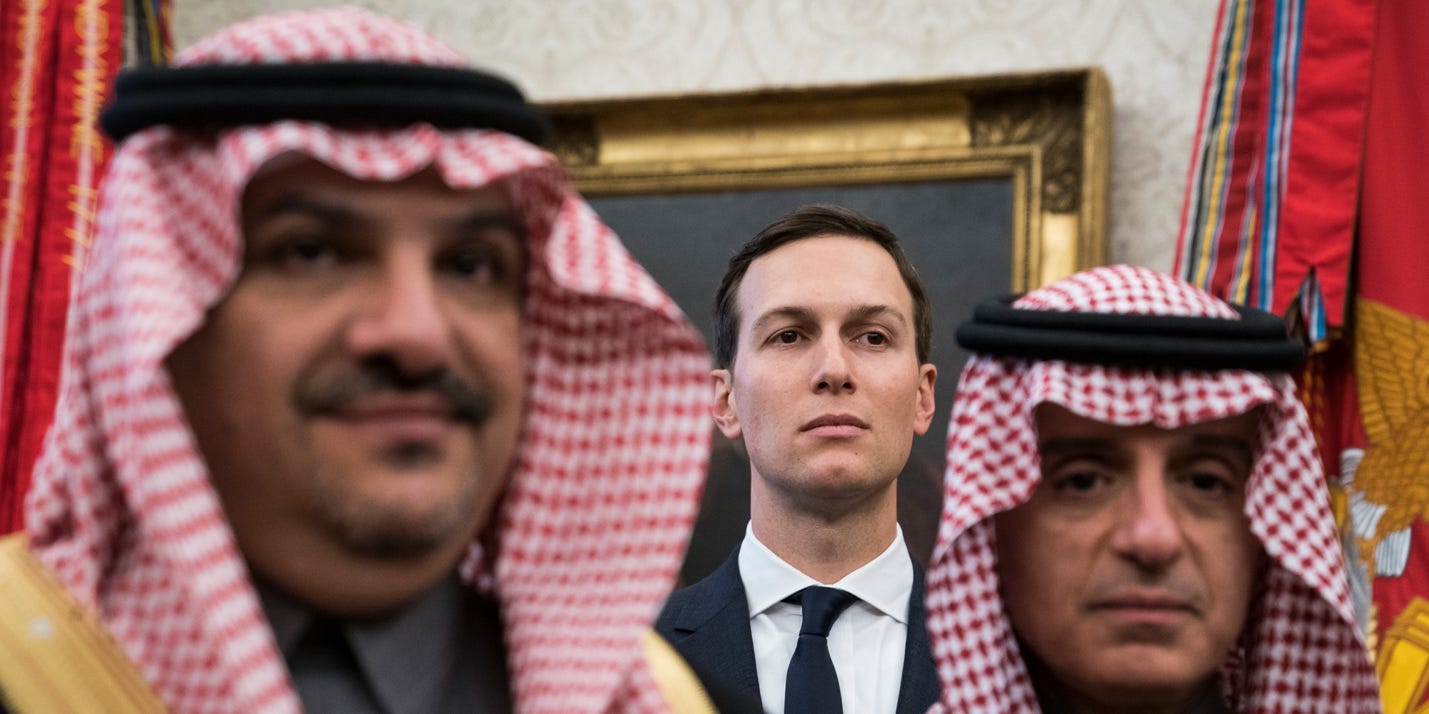
Meanwhile Jared Kushner, the First Son-in-Law, has been acting as one of the U.S. government’s chief negotiators on the Middle East while also raising large sums of money for his personal investment firm from investors in the region, especially the Saudi government’s Public Investment Fund. That fund is led by Crown Prince Mohammed bin Salman, who is widely believed to have had a critical journalist, Jamal Khashoggi, dismembered with a bone saw.
Why does Gulf oil money play an outsized role in U.S. corruption? Because petrostates, unlike advanced democracies, combine vast wealth with secrecy and a complete blurring of the lines between public office and private gain. So they’re better placed than anyone else to line U.S. officials’ pockets.
Foreign oil money, then, has been central to both the Trump administration’s economic schemes and Trump’s personal financial schemes. What has that money bought in terms of U.S. policy?
I’ve mentioned the Trump administration’s fanatical hostility to renewable energy. Like the Iran war, this hostility surely has multiple causes. Trump himself is still angry about the offshore wind farm that is visible from his Scotland golf course. Many MAGA types clearly think of wind and solar power as woke and unmanly; real men drill, baby, drill and burn, baby, burn. But suppressing alternatives to fossil fuels is also in the interests of governments and dynasties whose wealth is all about fossil fuels.
As the Guardian notes,
“For decades, Saudi Arabia has fought harder than any other country to block and delay international climate action – a diplomatic “wrecking ball” saying that abandoning fossil fuels is a fantasy.”
So the Trump administration’s energy policy can be seen as what Prince bin Salman would do if he were in charge. Is he?
Finally, about the war: As the bombing began, the Washington Post reported that foreign influence — and not just from Israel — played a role:
“President Donald Trump launched Saturday’s wide-ranging attack on Iran after a weeks-long lobbying effort by an unusual pair of U.S. allies in the Middle East — Israel and Saudi Arabia — according to four people familiar with the matter, as Israeli and U.S. forces teamed to topple Iranian Supreme Leader Ali Khamenei after nearly four decades in power.
Saudi Crown Prince Mohammed bin Salman made multiple private phone calls to Trump over the past month advocating a U.S. attack, despite his public support for a diplomatic solution.”
At this point bin Salman is surely regretting his role in promoting the war. But being corrupt and good at corrupting others is not the same thing as being smart.
Again, it’s a mistake to look for monocausal explanations of this debacle. But if you want to understand Operation Epic FUBAR, don’t forget to follow the oil money.
Donald Trump, il Petropresidente,
Perché Donald Trump ha attaccato l’Iran? Credeva forse che una rapida vittoria avrebbe incrementato i suoi consensi nei sondaggi? Cercava un modo per distogliere l’attenzione dal caso Epstein e dalla questione dell’accessibilità economica? È stato forse spinto alla guerra dal governo israeliano?
La risposta, senza dubbio, sono tutte le precedenti. Le decisioni sbagliate non hanno necessariamente una sola spiegazione. Anzi, disastri della portata di quelli che stiamo vivendo ora di solito hanno molteplici cause.
Ma quando guardo al quadro generale delle politiche dell’amministrazione Trump, non solo all’attacco all’Iran, ma anche alle politiche interne, in particolare all’odio apparentemente irrazionale dell’amministrazione per le energie rinnovabili e alla sua determinazione a far sì che l’America continui a bruciare combustibili fossili a qualunque costo, continuo a tornare con la mente all’enorme influenza esercitata oggi dal denaro del petrolio.
Non mi riferisco principalmente all’industria petrolifera nazionale statunitense, sebbene anche quella sia inclusa. Il settore petrolifero e del gas degli Stati Uniti ha speso ingenti somme per sostenere i Repubblicani nelle elezioni del 2024, dando ben poco ai Democratici [1].
Ma ciò che spicca davvero è la centralità dei proventi del petrolio del Golfo Persico, denaro che si è rivelato cruciale in due ambiti: i progetti economici internazionali di Trump e il suo arricchimento personale.
Un tema ricorrente nei discorsi economici di Trump è stato vantarsi dell’entità degli impegni di investimento estero ricevuti nell’ambito della sua strategia tariffaria. “In 12 mesi”, ha dichiarato nel discorso sullo Stato dell’Unione , “ho ottenuto impegni per oltre 18 trilioni di dollari provenienti da tutto il mondo”.
Nessuno sa da dove provenga quella cifra di 18 trilioni di dollari, che cita continuamente. Gli impegni effettivi annunciati dai governi stranieri per investire negli Stati Uniti ammontano a soli 6 trilioni di dollari circa , e molti di questi impegni sono vaghe dichiarazioni di intenti piuttosto che seri propositi. Anzi, l’accordo con l’Europa potrebbe addirittura sgretolarsi in parte perché i dazi di Trump sono stati dichiarati illegali.
Ma ciò che è particolarmente interessante è chi ha preso questi impegni di investimento, per quanto di questo tipo:
Ciascuno dei principali stati petroliferi del Golfo si è impegnato a investire più dell’intera Unione Europea, pur avendo economie di gran lunga più piccole. Ecco un’altra rappresentazione grafica:
Quindi, quando Trump si vanta degli investimenti stranieri che sta portando in America, la realtà è che, per lo più, gli stati petroliferi del Golfo hanno affermato – con dubbia credibilità – che effettueranno ingenti investimenti. Questo getta una luce diversa sulle sue vanterie, non è vero?
E poi c’è l’uso implacabile che Trump fa della sua carica per arricchire se stesso e la sua famiglia. Come documentato dal comitato editoriale del New York Times , Trump ha incassato almeno 1,4 miliardi di dollari dal suo ritorno alla Casa Bianca. La parte più consistente di questa somma è rappresentata dal regalo del Qatar: un jet privato da 400 milioni di dollari. Gran parte del resto proviene dalla vendita di criptovalute. Non sappiamo chi siano gli acquirenti delle criptovalute di Trump, ma sembra probabile che i proventi del petrolio del Golfo abbiano rappresentato una quota significativa. Il Wall Street Journal riporta che un membro della famiglia reale di Abu Dhabi ha investito segretamente 500 milioni di dollari in World Liberty Financial, il centro dell’impero delle criptovalute di Trump.
Nel frattempo, Jared Kushner, il genero del presidente, ha svolto il ruolo di uno dei principali negoziatori del governo statunitense per il Medio Oriente, raccogliendo al contempo ingenti somme di denaro per la sua società di investimento personale da investitori della regione, in particolare dal Fondo di investimento pubblico del governo saudita. Tale fondo è guidato dal principe ereditario Mohammed bin Salman, che è ampiamente ritenuto responsabile dello smembramento del giornalista critico Jamal Khashoggi con una sega per ossa .
Perché il denaro proveniente dal petrolio del Golfo gioca un ruolo così preponderante nella corruzione negli Stati Uniti? Perché gli stati petroliferi, a differenza delle democrazie avanzate, combinano immense ricchezze con la segretezza e una totale confusione tra carica pubblica e profitto privato. Pertanto, sono nella posizione migliore per riempire le tasche dei funzionari statunitensi.
Il denaro proveniente dal petrolio estero è stato dunque fondamentale sia per i piani economici dell’amministrazione Trump sia per quelli finanziari personali dello stesso Trump. Cosa ha prodotto, in termini di politica statunitense, questo denaro?
Ho già accennato all’ostilità fanatica dell’amministrazione Trump nei confronti delle energie rinnovabili. Come la guerra con l’Iran, questa ostilità ha sicuramente molteplici cause. Lo stesso Trump è ancora infuriato per il parco eolico in mare aperto visibile dal suo campo da golf in Scozia. Molti sostenitori del movimento MAGA considerano chiaramente l’energia eolica e solare come qualcosa di “woke” [3] e poco virile; i veri uomini trivellano, trivellano e bruciano, trivellano e bruciano. Ma sopprimere le alternative ai combustibili fossili è anche nell’interesse dei governi e delle dinastie la cui ricchezza deriva proprio dai combustibili fossili.
Come fa notare il Guardian ,
“Per decenni, l’Arabia Saudita ha lottato più di qualsiasi altro Paese per bloccare e ritardare l’azione internazionale sul clima, agendo come una “palla da demolizione” diplomatica e sostenendo che abbandonare i combustibili fossili sia un’utopia.”
Quindi la politica energetica dell’amministrazione Trump può essere vista come ciò che farebbe il principe bin Salman se fosse al potere. Lo è davvero?
Infine, riguardo alla guerra: all’inizio dei bombardamenti, il Washington Post riportò che l’influenza straniera, e non solo quella israeliana, aveva giocato un ruolo importante.
“Secondo quanto riferito da quattro persone a conoscenza dei fatti, il presidente Donald Trump ha lanciato sabato un attacco su vasta scala contro l’Iran dopo settimane di pressioni da parte di una coppia insolita di alleati degli Stati Uniti in Medio Oriente: Israele e Arabia Saudita, mentre le forze israeliane e statunitensi collaboravano per rovesciare la Guida Suprema iraniana Ali Khamenei dopo quasi quarant’anni al potere.
Il principe ereditario saudita Mohammed bin Salman ha effettuato diverse telefonate private a Trump nel corso dell’ultimo mese, auspicando un attacco statunitense, nonostante il suo sostegno pubblico a una soluzione diplomatica.”
A questo punto, bin Salman si starà sicuramente pentendo del suo ruolo nel promuovere la guerra. Ma essere corrotti e bravi a corrompere gli altri non è la stessa cosa che essere intelligenti.
Anche in questo caso, è un errore cercare spiegazioni monocausali di questa debacle. Ma se si vuole comprendere l’Operazione Epic FUBAR [4], non bisogna dimenticare di seguire il flusso di denaro proveniente dal petrolio.
[1] La connessione nei testi rimanda ad una interessante tabella (fonte Open Secrets) sui finanziamenti elettorali dagli anni ‘990 ad oggi. In particolare sono aumentati i finanziamenti più deregolamentati, di circa 150 volte.
[2] Gli ‘impegni’ ad investire dei vari paesi e regioni. Solo i tre paesi arabi citati hanno assunto impegni per 3.800 miliardi di dollari, pari a circa sette volte quelli dell’intera Unione Europea, peraltro assai dubbi.
Oppure, come mostra la tabella successiva, pari a quasi due volte quelli di tutti i paesi avanzati.
[3] Il termine woke è un aggettivo inglese (participio passato di wake, “svegliare”) che significa “sveglio” o “all’erta”. Indica una spiccata consapevolezza riguardo alle ingiustizie sociali, in particolare il razzismo, le disuguaglianze di genere. Originariamente legato alla cultura afroamericana come invito a non abbassare la guardia (stay woke), oggi è soprattutto usato dalla destra in modo dispregiativo per indicare la cultura radicale di sinistra.
[4] La guerra è stata chiamata “Furia Epica” (“Epic Fury”). Krugman sostituisce la “furia” con il “FUBAR”.
FUBAR è un acronimo militare inglese nato durante la Seconda Guerra Mondiale, che sta per “Fucked Up Beyond All Repair/Recognition” (Fottuto/rovinato oltre ogni possibilità di riparazione o riconoscimento). Indica una situazione, un piano o un oggetto talmente danneggiato, caotico o malfunzionante da essere ormai irrecuperabile.
Costi e benefici della nuova crisi energetica. Ci sono molti perdenti, ma anche alcuni vincitori. Di Paul Krugman (dal blog di Krugman, 15 marzo 2026)
marzo 17, 2026
Mar 15, 2026
Costs and Benefits from the New Energy Crisis
There are many losers, but also some winners

Operation Epic Fury, the U.S.-Israeli bombing campaign against Iran, began on Feb. 28. At first, the reaction of energy markets was muted. As the days passed, however, it became clear that the air strike that killed much of the Iranian regime’s top leadership had not broken that regime’s grip on power. It also became clear that despite heavy bombing the regime retained the ability to launch drones and missiles at energy facilities and shipping in the Persian Gulf. More than two weeks after the war began, the Strait of Hormuz, a crucial choke point for world energy supplies, remains effectively closed, and nobody knows when it will reopen.
Inevitably, given these events, the prices of oil, liquefied natural gas, and fertilizer produced from natural gas have soared.
I wrote about the possible economic consequences of such price shocks last week. It has become clear to me, however, that it would be useful to provide a sort of prequel to that discussion: a review of how global energy markets work, the factors determining energy prices, and the distribution of losses and gains — for there are some winners even from bad news — as oil prices soar.
Some of the winners are obvious: Russia and oil producers everywhere except in the Persian Gulf. The losers may come as a surprise: American consumers are being hit hard even though the US produces more oil and natural gas than it consumes, while China, despite its dependence on imported hydrocarbons, is relatively insulated from this shock.
Beyond the paywall I will address the following
- Tankers, pipelines and the geography of energy
- How high can energy prices go?
- Why domestic oil production doesn’t protect consumers
- The importance of oil intensity
Tankers, pipelines and the geography of energy
There are two main hydrocarbons that matter for the world economy: Oil and natural gas. Large amounts of both are currently bottled up inside the Strait of Hormuz. However, the global distribution of pain from this blockade is different for the two fuels.
Oil is normally easy to transport either overland, via pipelines, or by sea in tankers. This ease of transportation creates a global market in which prices in different regions can’t get too far apart, because any large divergence creates an incentive to divert supplies to the high-price locations. Notably, oil extracted from U.S. shale can be shipped either via pipeline to domestic markets or overseas to European markets. This possibility of arbitrage has kept the world’s two leading benchmark prices for oil, West Texas Intermediate in the U.S. and Brent in Europe, rising in tandem since the war began:

By the way, these are prices at the end of the day, and some of the small differences in daily changes you see reflect nothing more than time zone differences in a highly volatile market.
The fact that there is a global market for oil explains why U.S. oil prices and the prices of oil-derived products, most visibly gasoline but also diesel, jet fuel and more have soared even though America buys very little oil from the Middle East.
Natural gas is a different story. Gas can be cheaply transported by pipeline, but it’s very difficult to run pipelines under the ocean. True, the UK has pipelines to deliver gas from Norway and the Low Countries, but there are no pipelines linking Europe and North America or the Middle East with Asia. To transport gas by sea, it must be cooled to a liquid and shipped on special ships to and from specialized facilities, which have limited capacity.
The limits on ocean shipping of LNG mean that markets for natural gas are regional rather than global. Europe and Asia, which import LNG, have been hit hard by the cutoff of LNG from the Persian Gulf, while the United States gas market, served from domestic sources by pipelines, has seen only a modest rise in prices. The chart below shows percentage changes in oil and gas prices since Feb. 27, where the US gas price is the Henry Hub price while Europe is the Dutch TTF price:

The fact that Europe has been hit much harder than the U.S. by the threat to natural gas prices would lead us to expect more damage from the Iran war to the European than the U.S. economy, other things equal. However, as I’ll explain in the final part of this primer, other things aren’t equal, and America’s high “oil intensity” pushes the other way.
Finally, one other commodity whose price has soared since the Iran war began may come as a surprise: urea, a crucial fertilizer. What’s that about? Urea is produced from natural gas — and gas is normally cheap in the Persian Gulf, because it’s expensive to ship it out even when drones and mines aren’t threatening shipping. So the region produces and exports a lot of urea, accounting for nearly half the world’s traded supply.
And while the US doesn’t import natural gas, it imports a large share of its fertilizer. So urea prices have risen sharply, even in the United States — about 30 percent so far.
Furthermore, there are good reasons to worry that the price increases so far may be only the beginning.
How high can prices go?
It’s a cliché to assert that some event or policy change takes us into uncharted territory. Yet the Iran war has done just that, literally. By cutting off all shipments through the Strait of Hormuz — shipments that supplied 20 percent of the world’s oil — the war has inflicted a shock to world oil supplies that is, as Donald Trump might put it, like nothing anyone has ever seen before. You can look at charts of previous energy crises; they don’t show anything like this.
In fact, let me steal reproduce a chart from Matthew Klein’s invaluable newsletter The Overshoot, in which he shows global oil consumption (which equals world oil production) during the infamous energy crises of the 1970s:

The 1973 Arab oil embargo only caused a small decline in global oil output, although the shortfall was larger if you compare it with the pre-crisis trend. The 1979 Iranian revolution was followed by a somewhat larger production decline, but as I explained last week this largely reflected production cuts by Saudi Arabia as the kingdom tried to keep prices high in the face of declining world demand. Neither episode involved anything like a sudden 20 percent reduction in world oil supply.
Now, the effects of the closure of the Strait of Hormuz may be somewhat mitigated by diversion of Saudi production via pipeline to the Red Sea, although the pipeline’s capacity is limited — and Iran’s Houthi allies may disrupt that route too. There may be small additional supplies from other producers, as well as a gradual release of oil from emergency reserves around the world. But even so, continued blockage of the Strait will soon cause a global oil shortage much more severe than any previous oil crisis.
So what will happen? Prices will rise until they are high enough to persuade or force people around the world to burn much less oil. In the bloodless language of textbook economics, we’ll have to move up the demand curve until the quantity demanded has been reduced to match the reduced quantity supplied. In the more graphic language of market analysts, prices will have to rise enough to cause widespread “demand destruction.”
How high will prices have to go to cause sufficient demand destruction? Very, very high, because the short-run demand for oil is highly “inelastic,” that is, doesn’t respond much to even large price increases.
Consider consumption of gasoline. In the long run high gas prices will induce people to buy more fuel-efficient cars, including hybrids and electric vehicles. High prices can even induce people to arrange their lives so that they don’t need to drive everywhere. In the short run, however, the only way to reduce gasoline consumption is to drive less. And people who have to get to work, pick up their children, etc. find that very difficult even in the face of large increases in gas prices.
The chart below shows 12-month lagging averages of the price of gasoline and vehicle-miles traveled over the past 5 years:

Source: FRED
There was a large runup in gasoline prices during 2022, reflecting both Russia’s invasion of Ukraine and some problems at major refineries. This surge in prices had no visible effect on miles driven. A careful analysis that takes other factors into account would surely show some effect of gas prices on demand, but it was clearly small.
Now we’re in a situation in which the world as a whole must, one way or another, drive substantially less or find other ways to burn less oil, because unless the Strait of Hormuz is opened soon the oil simply won’t be available. To achieve demand destruction on that scale would clearly require driving the price of gasoline well above 2022 levels, which would in turn require world oil prices well above $150 a barrel, quite possibly well above $200 a barrel.
Unless the Strait is opened soon — and while this post isn’t about geopolitics, it’s very hard to see how that will happen — the energy situation will soon become very ugly.
But ugly for whom?
The irrelevance of domestic oil production
President Trump raised eyebrows with a social media post Wednesday in which he argued that soaring oil prices are a good thing:
“The United States is the largest Oil Producer in the World, by far, so when oil prices go up, we make a lot of money.”
He wasn’t wrong about the U.S. being the world’s largest oil producer. We are, however, also the world’s largest oil consumer, which should curb our enthusiasm. Still, the U.S. produces more oil than it consumes. Doesn’t that mean that on net we gain from higher oil prices?
The answer is, what do you mean by “we”?
A rise in oil prices, which leads in turn to higher prices of gasoline, diesel, and heating oil, hurts U.S. consumers. On the other hand, U.S. oil producers do indeed “make a lot of money,” a gain that ultimately accrues to their stockholders.
A new report from the investment bank Jeffries estimates that if oil stays near $100 a barrel this will generate more than $60 billion in windfall gains for US oil companies. If oil prices go much higher, as I’ve suggested they may, the gains will be much bigger.
The crucial point is that even within the United States, consumers and the beneficiaries of higher oil prices are different people. I don’t know of data on who exactly owns oil-company stock, but if the composition of ownership resembles ownership of U.S. equities in general, a large fraction — possibly as high as 40 percent — is owned by foreigners, and of the share owned by U.S. residents, almost 90 percent is owned by the richest 10 percent, half by the richest 1 percent.
Before the Iran war, some commentators argued that the U.S. was well positioned to weather a shock to oil prices, because as a nation we are more than self-sufficient in oil, indeed a net exporter. But this self-sufficiency is irrelevant to the great majority of U.S. households, who are hurt by higher prices at the pump while having little or no share in the gains to domestic oil producers. In this sense U.S. households are in the same position as households in, say, Europe or Japan, even though the U.S. is a major oil producer and most other nations are not.
Is domestic production of oil always irrelevant to most people? No.
In the 1970s the U.S. imposed price controls on both oil producers and refiners as oil prices soared. These price controls had problems — they led to shortages and the infamous gas lines — but did initially limit the hardship faced by families. When the controls were gradually lifted beginning in 1979, they were followed by an excess profits tax (actually an excise tax on domestic oil) designed to capture part of the gains to oil companies.
Today, with America a net exporter of oil, the U.S. government could devise policies that would largely insulate U.S. households from the Iran war shock. But it’s hard to imagine either price controls or excess profits taxes being imposed in the current U.S. political environment.
The politics of oil prices are different in other nations. China has price controls on gasoline and other energy products that will insulate consumers if the world oil price rises above $130 a barrel. And Russia, the world’s second largest oil exporter after Saudi Arabia, has a “mineral extraction tax” tied to world oil prices, which means that soaring oil prices translate into a large gain in Russian government revenue.
Under the current rules of the game, then, the disruption of oil supplies resulting from the Iran war will hurt consumers around the world, even if they are living in countries with large domestic oil production. Companies that produce oil, and hence their stockholders, will gain. And the Russian government will be a major beneficiary.
That being said, the impact on consumers will vary around the world, because there are significant differences in how much oil nations consume relative to the size of their economies: The U.S. economy is “oil-intensive” compared with Europe and especially China.
The importance of oil intensity
Rosemary Kelanic at Defense Priorities had a good op-ed in the Times about the importance of oil intensity when assessing the impacts of the Iran war. I wrote early in the war about how the economy’s oil intensity has declined since the 1970s and why that matters. But I worry that the concept may seem abstract and could use more explanation. I also think it would be useful to offer a brief explanation of the reasons the U.S. economy is more oil-intensive than the economies of other nations.
The raw fact is that other nations consume much less oil per capita than the United States. The European Union consumes less than half as much; China only about a fifth as much. However, residents of other nations also have lower incomes than Americans. In the case of Europe roughly half of this income gap is explained by shorter work hours — Europeans take vacations! — and much of the rest can be attributed to a handful of U.S. technology and financial clusters, but that’s another story. China is simply poorer, despite its rapid economic growth. The point, however, is that the difference in oil consumption is substantially bigger than the difference in per capita GDP:

Relative oil intensity is just the ratio of oil consumption to GDP. The European and Chinese economies are both only about two-thirds as oil-intensive as the US economy.
What this means is that a spike in oil prices hits U.S. consumers harder than it hits European or Chinese consumers. This is true even though America is self-sufficient in oil while other major economies are not.
Now, because Europe and China import LNG, natural gas prices are rising sharply in their economies while mostly unaffected in the US. Even so, the overall negative effect of the Iran crisis on US consumers is probably larger than the effect overseas. Again, this is happening even though America is a net oil exporter.
Why are other economies less oil-intensive than the U.S. economy? Part of the answer is that they have been faster to adopt renewable energy, with China’s rapid move to electric cars especially impressive. But that’s a relatively recent factor. The longer-term reason for the difference is that the U.S. has long had exceptionally low taxes on gasoline, and as a result low gas prices:

Low US gas prices lead to somewhat more driving in the United States, as well as a more car-dependent lifestyle. Above all, however, Americans drive bigger, less fuel-efficient vehicles than citizens of other advanced nations. And this leaves us more exposed when faced with a major disruption to world oil markets.
To summarize: Because there is effectively a single market for oil, US households are facing the same price shock as residents of other nations, even though the US is a net exporter of oil. We are somewhat insulated from the rise in prices of liquefied natural gas, but also exposed to a sharp rise in fertilizer prices. And it seems all too possible that the surge in oil prices has just begun, that prices will go much higher than they are.
There are some winners from the Iran war oil disruption: mainly oil producing companies and the Russian government. That’s cold comfort to ordinary families.
And U.S. families are arguably even more exposed than their counterparts in other advanced economies because of the U.S. economy’s high oil intensity.
I wish I could paint a less depressing picture, but that’s where we are as the war enters its third week.
Costi e benefici della nuova crisi energetica
Ci sono molti perdenti, ma anche alcuni vincitori.
L’operazione Epic Fury, la campagna di bombardamenti israelo-americana contro l’Iran, è iniziata il 28 febbraio. Inizialmente, la reazione dei mercati energetici è stata contenuta. Con il passare dei giorni, tuttavia, è diventato chiaro che l’attacco aereo che ha ucciso buona parte dei vertici del regime iraniano non aveva spezzato la presa del regime sul potere. È diventato altrettanto chiaro che, nonostante i pesanti bombardamenti, il regime manteneva la capacità di lanciare droni e missili contro impianti energetici e navi nel Golfo Persico. A più di due settimane dall’inizio della guerra, lo Stretto di Hormuz, punto di strozzatura cruciale per gli approvvigionamenti energetici mondiali, rimane di fatto chiuso e nessuno sa quando verrà riaperto.
Inevitabilmente, a seguito di questi eventi, i prezzi del petrolio, del gas naturale liquefatto e dei fertilizzanti derivati dal gas naturale sono schizzati alle stelle.
La settimana scorsa ho scritto delle possibili conseguenze economiche di tali shock tariffari. Mi è però apparso chiaro che sarebbe utile fornire una sorta di premessa a quella discussione: una panoramica sul funzionamento dei mercati energetici globali, sui fattori che determinano i prezzi dell’energia e sulla distribuzione di perdite e guadagni – perché ci sono vincitori anche dalle cattive notizie – con l’impennata dei prezzi del petrolio.
Alcuni dei vincitori sono evidenti: la Russia e i produttori di petrolio ovunque tranne che nel Golfo Persico. I perdenti potrebbero essere una sorpresa: i consumatori americani stanno subendo un duro colpo nonostante gli Stati Uniti producano più petrolio e gas naturale di quanto ne consumino, mentre la Cina, nonostante la sua dipendenza dagli idrocarburi importati, è relativamente al riparo da questo shock.
Oltre il limite per i non sottoscrittori tratterò i seguenti argomenti
- Petroliere, oleodotti e la geografia dell’energia
- Fino a che punto possono arrivare i prezzi dell’energia?
- Perché la produzione petrolifera nazionale non tutela i consumatori
- L’importanza dell’intensità del petrolio
Petroliere, oleodotti e la geografia dell’energia
Per l’economia mondiale sono fondamentali due tipi di idrocarburi: il petrolio e il gas naturale. Attualmente, grandi quantità di entrambi sono intrappolate nello Stretto di Hormuz. Tuttavia, l’impatto di questo blocco a livello globale è differente per i due combustibili.
Il petrolio è generalmente facile da trasportare via terra, tramite oleodotti, o via mare con petroliere. Questa facilità di trasporto crea un mercato globale in cui i prezzi nelle diverse regioni non possono discostarsi eccessivamente, poiché qualsiasi divergenza significativa incentiva a dirottare le forniture verso le aree con i prezzi più elevati. In particolare, il petrolio estratto dagli scisti bituminosi statunitensi può essere spedito tramite oleodotti ai mercati nazionali o via mare verso i mercati europei. Questa possibilità di arbitraggio ha fatto sì che i due principali prezzi di riferimento mondiali per il petrolio, il West Texas Intermediate negli Stati Uniti e il Brent in Europa, aumentassero di pari passo dall’inizio della guerra.
Tra l’altro, questi sono i prezzi di fine giornata, e alcune delle piccole differenze nelle variazioni giornaliere che si osservano non sono altro che dovute ai fusi orari in un mercato altamente volatile.
Il fatto che esista un mercato globale per il petrolio spiega perché i prezzi del petrolio negli Stati Uniti e dei prodotti derivati, in particolare la benzina, ma anche il gasolio, il carburante per aerei e altro ancora, siano schizzati alle stelle, nonostante gli Stati Uniti acquistino pochissimo petrolio dal Medio Oriente.
Il gas naturale è un discorso a parte. Il gas può essere trasportato a basso costo tramite gasdotti, ma è molto difficile costruire gasdotti sotto l’oceano. È vero che il Regno Unito ha gasdotti per il trasporto del gas dalla Norvegia e dai Paesi Bassi, ma non esistono gasdotti che colleghino l’Europa al Nord America o il Medio Oriente all’Asia. Per trasportare il gas via mare, è necessario raffreddarlo fino a renderlo liquido e caricarlo su navi speciali da e verso impianti specializzati, che hanno una capacità limitata.
Le limitazioni al trasporto marittimo di GNL implicano che i mercati del gas naturale siano regionali anziché globali. L’Europa e l’Asia, che importano GNL, sono state duramente colpite dall’interruzione delle forniture di GNL dal Golfo Persico, mentre il mercato del gas statunitense, alimentato da fonti interne tramite gasdotti, ha registrato solo un modesto aumento dei prezzi. Il grafico seguente mostra le variazioni percentuali dei prezzi del petrolio e del gas dal 27 febbraio, dove il prezzo del gas negli Stati Uniti è il prezzo Henry Hub, mentre in Europa è il prezzo TTF olandese:
Il fatto che l’Europa sia stata colpita molto più duramente degli Stati Uniti dalla minaccia ai prezzi del gas naturale ci porterebbe ad aspettarci maggiori danni dall’economia europea a causa della guerra con l’Iran rispetto a quella statunitense, a parità di altre condizioni. Tuttavia, come spiegherò nella parte finale di questa introduzione, le altre condizioni non sono uguali, e l’elevata “intensità di petrolio” degli Stati Uniti spinge nella direzione opposta.
Infine, un’altra materia prima il cui prezzo è schizzato alle stelle dall’inizio della guerra con l’Iran potrebbe sorprendere: l’urea, un fertilizzante fondamentale. Come mai? L’urea viene prodotta dal gas naturale, e il gas è normalmente economico nel Golfo Persico, perché è costoso trasportarlo anche quando droni e mine non minacciano le rotte marittime. Pertanto, la regione produce ed esporta grandi quantità di urea, rappresentando quasi la metà dell’offerta mondiale.
Sebbene gli Stati Uniti non importino gas naturale, importano una quota considerevole dei fertilizzanti di cui necessitano. Di conseguenza, i prezzi dell’urea sono aumentati vertiginosamente, anche negli Stati Uniti, di circa il 30% finora.
Inoltre, ci sono validi motivi per temere che gli aumenti di prezzo registrati finora siano solo l’inizio.
Fino a che punto possono arrivare i prezzi?
È un cliché affermare che un evento o un cambiamento di politica ci porti in un territorio inesplorato. Eppure la guerra con l’Iran ha fatto proprio questo, letteralmente. Interrompendo tutti i trasporti attraverso lo Stretto di Hormuz – trasporti che rifornivano il 20% del petrolio mondiale – la guerra ha inflitto uno shock alle forniture petrolifere globali che, come direbbe Donald Trump, non ha precedenti. Si possono guardare i grafici delle precedenti crisi energetiche; non mostrano nulla di simile.
Permetetemi, infatti, di (rubare) riprodurre un grafico tratto dalla preziosa newsletter di Matthew Klein, The Overshoot , in cui egli mostra il consumo globale di petrolio (che corrisponde alla produzione mondiale di petrolio) durante le famigerate crisi energetiche degli anni ’70:
L’embargo petrolifero arabo del 1973 causò solo un lieve calo della produzione petrolifera mondiale, sebbene la diminuzione fosse maggiore se confrontata con l’andamento pre-crisi. La rivoluzione iraniana del 1979 fu seguita da un calo della produzione leggermente più consistente, ma come ho spiegato la settimana scorsa, ciò rifletteva in gran parte i tagli alla produzione operati dall’Arabia Saudita nel tentativo di mantenere alti i prezzi a fronte del calo della domanda mondiale. Nessuno dei due episodi comportò una riduzione improvvisa del 20% dell’offerta mondiale di petrolio.
Ora, gli effetti della chiusura dello Stretto di Hormuz potrebbero essere in qualche modo attenuati dalla deviazione della produzione saudita verso il Mar Rosso tramite un oleodotto, sebbene la capacità dell’oleodotto sia limitata e gli alleati Houthi dell’Iran potrebbero interrompere anche questa rotta. Potrebbero esserci piccole forniture aggiuntive da altri produttori, così come un graduale rilascio di petrolio dalle riserve di emergenza in tutto il mondo. Ma anche così, il blocco prolungato dello Stretto causerà presto una carenza globale di petrolio ben più grave di qualsiasi precedente crisi petrolifera.
Cosa succederà dunque? I prezzi saliranno fino a raggiungere livelli tali da persuadere o costringere le persone in tutto il mondo a consumare molto meno petrolio. Nel linguaggio asettico dell’economia di base, dovremo spostarci verso l’alto della curva della domanda fino a quando la quantità domandata non si sarà ridotta in modo da eguagliare la quantità offerta ridotta. Nel linguaggio più crudo degli analisti di mercato, i prezzi dovranno aumentare a tal punto da causare una ” distruzione della domanda ” diffusa.
Fino a che punto dovranno salire i prezzi per causare una distruzione sufficiente della domanda? Molto, molto in alto, perché la domanda di petrolio a breve termine è altamente “anelastica”, ovvero non reagisce in modo significativo nemmeno a forti aumenti di prezzo.
Consideriamo il consumo di benzina. A lungo termine, i prezzi elevati della benzina indurranno le persone ad acquistare auto più efficienti dal punto di vista dei consumi, comprese le ibride e i veicoli elettrici. I prezzi elevati potrebbero persino spingere le persone a organizzare la propria vita in modo da non dover usare l’auto per ogni spostamento. Nel breve periodo, tuttavia, l’unico modo per ridurre il consumo di benzina è guidare di meno. E per chi deve andare al lavoro, accompagnare i figli a scuola, ecc., questo risulta molto difficile, anche a fronte di forti aumenti dei prezzi della benzina.
Il grafico seguente mostra le medie, con un ritardo di 12 mesi, del prezzo della benzina e dei chilometri percorsi dai veicoli negli ultimi 5 anni:
[5] Fonte: FRED
Nel 2022 si è registrato un forte aumento dei prezzi della benzina, dovuto sia all’invasione russa dell’Ucraina sia ad alcuni problemi riscontrati nelle principali raffinerie. Questo aumento dei prezzi non ha avuto alcun effetto visibile sui chilometri percorsi. Un’analisi più accurata, che tenga conto di altri fattori, mostrerebbe sicuramente un qualche impatto dei prezzi della benzina sulla domanda, ma questo è risultato chiaramente limitato.
Ora ci troviamo in una situazione in cui il mondo intero deve, in un modo o nell’altro, guidare molto meno o trovare altri modi per bruciare meno petrolio, perché a meno che lo Stretto di Hormuz non venga riaperto presto, il petrolio semplicemente non sarà disponibile. Per ottenere una distruzione della domanda di tale portata sarebbe chiaramente necessario far salire il prezzo della benzina ben oltre i livelli del 2022, il che a sua volta richiederebbe prezzi mondiali del petrolio ben superiori a 150 dollari al barile, molto probabilmente ben oltre i 200 dollari al barile.
A meno che lo Stretto non venga aperto presto — e, sebbene questo post non tratti di geopolitica, è molto difficile immaginare come ciò possa accadere — la situazione energetica diventerà presto molto critica.
Ma critica per chi?
L’irrilevanza della produzione petrolifera nazionale
Il presidente Trump ha suscitato scalpore con un post sui social media pubblicato mercoledì, in cui sosteneva che l’impennata dei prezzi del petrolio sia una cosa positiva :
“Gli Stati Uniti sono di gran lunga il più grande produttore di petrolio al mondo, quindi quando i prezzi del petrolio aumentano, guadagniamo un sacco di soldi.”
Non aveva torto nell’affermare che gli Stati Uniti sono il più grande produttore di petrolio al mondo. Siamo, tuttavia, anche il più grande consumatore di petrolio al mondo, il che dovrebbe frenare il nostro entusiasmo. Ciononostante, gli Stati Uniti producono più petrolio di quanto ne consumino. Questo non significa forse che, nel complesso, beneficiamo dell’aumento dei prezzi del petrolio?
La risposta è: cosa si intende con “noi”?
L’aumento dei prezzi del petrolio, che a sua volta comporta un aumento dei prezzi di benzina, gasolio e olio combustibile, danneggia i consumatori statunitensi. D’altro canto, i produttori di petrolio statunitensi “guadagnano davvero molto”, un profitto che in definitiva va a vantaggio dei loro azionisti.
Un nuovo rapporto della banca d’investimento Jeffries stima che, se il prezzo del petrolio si manterrà intorno ai 100 dollari al barile, le compagnie petrolifere statunitensi beneficeranno di oltre 60 miliardi di dollari di profitti straordinari. Se, come ho ipotizzato, i prezzi del petrolio dovessero salire ulteriormente, i guadagni sarebbero ancora maggiori.
Il punto cruciale è che, persino all’interno degli Stati Uniti, i consumatori e i beneficiari dell’aumento dei prezzi del petrolio sono persone diverse. Non conosco dati precisi su chi possiede le azioni delle compagnie petrolifere, ma se la composizione della proprietà rispecchia quella delle azioni statunitensi in generale, una quota consistente – forse fino al 40% – è detenuta da stranieri, e della quota posseduta dai residenti negli Stati Uniti, quasi il 90% è in mano al 10% più ricco della popolazione, e la metà all’1% più ricco.
Prima della guerra con l’Iran, alcuni commentatori sostenevano che gli Stati Uniti fossero ben posizionati per resistere a uno shock dei prezzi del petrolio, poiché, come nazione, siamo più che autosufficienti in termini di petrolio, anzi, siamo esportatori netti. Ma questa autosufficienza è irrilevante per la grande maggioranza delle famiglie statunitensi, che subiscono le conseguenze dell’aumento dei prezzi alla pompa pur avendo una quota minima o nulla dei guadagni dei produttori petroliferi nazionali. In questo senso, le famiglie statunitensi si trovano nella stessa situazione delle famiglie, ad esempio, in Europa o in Giappone, nonostante gli Stati Uniti siano un importante produttore di petrolio e la maggior parte degli altri paesi non lo sia.
La produzione interna di petrolio è sempre irrilevante per la maggior parte delle persone? No.
Negli anni ’70, a causa dell’impennata dei prezzi del petrolio, gli Stati Uniti imposero un controllo dei prezzi sia ai produttori che alle raffinerie. Questo controllo dei prezzi presentò dei problemi, causando carenze e le famigerate code ai distributori di benzina, ma inizialmente limitò le difficoltà economiche delle famiglie. Quando i controlli furono gradualmente revocati a partire dal 1979, venne introdotta una tassa sugli extraprofitti (in realtà un’accisa sul petrolio nazionale) concepita per appropriarsi di parte dei guadagni delle compagnie petrolifere.
Oggi, con gli Stati Uniti in qualità di esportatori netti di petrolio, il governo americano potrebbe elaborare politiche in grado di proteggere in larga misura le famiglie statunitensi dallo shock della guerra in Iran. Tuttavia, è difficile immaginare che nell’attuale contesto politico statunitense vengano imposti controlli sui prezzi o tasse sugli extraprofitti.
Le dinamiche politiche relative ai prezzi del petrolio variano da paese a paese. La Cina applica un controllo dei prezzi su benzina e altri prodotti energetici, proteggendo così i consumatori qualora il prezzo mondiale del petrolio superi i 130 dollari al barile. La Russia, secondo esportatore di petrolio al mondo dopo l’Arabia Saudita, ha invece una “tassa sull’estrazione mineraria” legata ai prezzi mondiali del petrolio, il che significa che un’impennata dei prezzi si traduce in un notevole aumento delle entrate per il governo russo .
Secondo le attuali regole del gioco, quindi, l’interruzione delle forniture petrolifere derivante dalla guerra con l’Iran danneggerà i consumatori di tutto il mondo, anche quelli che vivono in paesi con un’elevata produzione interna di petrolio. Le compagnie petrolifere, e di conseguenza i loro azionisti, ne trarranno vantaggio. E il governo russo sarà uno dei principali beneficiari.
Ciò detto, l’impatto sui consumatori varierà in tutto il mondo, perché ci sono differenze significative nella quantità di petrolio consumata dai paesi produttori in rapporto alle dimensioni delle loro economie: l’economia statunitense è “ad alta intensità di petrolio” rispetto all’Europa e soprattutto alla Cina.
L’importanza dell’intensità del petrolio
Rosemary Kelanic di Defense Priorities ha pubblicato un ottimo articolo di opinione sul Times sull’importanza dell’intensità petrolifera nella valutazione dell’impatto della guerra con l’Iran. All’inizio della guerra, ho scritto di come l’intensità petrolifera dell’economia sia diminuita dagli anni ’70 e del perché questo sia importante. Temo però che il concetto possa sembrare astratto e necessiti di maggiori spiegazioni. Ritengo inoltre utile offrire una breve spiegazione dei motivi per cui l’economia statunitense è più dipendente dal petrolio rispetto a quella di altri paesi.
Il dato di fatto è che altre nazioni consumano molto meno petrolio pro capite rispetto agli Stati Uniti. L’Unione Europea ne consuma meno della metà; la Cina solo circa un quinto. Tuttavia, i residenti di queste altre nazioni hanno anche redditi inferiori rispetto agli americani. Nel caso dell’Europa, circa la metà di questo divario di reddito è spiegata dalla riduzione dell’orario di lavoro – gli europei vanno in vacanza! – e gran parte del resto può essere attribuito a una manciata di poli tecnologici e finanziari statunitensi, ma questa è un’altra storia. La Cina è semplicemente più povera, nonostante la sua rapida crescita economica. Il punto, tuttavia, è che la differenza nel consumo di petrolio è sostanzialmente maggiore della differenza nel PIL pro capite:

L’intensità relativa di petrolio è semplicemente il rapporto tra consumo di petrolio e PIL. Le economie europea e cinese sono entrambe ad intensità di petrolio soltanto pari a circa due terzi di quella statunitense.
Ciò significa che un’impennata dei prezzi del petrolio colpisce i consumatori statunitensi più duramente rispetto a quelli europei o cinesi. Questo è vero nonostante gli Stati Uniti siano autosufficienti in termini di petrolio, a differenza di altre grandi economie.
Ora, poiché l’Europa e la Cina importano GNL, i prezzi del gas naturale stanno aumentando vertiginosamente nelle loro economie, mentre negli Stati Uniti rimangono sostanzialmente invariati. Ciononostante, l’effetto negativo complessivo della crisi iraniana sui consumatori statunitensi è probabilmente maggiore rispetto all’impatto all’estero. E tutto ciò accade nonostante gli Stati Uniti siano un esportatore netto di petrolio.
Perché altre economie sono meno dipendenti dal petrolio rispetto a quella statunitense? Parte della risposta risiede nella loro più rapida adozione delle energie rinnovabili, con la transizione della Cina verso le auto elettriche particolarmente impressionante. Ma questo è un fattore relativamente recente. La ragione a lungo termine di questa differenza è che gli Stati Uniti hanno a lungo mantenuto tasse sulla benzina eccezionalmente basse, e di conseguenza prezzi del carburante contenuti.

I bassi prezzi della benzina negli Stati Uniti portano a un maggiore utilizzo dell’auto e a uno stile di vita più dipendente dal veicolo. Soprattutto, però, gli americani guidano veicoli più grandi e meno efficienti dal punto di vista dei consumi rispetto ai cittadini di altre nazioni avanzate. E questo ci rende più vulnerabili in caso di gravi sconvolgimenti dei mercati petroliferi mondiali.
In sintesi: poiché di fatto esiste un mercato unico per il petrolio, le famiglie statunitensi stanno subendo lo stesso shock dei prezzi dei residenti di altri paesi, nonostante gli Stati Uniti siano un esportatore netto di petrolio. Siamo in qualche modo al riparo dall’aumento dei prezzi del gas naturale liquefatto, ma siamo anche esposti a un forte aumento dei prezzi dei fertilizzanti. E sembra fin troppo probabile che l’impennata dei prezzi del petrolio sia appena iniziata e che i prezzi saliranno ben oltre i livelli attuali.
Ci sono alcuni vincitori nell’interruzione delle forniture petrolifere causata dalla guerra con l’Iran: principalmente le compagnie petrolifere e il governo russo. Una magra consolazione per le famiglie comuni.
E le famiglie statunitensi sono probabilmente ancora più esposte rispetto alle loro controparti in altre economie avanzate a causa dell’elevata dipendenza dell’economia statunitense dal petrolio.
Vorrei poter dipingere un quadro meno deprimente, ma questa è la situazione in cui ci troviamo, ora che la guerra è entrata nella sua terza settimana.
[1] Andamenti medi mensili dei prezzi dei carburanti negli Stati Uniti, dal 15 settembre 2025 al 15 marzo 2026.
[2] Il barile è l’unità di misura di capacità usata per il petrolio greggio, in origine negli USA e poi internazionalmente, pari a 42 galloni cioè a circa 160 litri.
La tabella mostra le variazioni quotidiane delle ultime settimane dei prezzi dei “future” europei (Brent) e statunitensi (WTI).
I futures sul petrolio (oil futures) sono contratti finanziari standardizzati che impegnano le parti a comprare o vendere una quantità specifica di greggio (solitamente 1.000 barili) a un prezzo predeterminato in una data futura.
[3] Come si vede, l’impennata del prezzo è simile per il petrolio, ed è invece molto maggiore in Europa per il gas liquido.
[4] Le tre linee mostrano le conseguenze nei termini di minori consumi di petrolio di tre declini: l’embargo del petrolio arabo del 1973 (tratteggiata rossa, in alto); la rivoluzione iraniana del 1979 (tratteggiata rossa, nel mezzo); la tendenza a ‘vivere con meno petrolio’ negli ani 1975-78.
[5] In blu gli andamenti dei prezzi della benzina, in rosso gli andamenti in milioni di miglia dei viaggi con autoveicoli.
[6] La tabella mostra il PIL procapite europeo e cinese (in blu) in percentuale su quello statunitense, ed i consumi procapite di petrolio europei e cinesi (in celeste), sempre in percentuale sui consumi statunitensi.
Le percentuali di PIL procapite sono in entrambi i casi assai più elevate delle percentuali di consumi petroliferi, il che indica la grande ‘intensità di petrolio’ tipica dell’America. Le principali ragioni sono spiegate nell’articolo; tra esse, Krugman indica i prezzi bassi dei carburanti statunitensi, per effetto di una bassa tassazione, come mostrata nella tabella successiva.
I prezzi del petrolio potrebbero facilmente salire molto di più. Se lo stretto rimane chiuso, fate attenzione. Di PAUL KRUGMAN (dal blog di Krugman, 13 marzo 2026)
marzo 13, 2026
Mar 13, 2026
Oil Prices Could Easily Go Much Higher
If the Strait stays closed, look out above

Source: FRED
I did not have time yesterday to do a full post for today, but wanted to say something I suspect many economists are thinking, but which I haven’t seen clearly expressed: the world economy’s very robustness to oil price shocks may lead to extremely high oil prices.
Or to put it differently: even after the spike in oil prices we’ve seen, those prices aren’t high enough to cause a global economic crisis. And that’s a reason prices may have to go much, much higher.
The rise in prices since the bombs began falling has evidently come as a huge shock to Trump and company, and they are flailing furiously (and epically.) But as I and many others have pointed out, the U.S. and other major economies are a lot less oil-dependent than they were in the 1970s, and even at $100 a barrel oil prices are not high enough to provoke a major crisis.
In fact, as the chart at the top of this post shows, the real price of oil — the price of oil relative to the prices of everything else, as measured by the Consumer Price Index — isn’t much higher than it was during much of Trump’s first term, when nobody was talking about an energy crisis.
Yet if one looks at the state of global oil supply, it’s extremely dire. Around 20 percent of the world’s normal flow of oil is bottled up inside the Strait of Hormuz — and as we’ve seen in the past day, even tankers and oil facilities inside the Strait are vulnerable to attack. If this blockade persists, it will be a much worse shock to world oil supplies than the 1973 embargo, the 1979 Iranian revolution, or the 2022 Russian invasion of Ukraine.
So what happens if the Strait remains closed for months? It’s a matter of supply and demand. If the quantity of oil supplied to world markets can’t rise — which, as far as we can tell, it won’t until the mullahs decide to let tankers through again — the price of oil will have to rise high enough to reduce the quantity demanded.
And how high would that price have to be? It would have to be high enough to persuade drivers to stop driving, trucks to stop trucking, airlines to stop flying.
In other words, the price of oil would have to rise enough to cause a global economic crisis even though the world is much less oil-dependent than it used to be.
Given time to adjust, the world can conserve oil in many different ways. For example, gas mileage roughly doubled in the decades that followed the 70s oil shocks — and that was before hybrid and electric vehicles. In the long run, the world economy could make do without Persian Gulf oil, at minimal cost in terms of global GDP.
But in the long run we are all dead. In the short run, the economic impact of a sustained loss of Gulf oil could be very ugly. In fact, it would have to get ugly to persuade the world to buy a lot less oil.
I’ve seen some alarmists warn that a long war in the Gulf could lead to oil at $150 a barrel. That looks low to me.
I prezzi del petrolio potrebbero facilmente salire molto di più.
Se lo stretto rimane chiuso, fate attenzione.
Fonte: FRED
Ieri non ho avuto tempo di scrivere un post completo per oggi, ma volevo dire qualcosa che sospetto molti economisti stiano pensando, ma che non ho visto espresso chiaramente: la stessa robustezza dell’economia mondiale agli shock dei prezzi del petrolio potrebbe portare a prezzi del petrolio estremamente elevati.
O, per dirla in altro modo: anche dopo l’impennata dei prezzi del petrolio che abbiamo visto, questi prezzi non sono abbastanza alti da causare una crisi economica globale. Ed è per questo che i prezzi potrebbero dover salire molto, molto di più.
L’aumento dei prezzi da quando sono iniziati i bombardamenti ha evidentemente rappresentato un duro colpo per Trump e soci, che si stanno agitando furiosamente (e in modo epico). Ma come io e molti altri abbiamo sottolineato, gli Stati Uniti e le altre principali economie dipendono molto meno dal petrolio rispetto agli anni ’70, e anche a 100 dollari al barile i prezzi del petrolio non sono abbastanza alti da provocare una grave crisi.
In realtà, come mostra il grafico in cima a questo articolo, il prezzo reale del petrolio – ovvero il prezzo del petrolio rispetto al prezzo di tutti gli altri beni, misurato dall’indice dei prezzi al consumo – non è molto più alto di quanto non fosse durante gran parte del primo mandato di Trump, quando nessuno parlava di crisi energetica.
Eppure, se si guarda alla situazione dell’approvvigionamento petrolifero globale, il quadro è estremamente critico. Circa il 20% del normale flusso mondiale di petrolio è intrappolato nello Stretto di Hormuz e, come abbiamo visto negli ultimi giorni, persino le petroliere e gli impianti petroliferi all’interno dello Stretto sono vulnerabili agli attacchi. Se questo blocco dovesse persistere, rappresenterebbe uno shock per le forniture petrolifere mondiali ben peggiore dell’embargo del 1973, della rivoluzione iraniana del 1979 o dell’invasione russa dell’Ucraina del 2022.
Cosa succederebbe se lo Stretto rimanesse chiuso per mesi? È una questione di domanda e offerta. Se la quantità di petrolio fornita ai mercati mondiali non può aumentare – cosa che, a quanto pare, non accadrà finché i mullah non decideranno di far passare di nuovo le petroliere – il prezzo del petrolio dovrà salire a sufficienza da ridurre la quantità domandata.
E quanto alto dovrebbe essere quel prezzo? Dovrebbe essere abbastanza alto da convincere gli automobilisti a smettere di guidare, i camionisti a smettere di trasportare merci e le compagnie aeree a smettere di volare.
In altre parole, il prezzo del petrolio dovrebbe aumentare a tal punto da provocare una crisi economica globale, nonostante il mondo sia molto meno dipendente dal petrolio rispetto al passato.
Con il tempo necessario per adattarsi, il mondo può risparmiare petrolio in molti modi diversi. Ad esempio, il consumo di carburante è praticamente raddoppiato nei decenni successivi agli shock petroliferi degli anni ’70, e questo prima ancora dell’avvento dei veicoli ibridi ed elettrici. A lungo termine, l’economia mondiale potrebbe fare a meno del petrolio del Golfo Persico, con un costo minimo in termini di PIL globale.
Ma nel lungo periodo saremo tutti morti. Nel breve periodo, l’impatto economico di una prolungata perdita di petrolio nel Golfo potrebbe essere molto grave. Anzi, dovrebbe diventare davvero grave per convincere il mondo ad acquistare molto meno petrolio.
Ho visto alcuni allarmisti avvertire che una lunga guerra nel Golfo potrebbe portare il petrolio a 150 dollari al barile. A me sembra un prezzo troppo basso.
La realtà si fa strada nella nuova guerra di Trump. Di PAUL KRUGMAN (dal blog di Krugman, 4 marzo 2026)
marzo 6, 2026
Mar 04, 2026
Reality Sets In on Trump’s New War
Surprise! War in the middle of the world’s most important oil fields has consequences

Source: Financial Times
On Monday, the market reaction to the Trump/Netanyahu war with Iran was surprisingly muted. Stocks were roughly flat. Prices of oil and gas futures were up, but only moderately.
Yesterday reality apparently began to set in, although stocks made up most of their initial losses.
This will be a brief post, with some bad news and some good news.
The bad news comes in two parts.
First, any hopes that this war might be extremely brief are fading. The Trump administration may have imagined that decapitating the Iranian government would bring swift regime change, but the Islamic State isn’t a government of mere thugs — yes, they’re evil thugs, but they’re also serious religious fanatics facing what for them is an existential threat, and their grip on power isn’t that easy to break. Furthermore, it’s painfully obvious that Trump and co. had no plan beyond bombing Iran, killing its current leaders, and hoping that something good would happen.
Second, war in the middle of the world’s most important oil-producing region — which is also a key source of liquefied natural gas — inevitably has major consequences for energy prices. Once upon a time US and Israeli air superiority might have contained Iran’s ability to harm its neighbors. But in an age in which even third-rate powers have the ability to launch missiles and drones, Iran has a huge stockpile of drones and also has ballistic missiles that are destructive, hard to intercept, and have a 1200 mile range.
The U.S. embassy in Saudi Arabia has been hit by two drone strikes. Airports in Dubai, Abu Dhabi and Doha and the U.S. consulate in Dubai have also been hit.
U.S. officials have urged all Americans in the region to leave, but they did so after almost all flights had been canceled. Only now are they saying that they’re going to arrange flights on military aircraft and charter flights — an airlift that will have to be immense given that there are surely tens of thousands of Americans currently stranded. Did I mention that Trump and co. clearly went to war without a plan?
The potential targets at risk include key parts of the region’s energy infrastructure. Above all, the war threatens tanker traffic through the Strait of Hormuz, which is how the bulk of Middle Eastern oil and gas normally reaches world markets. And the risk of Iranian attacks has effectively closed the Strait. Yesterday Trump, obviously scrambling to limit the damage, declared that he is ordering the U.S. International Development Finance Corporation to provide “guarantees for the Financial Security of ALL Maritime Trade, especially Energy, traveling through the Gulf,” as well as telling the Navy to provide security. Do we have the resources to do all of that?
Oil prices are up around $15 per barrel since mid-February:

Source: Trading Economics
In case you’re wondering, there are 42 gallons in a barrel.
Indeed, it’s hard to understand why oil prices haven’t risen even more. “Why has oil not hit $100 a barrel?”, asks the Financial Times. The best answer seems to be that even now traders are betting that the Strait of Hormuz won’t stay closed for more than a few days. I hope I’m wrong, but I expect the strait to remain closed for weeks despite Trump’s assurances.
Now the good news: Even if oil prices go much higher, to $100 a barrel and beyond, it won’t necessarily trigger an economic crisis. I explained why on Monday: The United States and other advanced nations are far less oil-dependent than they were in the 1970s, when oil shocks did cause major economic disruption.
It’s true that Europe, which depends heavily on imported LNG from both the Middle East and the United States, will be hit harder than we will. However, even with a sustained closure of the Strait of Hormuz Europe will face a smaller shock than it did following the Russian invasion of Ukraine in 2022.
My back of the envelope calculations say that a $15 a barrel rise in oil prices, which is what has happened so far, will raise overall U.S. consumer prices by about 0.3 percent. A $50 a barrel rise from the pre-bombing level, which would take the price to more than $120, would raise consumer prices by about 1 percent. For perspective, that’s roughly what Trump’s tariffs have done. Yet those tariffs, while they have hurt, have caused neither runaway inflation nor a recession. Neither will rising oil prices on their own even if they go well above $100 a barrel.
However, the key point is that this latest economic shock isn’t happening on its own. The tariffs — and the huge uncertainty they create for the future — haven’t gone away. Neither have draconian anti-immigrant policies and their growing economic drag. There are widespread concerns about AI — both as a bubble that might burst and as a force driving job losses. And many people, myself included, are worried about financial stability: In many ways we have recreated the “shadow banking” risks that made the 2008 crisis possible.
Now we’ve added a fresh level of massive uncertainty. Bear in mind that this isn’t even a war of choice; it’s a war of whim, marked by a near-total lack of planning.
One shouldn’t exaggerate the economic fallout from this war. But it isn’t occurring in isolation: There are many stresses on our economy, and this could be the straw that breaks the camel’s back — a straw that becomes heavier the longer the war goes on. Furthermore, if Trump is this erratic now, what will he do as the midterms get even closer?
La realtà si fa strada nella nuova guerra di Trump
Sorpresa! La guerra nel mezzo dei giacimenti petroliferi più importanti del mondo ha conseguenze.
Fonte: Financial Times
Lunedì, la reazione del mercato alla guerra tra Trump e Netanyahu con l’Iran è stata sorprendentemente contenuta. Le azioni sono rimaste pressoché invariate. I prezzi dei future [1] su petrolio e gas sono aumentati, ma solo moderatamente.
Ieri la realtà ha cominciato a farsi sentire, anche se le azioni hanno recuperato gran parte delle perdite iniziali.
Questo sarà un post breve, con alcune cattive notizie e alcune buone notizie.
La cattiva notizia si divide in due parti.
In primo luogo, ogni speranza che questa guerra potesse essere estremamente breve sta svanendo. L’amministrazione Trump potrebbe aver immaginato che decapitare il governo iraniano avrebbe portato a un rapido cambio di regime, ma lo Stato Islamico non è un governo di semplici delinquenti: sì, sono delinquenti malvagi, ma sono anche seri fanatici religiosi che affrontano quella che per loro è una minaccia esistenziale, e la loro presa sul potere non è così facile da spezzare. Inoltre, è dolorosamente ovvio che Trump e soci non avevano un piano se non quello di bombardare l’Iran, uccidere i suoi attuali leader e sperare che accadesse qualcosa di buono.
In secondo luogo, una guerra nel cuore della regione petrolifera più importante al mondo – che è anche una fonte chiave di gas naturale liquefatto – ha inevitabilmente conseguenze significative sui prezzi dell’energia. Un tempo, la superiorità aerea di Stati Uniti e Israele avrebbe potuto limitare la capacità dell’Iran di danneggiare i suoi vicini. Ma in un’epoca in cui anche potenze di terzo livello hanno la capacità di lanciare missili e droni, l’Iran dispone di un’enorme riserva di droni e di missili balistici distruttivi, difficili da intercettare e con una gittata di 1200 miglia.
L’ambasciata statunitense in Arabia Saudita è stata colpita da due attacchi con droni . Sono stati colpiti anche gli aeroporti di Dubai, Abu Dhabi e Doha e il consolato statunitense a Dubai.
I funzionari statunitensi hanno esortato tutti gli americani nella regione ad andarsene, ma lo hanno fatto dopo che quasi tutti i voli erano stati cancellati. Solo ora affermano che organizzeranno voli con aerei militari e voli charter – un ponte aereo che dovrà essere immenso, dato che ci sono sicuramente decine di migliaia di americani attualmente bloccati. Ho già detto che Trump e soci sono chiaramente andati in guerra senza un piano?
Tra i potenziali obiettivi a rischio figurano parti fondamentali delle infrastrutture energetiche della regione. Soprattutto, la guerra minaccia il traffico di petroliere attraverso lo Stretto di Hormuz, attraverso il quale la maggior parte del petrolio e del gas mediorientale raggiunge normalmente i mercati mondiali. E il rischio di attacchi iraniani ha di fatto chiuso lo Stretto. Ieri Trump, evidentemente impegnato a limitare i danni, ha dichiarato di voler ordinare alla US International Development Finance Corporation di fornire “garanzie per la sicurezza finanziaria di TUTTO il commercio marittimo, in particolare energetico, che attraversa il Golfo”, oltre a chiedere alla Marina di garantire la sicurezza. Abbiamo le risorse per fare tutto questo?
I prezzi del petrolio sono aumentati di circa 15 dollari al barile da metà febbraio:
Fonte: Trading Economics
Nel caso ve lo stiate chiedendo, ci sono 42 galloni in un barile [2].
In effetti, è difficile capire perché i prezzi del petrolio non siano aumentati ulteriormente. “Perché il petrolio non ha raggiunto i 100 dollari al barile?”, si chiede il Financial Times . La risposta migliore sembra essere che anche ora gli operatori scommettono che lo Stretto di Hormuz non rimarrà chiuso per più di qualche giorno. Spero di sbagliarmi, ma mi aspetto che lo stretto rimanga chiuso per settimane, nonostante le rassicurazioni di Trump.
Ora la buona notizia: anche se i prezzi del petrolio salissero notevolmente, fino a 100 dollari al barile e oltre, non si innescherebbe necessariamente una crisi economica. Lunedì ho spiegato perché : gli Stati Uniti e altre nazioni avanzate dipendono molto meno dal petrolio rispetto agli anni ’70, quando gli shock petroliferi causarono gravi sconvolgimenti economici.
È vero che l’Europa, che dipende fortemente dal GNL [3] importato sia dal Medio Oriente che dagli Stati Uniti, sarà colpita più duramente di noi. Tuttavia, anche con una chiusura prolungata dello Stretto di Hormuz, l’Europa dovrà affrontare uno shock minore rispetto a quello subito dopo l’invasione russa dell’Ucraina nel 2022.
I miei calcoli approssimativi dicono che un aumento di 15 dollari al barile del prezzo del petrolio, come è successo finora, aumenterà i prezzi al consumo complessivi negli Stati Uniti di circa lo 0,3%. Un aumento di 50 dollari al barile rispetto al livello pre-bombardamento, che porterebbe il prezzo a oltre 120 dollari, aumenterebbe i prezzi al consumo di circa l’1%. Per dare un’idea, questo è più o meno l’effetto dei dazi di Trump. Eppure, questi dazi, pur avendo avuto effetti negativi, non hanno causato né un’inflazione galoppante né una recessione. Né l’aumento dei prezzi del petrolio, da solo, anche se superasse di gran lunga i 100 dollari al barile, lo farà.
Tuttavia, il punto chiave è che quest’ultimo shock economico non si sta verificando da solo. I dazi – e l’enorme incertezza che creano per il futuro – non sono scomparsi. Né sono scomparsi le draconiane politiche anti-immigrazione e il loro crescente impatto economico. Ci sono preoccupazioni diffuse sull’intelligenza artificiale – sia come bolla che potrebbe scoppiare, sia come forza trainante per la perdita di posti di lavoro. E molte persone, me compreso, sono preoccupate per la stabilità finanziaria: per molti versi abbiamo ricreato i rischi del “sistema bancario ombra” che hanno reso possibile la crisi del 2008.
Ora abbiamo aggiunto un nuovo livello di enorme incertezza. Tenete presente che questa non è nemmeno una guerra di scelta; è una guerra di capriccio, caratterizzata da una quasi totale mancanza di pianificazione.
Non bisogna esagerare le ricadute economiche di questa guerra. Ma non si tratta di un evento isolato: la nostra economia è sottoposta a molte pressioni, e questa potrebbe essere la goccia che fa traboccare il vaso – una goccia che diventa sempre più pesante man mano che la guerra prosegue. Inoltre, se Trump è così imprevedibile ora, cosa farà ora che le elezioni di medio termine si avvicinano?
[1] Contratto mediante il quale si acquistano determinati titoli o merci ad un prezzo che viene fissato immediatamente, mentre consegna e pagamento avranno luogo a una certa scadenza futura.
[2] Gallone statunitense (US gallon): 1 gallone equivale a 3,78541 litri.
[3] Il GNL (Gas Naturale Liquefatto) è metano quasi puro (90-99%) raffreddato a circa -162°C fino a diventare liquido, riducendo il suo volume di 600 volte. È incolore, inodore, non tossico e non corrosivo. Viene trasportato via mare e su strada in forma liquida per poi essere rigassificato per uso industriale, civile (off-grid) e come carburante per trasporti pesanti.
Guerra, petrolio ed economia mondiale Siamo meno vulnerabili a uno shock del prezzo del petrolio rispetto al 1979? Di PAUL KRUGMAN (dal blog di Krugman, 2 marzo 2026)
marzo 2, 2026
Mar 02, 2026
War, Oil and the World Economy
Are we less vulnerable to an oil price shock than we were in 1979?
Do you remember the 1979 energy crisis? I hope not — or at least I hope many of you don’t. Because I’d like to believe that my readers aren’t all old codgers like me.
I, however, remember the gas lines and the panic they instilled. I remember the Iranian hostage crisis and the sense that we were all at risk from political instability on the other side of the world. I remember how soaring energy prices were followed by soaring inflation across the board.
Now Donald Trump has taken us to war with the nation that was at the epicenter of that crisis. Obligatory disclaimer: The Iranian regime is evil, and it would be a good thing if this war leads to its demise. But my topic today is the side consequences of the US attack.
Almost everyone assumes that the economic fallout from Operation Masculine Insecurity Epic Fury will be much less severe than the fallout from the rise of the mullahs nearly fifty years ago. And they’re probably — probably — right.
But it’s worth asking why the world economy looks less vulnerable to instability in Iran now than it did in 1979. The main explanation isn’t what you may think. And it’s also worth asking what new vulnerabilities have emerged over the last 47 years.
The following table shows some indicators that help explain how the world economy’s vulnerability to Middle East turmoil has changed since the eve of the Iranian Revolution:

Source: Our World in Data, FRED
As the first line of the table shows, Iran, while a significant oil producer, accounts for only a modest share of total world oil production. On that basis alone one would not expect a shutdown of Iranian exports, which is presumably happening as you read this, to cause a huge spike in world oil prices.
However, in 1978 Iran didn’t account for a large share of world oil production either. So why did world oil prices rise 165 percent after the Iranian Revolution? Fears of disruption in other Middle Eastern nations led to speculative hoarding, followed by Saudi production cuts that kept prices high. The lesson for today is that when assessing the impact of events in Iran on world oil markets, we need to consider the impact on exports from Iran’s neighbors.
And that’s somewhat worrying. In 1979 radical forces in Iran, whatever they did to oil production and exports from their own nation, couldn’t disrupt exports from Saudi Arabia, Kuwait and so on. Today the Iranian regime possesses large numbers of missiles and drones, which it has already used to strike Dubai, Bahrain, and other states in the region. Shipments of oil through the Strait of Hormuz, which is how most Middle Eastern oil reaches world markets, appear to have come to a more or less complete halt.
And the world still relies heavily on Middle Eastern oil. As the second line in the table shows, the Middle Eastern share of world production is only slightly lower now than it was in 1978. This share has remained high despite the fracking-based rise in U.S. production, shown in the third line of the table, which has made America self-sufficient in oil but hasn’t changed the fact that Middle Eastern oil remains crucial for the world economy as a whole.
As of this morning, oil prices were about $10 a barrel higher than they were in mid-February. That will add approximately 25 cents to the price of a gallon of gasoline. So far markets are in effect betting on a short, not-too-disruptive war, although that could change.
Yet the economic effect of an oil price shock should be less than it was in the 1970s, for two reasons.
First, major economies are much less dependent on oil than they were in the 1970s. The “oil intensity of GDP” is the ratio of oil consumption (measured in terawatt-hours of energy) to real GDP, measured in 2017 dollars. This indicator has declined more than 70 percent since the 1970s, which basically tells us that today’s economy uses much less oil to produce a given amount of output than the economy of the 1970s. One way to see this is to compare growth in US real GDP to the change in US oil consumption since 1978:

Source: Our World in Data, FRED
The U.S. economy has tripled in size, but oil consumption now is about the same as it was in the late 1970s.
How did we manage that? Among other things, the gas mileage of the average car has roughly doubled. Also, cheap natural gas has replaced oil in many uses, for example in home heating, and renewable energy is also starting to make a dent.
The reduced oil intensity of U.S. GDP means that even if the current war causes a large, sustained increase in oil prices, there will be less economic damage inflicted as a comparable increase would have done a few decades ago.
The next line of the table shows another reason to be less worried about an oil shock than in the past: Reduced risk of stagflation. The 1979 oil shock hit an economy that was already suffering from persistently high inflation. Furthermore, it was an economy in which, to use Federal Reserve jargon, expectations of future inflation had become “unanchored”: Companies reacted to sudden price increases by raising their own prices in the belief that there would be more to come, workers demanded wage hikes to offset the rising cost of living, and so on. As a result, the 1979 oil price shock set off a wage-price spiral.
Today, inflation — while still running above the Fed’s target of 2 percent — is much lower. Moreover, surveys show that most people expect inflation to return to normal levels in the future. So any effect of the new war on inflation will probably be transitory.
So far, so reassuring. Yet there are, as I see it, at least two reasons — in addition to the threat to shipping — to be moreworried about a war in the Middle East than we would have been decades ago.
First is financial fragility. In 1979 the U.S. financial system was still highly regulated, so that there was little room for serious bank runs and other disruptions. Today many observers have been warning about potential risks to financial stability, most urgently from private credit. Could the Iran war trigger a broader financial crisis? I don’t know, but it doesn’t seem alarmist to be worried.
Also, might the war burst a market bubble? The next to last line in the table shows the price-earnings ratio for the S&P 500, which was low in 1978 but is very high now. Will those high valuations be sustainable if the fallout from the war causes significant economic damage?
Finally, one point I haven’t seen many observers emphasize is that the modern Middle East now plays an important role in the world economy that goes beyond its status as a major source of oil. Dubai in particular is an important node in the global financial system, as well as playing host to many extremely rich people who thought they had found a safe haven. One indicator of that changing status is the transformation of Dubai International Airport into one of the world’s most important travel hubs.
To the extent that the war disrupts this new role for the region, that will be another risk to the world economy.
I don’t want to engage in doomsaying. But I do worry that people are too complacent about the economic risks this war creates.
Guerra, petrolio ed economia mondiale
Siamo meno vulnerabili a uno shock del prezzo del petrolio rispetto al 1979?
Ricordate la crisi energetica del 1979? Spero di no, o almeno spero che molti di voi non se la ricordino. Perché mi piace credere che i miei lettori non siano tutti dei vecchietti come me.
Io, invece, ricordo le code per il gas e il panico che instillarono. Ricordo la crisi degli ostaggi in Iran e la sensazione che fossimo tutti a rischio a causa dell’instabilità politica dall’altra parte del mondo. Ricordo come l’impennata dei prezzi dell’energia fu seguita da un’inflazione alle stelle in tutti i settori.
Ora Donald Trump ci ha portato in guerra con la nazione che era l’epicentro di quella crisi. Premessa d’obbligo: il regime iraniano è malvagio, e sarebbe positivo se questa guerra portasse alla sua fine. Ma il mio argomento di oggi sono le conseguenze collaterali dell’attacco statunitense.
Quasi tutti danno per scontato che le ricadute economiche dell’Operazione lnsicurezza Mascolina “Furia Epica” saranno molto meno gravi di quelle dell’ascesa dei mullah quasi cinquant’anni fa. E probabilmente – solo probabilmente – hanno ragione.
Ma vale la pena chiedersi perché l’economia mondiale appaia meno vulnerabile all’instabilità in Iran oggi rispetto al 1979. La spiegazione principale non è quella che si potrebbe pensare. E vale anche la pena chiedersi quali nuove vulnerabilità siano emerse negli ultimi 47 anni.
La tabella seguente mostra alcuni indicatori che aiutano a spiegare come la vulnerabilità dell’economia mondiale alle turbolenze del Medio Oriente sia cambiata dalla vigilia della rivoluzione iraniana:
[1] Fonte: Il nostro mondo in dati, FRED
Come mostra la prima riga della tabella, l’Iran, pur essendo un importante produttore di petrolio, rappresenta solo una quota modesta della produzione mondiale totale. Basandosi su questo, non ci si aspetterebbe che un blocco delle esportazioni iraniane, che presumibilmente sta avvenendo mentre leggete questo articolo, provochi un’impennata dei prezzi mondiali del petrolio.
Tuttavia, neppure nel 1978 l’Iran non rappresentava una quota significativa della produzione petrolifera mondiale. Allora perché i prezzi mondiali del petrolio aumentarono del 165% dopo la Rivoluzione iraniana? I timori di crisi in altre nazioni del Medio Oriente portarono ad accaparramenti speculativi , seguiti dai tagli alla produzione saudita che mantennero alti i prezzi. La lezione per oggi è che, quando si valuta l’impatto degli eventi in Iran sui mercati petroliferi mondiali, dobbiamo considerare l’impatto sulle esportazioni dei paesi vicini dell’Iran.
E questo è alquanto preoccupante. Nel 1979, le forze radicali in Iran, qualunque cosa facessero alla produzione e alle esportazioni di petrolio del loro Paese, non riuscirono a bloccare le esportazioni dall’Arabia Saudita, dal Kuwait e così via. Oggi il regime iraniano possiede un gran numero di missili e droni, che ha già utilizzato per colpire Dubai, il Bahrein e altri stati della regione. Le spedizioni di petrolio attraverso lo Stretto di Hormuz, che è il modo in cui la maggior parte del petrolio mediorientale raggiunge i mercati mondiali, sembrano essersi praticamente fermate .
E il mondo dipende ancora fortemente dal petrolio mediorientale. Come mostra la seconda riga della tabella, la quota mediorientale della produzione mondiale è solo leggermente inferiore rispetto al 1978. Questa quota è rimasta elevata nonostante l’aumento della produzione statunitense, dovuto alla tecnica della frantumazione degli scisti, mostrato nella terza riga della tabella, che ha reso l’America autosufficiente in termini di petrolio, ma non ha cambiato il fatto che il petrolio mediorientale rimanga cruciale per l’economia mondiale nel suo complesso [2].
Stamattina, i prezzi del petrolio erano circa 10 dollari al barile più alti rispetto a metà febbraio. Questo aumenterà di circa 25 centesimi il prezzo di un gallone di benzina. Finora i mercati stanno di fatto scommettendo su una guerra breve e non troppo dirompente, anche se la situazione potrebbe cambiare.
Tuttavia, l’effetto economico di uno shock del prezzo del petrolio dovrebbe essere inferiore rispetto a quello degli anni ’70, per due ragioni.
In primo luogo, le principali economie sono molto meno dipendenti dal petrolio rispetto agli anni ’70. L'”intensità petrolifera del PIL” è il rapporto tra il consumo di petrolio (misurato in terawattora di energia) e il PIL reale, misurato in dollari del 2017. Questo indicatore è diminuito di oltre il 70% dagli anni ’70, il che ci dice sostanzialmente che l’economia odierna utilizza molto meno petrolio per produrre una data quantità di produzione rispetto all’economia degli anni ’70. Un modo per verificarlo è confrontare la crescita del PIL reale degli Stati Uniti con la variazione del consumo di petrolio degli Stati Uniti dal 1978:
[3] Fonte: Il nostro mondo in dati, FRED
L’economia statunitense è triplicata, ma il consumo di petrolio è rimasto pressoché invariato rispetto alla fine degli anni ’70.
Come ci siamo riusciti? Tra le altre cose, il consumo di carburante di un’auto media è quasi raddoppiato. Inoltre, il gas naturale a basso costo ha sostituito il petrolio in molti usi, ad esempio nel riscaldamento domestico, e anche le energie rinnovabili stanno iniziando a farsi sentire.
La ridotta intensità petrolifera del PIL statunitense significa che, anche se l’attuale guerra dovesse causare un aumento consistente e sostenuto dei prezzi del petrolio, il danno economico inflitto sarebbe inferiore a quello che si sarebbe verificato con un aumento comparabile qualche decennio fa.
La riga successiva della tabella mostra un altro motivo per essere meno preoccupati di uno shock petrolifero rispetto al passato: il rischio ridotto di stagflazione. Lo shock petrolifero del 1979 colpì un’economia che già soffriva di un’inflazione persistentemente elevata. Inoltre, si trattava di un’economia in cui, per usare il gergo della Federal Reserve, le aspettative di inflazione futura si erano “disancorate”: le aziende reagivano agli improvvisi aumenti dei prezzi aumentando i propri, nella convinzione che ce ne sarebbero stati altri in arrivo, i lavoratori chiedevano aumenti salariali per compensare l’aumento del costo della vita, e così via. Di conseguenza, lo shock petrolifero del 1979 innescò una spirale salari-prezzi.
Oggi, l’inflazione – pur continuando a superare l’obiettivo del 2% fissato dalla Fed – è molto più bassa. Inoltre, i sondaggi mostrano che la maggior parte delle persone si aspetta che l’inflazione torni a livelli normali in futuro. Quindi, qualsiasi effetto della nuova guerra all’inflazione sarà probabilmente transitorio.
Fin qui tutto rassicurante. Eppure, a mio avviso, ci sono almeno due motivi – oltre alla minaccia al trasporto marittimo – per essere più preoccupati di una guerra in Medio Oriente di quanto lo saremmo stati decenni fa.
La prima è la fragilità finanziaria. Nel 1979 il sistema finanziario statunitense era ancora fortemente regolamentato, quindi c’era poco spazio per gravi corse agli sportelli e altre perturbazioni. Oggi molti osservatori mettono in guardia dai potenziali rischi per la stabilità finanziaria, soprattutto quelli derivanti dal credito privato. La guerra in Iran potrebbe innescare una crisi finanziaria più ampia? Non lo so, ma non sembra allarmistico preoccuparsi.
Inoltre, la guerra potrebbe far scoppiare una bolla di mercato? La penultima riga della tabella mostra il rapporto prezzo/utili dell’S&P 500, che era basso nel 1978 ma è molto alto ora. Queste valutazioni elevate saranno sostenibili se le ricadute della guerra causeranno danni economici significativi?
Infine, un punto che non ho visto molti osservatori sottolineare è che il Medio Oriente moderno svolge oggi un ruolo importante nell’economia mondiale, che va oltre il suo status di principale fonte di petrolio. Dubai, in particolare, è un nodo importante del sistema finanziario globale, oltre a ospitare molte persone estremamente ricche che pensavano di aver trovato un rifugio sicuro. Un indicatore di questo cambiamento di status è la trasformazione dell’aeroporto internazionale di Dubai in uno degli hub di trasporto più importanti al mondo.
Nella misura in cui la guerra interromperà questo nuovo ruolo della regione, ciò rappresenterà un ulteriore rischio per l’economia mondiale.
Non voglio lanciarmi in previsioni catastrofiche. Ma temo che la gente sia troppo compiacente riguardo ai rischi economici che questa guerra crea.
[1] Titolo della tabella: “Vulnerabilità ora ed allora alle turbative del petrolio”.
I titoli della varie righe: “L’Iran come percentuale della produzione mondiale di petrolio”, “Il Medio Oriente come percentuale della produzione mondiale di petrolio”, “Gli Stati Uniti come percentuale della produzione mondiale di petrolio”, “Intensità di petrolio nel PIL degli Stati Uniti”, “Inflazione sostanziale negli Stati Uniti”, “Rapporto prezzi/utili negli Stati Uniti”, “Passeggeri (milioni) all’aeroporto internazionale di Dubai”.
I dati sono esaminati nell’articolo.
[2] Notizia importante: il mondo rischia da una crisi petrolifera mediorientale, ma non gli Stati Uniti.
[3] Tabella semplice: in quasi cinquanta anni il consumo americano di petrolio è rimasto stabile, mentre il PIL reale degli Stati Uniti aumentava di tre volte.
Europa contro America: chi vince davvero? Una discussione un po’ pedante ma importante. PAUL KRUGMAN (dal blog di Krugman, 25 febbraio 2026)
febbraio 27, 2026
Feb 25, 2026
Europe v America: Who’s Really Winning?
A wonkish but important discussion
Not one of my regular morning posts, but something I’ve been thinking about. Many readers may want to disregard it.
Regular readers know that I have a longstanding interest in comparisons between the U.S. and European economies — largely because that comparison is important for geopolitics and economic policy, but also because it’s intellectually interesting. The conventional wisdom among elites on both sides of the Atlantic is that Europe is falling far behind. But I’m a skeptic. And I have some new thoughts about the issue.
So I thought I’d do a wonkish post, aimed primarily at economists, to explain what I think is going on.
This post was inspired in large part by an extremely informative post by Seth Ackerman that has generated a lot of discussion in the circle of economists who worry about such matters. My take is a bit different from his, although not contradictory. I’m basically enlarging on a point I made a couple of months ago, although I hope this version is clearer.
Ackerman points us to a seeming contradiction between widely cited comparisons of the US and EU economies. I’d summarize this issue as a tale of three charts. In each case I’ll compare 2007 — the year before the global financial crisis, and a useful baseline — with 2024.
First, look at EU and US gross domestic product, measured in dollars at current prices.

Source: World Bank
In 2007 the EU economy was slightly larger by this measure. Now the US economy is about 50% bigger. Wow!
Or maybe not. A lot of this reflects a decline in the euro against the dollar, rather than differences in real economic growth. So this is a really bad measure to use.
An alternative is to look at growth in real GDP — GDP at constant prices (in this case 2015 dollars). This measure shows the U.S. growing substantially more than the EU, although not 50 percent more:

Source: World Bank
So US economic growth is outpacing growth in Europe, and Europe needs to address its lag. Right?
Not so fast.
Look at a third comparison: GDP at purchasing power parity, that is, using the same prices for goods in the EU and the US, in effect adjusting for differences in the overall price level. Here’s what that comparison looked like in 2007 and 2024:

Source: World Bank
By this measure, in 2007 the EU economy was slightly, but only slightly, smaller than the U.S. economy. By 2024 the EU economy was … still slightly smaller than the U.S. economy. Indeed, the gap was a bit less in percentage terms.
The second and third charts look contradictory. One says that in real terms the US economy has grown much faster than the EU economy. The other says that in real terms the two economies have stayed roughly equal in size. Those statements can’t both be true, can they?
Actually, they can.
Ackerman emphasizes data problems: Differences in the way national statistical agencies calculate growth. I don’t want to minimize those issues. But even with comparable data, the fact is that the EU and US economies produce different mixes of goods, with the US dominating information technology industries, which have also seen much faster productivity growth than other industries. And this difference in industrial mix causes differences in real GDP growth that aren’t reflected in different trends in living standards.
I find that the easiest way to make this point is with a stylized, exaggerated numerical Ricardian example.
Imagine, then, that there are two countries, the US and the EU. In each country, labor is the only factor of production, and each country has 100 workers. (Examples like this are thought experiments and are not supposed to be realistic.) There are two goods, tech (T) and non-tech (N). The US has a comparative advantage in T, so that all global T production is concentrated there.
An aside about the real world: In practice, the US tech advantage has a lot to do with local industrial clusters, but the source of the advantage doesn’t matter for current purposes.
Productivity in the two countries is the same in N; we can choose units so that 1 worker produces 1 unit of N.
I assume that half the US work force, 50 workers, is employed producing T. For the really nerdy, this is what you would get if preferences are Cobb-Douglas with a T share of 0.25. The rest of you can pretend you didn’t read that.
Since both countries produce N, and they have the same productivity in that sector, wages in the two countries will be the same.
Now assume that productivity in tech doubles. Since the EU doesn’t produce T, none of the numbers for the EU change. But numbers for the US economy do. Specifically, we would expect output of T to double, while the price of T relative to N falls in half.
The table below shows the effects on US GDP. Because output of T, which is half the economy in this example, doubles, GDP in 2007 prices rises 50 percent. However, because the price of T relative to N falls in half, GDP measured in terms of N doesn’t change.
Not shown: nothing happens in the EU, which doesn’t produce any T. And because the EU’s GDP — which consists only of N — doesn’t change, US GDP relative to EU GDP measured at current purchasing power also doesn’t change.

Source: Author’s imagination
In short, a situation in which the US dominates the sector with rapid technological progress, but this progress is passed on to everyone in the form of lower prices, will look just like what we see for the US/EU comparison in practice. America has faster growth measured in base-year prices, but the relative size of the economies measured at PPP doesn’t change.
If this feels like a contradiction, it’s because the concept of real GDP is often misunderstood. Calculations of real GDP involve using market prices to add up apples and oranges, a useful exercise for many purposes. We often like to think about economic growth as if the economy produces a single, homogeneous good. But that’s just a metaphor, and one needs to be careful not to use that metaphor when it can lead you astray. And it can very much lead you astray when you’re comparing nations that produce different mixes of goods because they have staked out different positions in the global economy.
One more real-world aside: Should Europe envy the United States for its tech sector? No. Aside from the fact that Europeans are living well, tech generates a big negative externality, because among other things it generates tech-bro billionaires, who are corrupting our politics.
Back to economics: When comparing the US and the EU, uncritical use of real GDP numbers can lead to the conclusion that Europe is getting poorer relative to America. But it isn’t.
Europa contro America: chi vince davvero?
Una discussione un po’ pedante ma importante.
Non è uno dei miei soliti post mattutini, ma è qualcosa a cui ho pensato. Molti lettori potrebbero volerlo ignorare .
I lettori abituali sanno che nutro da tempo un interesse per i confronti tra le economie statunitense ed europea, soprattutto perché questo confronto è importante per la geopolitica e la politica economica, ma anche perché è intellettualmente interessante. L’opinione diffusa tra le élite su entrambe le sponde dell’Atlantico è che l’Europa stia perdendo terreno. Ma io sono scettico. E ho alcune nuove riflessioni sulla questione.
Ho quindi pensato di scrivere un post un po’ elaborato, rivolto principalmente agli economisti, per spiegare cosa penso stia succedendo.
Questo post è stato in gran parte ispirato da un articolo estremamente informativo di Seth Ackerman , che ha generato molte discussioni tra gli economisti che si occupano di tali questioni. La mia opinione è leggermente diversa dalla sua, sebbene non contraddittoria. Sto sostanzialmente ampliando un punto che ho sollevato un paio di mesi fa , anche se spero che questa versione sia più chiara.
Ackerman ci segnala un’apparente contraddizione tra i confronti ampiamente citati tra le economie degli Stati Uniti e dell’Unione Europea. Riassumerei la questione come una storia di tre grafici. In ogni caso confronterò il 2007 – l’anno precedente la crisi finanziaria globale e un utile punto di riferimento – con il 2024.
Innanzitutto, consideriamo il prodotto interno lordo dell’UE e degli USA, misurato in dollari ai prezzi correnti.
Fonte: Banca Mondiale
Nel 2007 l’economia dell’UE era leggermente più grande in base a questo parametro. Ora l’economia statunitense è più grande di circa il 50%. Un bel salto!
Ma forse no. In gran parte esso riflette un calo dell’euro rispetto al dollaro, piuttosto che differenze nella crescita economica reale. Quindi, questo è un indicatore davvero pessimo da usare.
Un’alternativa è quella di considerare la crescita del PIL reale, ovvero il PIL a prezzi costanti (in questo caso dollari del 2015). Questa misura mostra che gli Stati Uniti crescono sostanzialmente più dell’UE, sebbene non del 50% in più:
Fonte: Banca Mondiale
Quindi la crescita economica degli Stati Uniti sta superando quella dell’Europa, e l’Europa deve colmare il suo ritardo. Giusto?
Non così in fretta.
Consideriamo un terzo confronto: il PIL a parità di potere d’acquisto, ovvero utilizzando gli stessi prezzi per i beni nell’UE e negli Stati Uniti, di fatto aggiustando per le differenze nel livello generale dei prezzi. Ecco come si presentava questo confronto nel 2007 e nel 2024:
Fonte: Banca Mondiale
In base a questa misura, nel 2007 l’economia dell’UE era leggermente, ma solo leggermente, inferiore a quella degli Stati Uniti. Nel 2024 l’economia dell’UE era ancora … leggermente inferiore a quella degli Stati Uniti. In effetti, il divario era leggermente inferiore in termini percentuali.
Il secondo e il terzo grafico appaiono contraddittori. Uno afferma che, in termini reali, l’economia statunitense è cresciuta molto più rapidamente di quella dell’UE. L’altro afferma che, in termini reali, le due economie sono rimaste pressoché uguali in termini di dimensioni. Queste affermazioni non possono essere entrambe vere, non è così?
In realtà possono.
Ackerman sottolinea i problemi dei dati: differenze nel modo in cui le agenzie statistiche nazionali calcolano la crescita. Non voglio minimizzare questi problemi. Ma anche con dati comparabili, il fatto è che le economie dell’UE e degli Stati Uniti producono diversi mix di beni, con gli Stati Uniti che dominano il settore dell’informatica, che ha anche registrato una crescita della produttività molto più rapida rispetto ad altri settori. E questa differenza nel mix industriale causa differenze nella crescita del PIL reale che non si riflettono nelle diverse tendenze del tenore di vita .
Ritengo che il modo più semplice per dimostrare questo concetto sia attraverso un esempio numerico ricardiano, non del tutto realoistico ed esagerato .
Immaginiamo, quindi, che ci siano due paesi, gli Stati Uniti e l’Unione Europea. In entrambi i paesi, il lavoro è l’unico fattore di produzione e ogni paese ha 100 lavoratori. (Esempi come questo sono esperimenti mentali e non si suppone siano realistici.) Ci sono due beni, tecnologici (T) e non tecnologici (N). Gli Stati Uniti hanno un vantaggio comparato in T, in modo che tutta la produzione globale di T è concentrata lì.
Una digressione sul mondo reale: in pratica, il vantaggio tecnologico degli Stati Uniti è strettamente legato ai distretti industriali locali, ma la fonte di tale vantaggio non ha importanza ai fini attuali.
La produttività nei due paesi è la stessa in N; possiamo scegliere le unità in modo che 1 lavoratore produca 1 unità di N.
Presumo che metà della forza lavoro statunitense, 50 lavoratori, sia impiegata nella produzione di T. Per i più esperti, questo è ciò che otterreste se le preferenze fossero Cobb-Douglas con una quota di T pari a 0,25. Il resto di voi può fingere di non averlo letto.
Poiché entrambi i paesi producono N e hanno la stessa produttività in quel settore, i salari nei due paesi saranno gli stessi.
Ora ipotizziamo che la produttività nel settore tecnologico raddoppi. Poiché l’UE non produce T, nessuno dei numeri per l’UE cambia. Ma i numeri per l’economia statunitense sì. Nello specifico, ci aspetteremmo che la produzione di T raddoppi, mentre il prezzo di T rispetto a N si dimezzi.
La tabella seguente mostra gli effetti sul PIL statunitense. Poiché la produzione di T, che in questo esempio rappresenta metà dell’economia, raddoppia, il PIL nel 2007 aumenta del 50%. Tuttavia, poiché il prezzo di T rispetto a N si dimezza, il PIL misurato in termini di N non cambia.
Non mostrato: non accade nulla nell’UE, che non produce alcun T. E poiché il PIL dell’UE, che consiste solo di N, non cambia, anche il PIL degli Stati Uniti rispetto al PIL dell’UE, misurato al potere d’acquisto attuale, non cambia.
Fonte: Immaginazione dell’autore
In breve, una situazione in cui gli Stati Uniti dominano il settore con un rapido progresso tecnologico, ma questo progresso viene trasmesso a tutti sotto forma di prezzi più bassi, sarà esattamente come quella che osserviamo nel confronto tra Stati Uniti e UE. L’America ha una crescita più rapida misurata in prezzi dell’anno base, ma la dimensione relativa delle economie misurata a parità di potere d’acquisto (PPA) non cambia.
Se questo sembra una contraddizione, è perché il concetto di PIL reale è spesso frainteso. I calcoli del PIL reale implicano l’utilizzo dei prezzi di mercato per sommare mele e arance, un esercizio utile per molti scopi. Spesso ci piace pensare alla crescita economica come se l’economia producesse un unico bene omogeneo. Ma questa è solo una metafora, e bisogna stare attenti a non usarla quando può trarre in inganno. E può trarre in inganno quando si confrontano nazioni che producono diversi mix di beni perché hanno conquistato posizioni diverse nell’economia globale.
Un’altra parentesi sul mondo reale: l’Europa dovrebbe invidiare gli Stati Uniti per il suo settore tecnologico? No. A parte il fatto che gli europei vivono bene, la tecnologia genera una grande esternalità negativa, perché tra le altre cose genera miliardari tecnologici, che stanno corrompendo la nostra politica.
Torniamo all’economia: confrontando Stati Uniti e Unione Europea, l’uso acritico dei dati sul PIL reale può portare alla conclusione che l’Europa si sta impoverendo rispetto all’America. Ma non è così.
[1] La tabella è interamente spiegata nell’articolo. “Employment” è l’occupazione, “productivity” la produttività, “output” la produzione e GDP è il PIL.
La politica tariffaria secondo i codici. Capire cosa è appena successo e cosa può succedere prossimamente. PAUL KRUGMAN (dal blog di Krugman, 22 febbraio 2026)
febbraio 23, 2026
Feb 22, 2026
Tariff Policy by the Numbers
Understanding what just happened and what can come next
Will Section 122 give Donald Trump enough time to invoke Sections 232 and 301? If not, is Section 338 really a possibility? Do you have any idea what I’m talking about? I hope not.
On Friday the Supreme Court delivered a body blow to Trump’s tariff policies, ruling that his promiscuous use of the International Emergency Economic Powers Act — the acronym IEEPA sounds like a yelp of pain, which is appropriate — is illegal. In principle Trump could reclaim authority to do whatever he wants on international trade by getting Congress to pass enabling legislation, which is how the federal government normally works. But his tariff policy is wildly unpopular, the most unpopular ever, unpopular like nobody has ever seen before:

Members of Congress know this, and while Republicans will do almost anything for Trump, they won’t do that — that is, they wouldn’t have voted in the Trump tariffs as they were until Friday, and they won’t vote to restore them now. The Supreme Court struck down those tariffs because Trump tried to use IEEPA to impose tariffs without Congressional approval, and the Court said that was illegal.
But how was it ever possible to impose tariffs without a Congressional vote? Tariffs are taxes, and imposing taxes normally requires legislation. Why, then, has Trump been able to impose large tariffs without even consulting Congress? Why might he be able to keep tariffs high despite the Court’s ruling? And what’s with all the section numbers?
To understand what’s happening on tariffs, one needs to understand the history of U.S. international trade policy. And I do mean history: America has a system for tariff-setting whose roots go all the way back to the 1930s. That system was hammered together over decades by some very smart people who ingeniously harnessed self-interest in pursuit of their perception of the public good, cleverly created a synergy between domestic legislation and international diplomacy, and combined all of this with a keen sense of political realism. Unfortunately, that system was not designed to deal with a president like Trump.
Beyond the paywall I will address the following:
- The long march to relatively free trade
- The rules of the game, 1934-2025
- Why presidents have so much discretion on tariffs
- The Trump shock
The long march to relatively free trade
In the beginning there was Smoot-Hawley. The United States had maintained high tariffs since the 19th century, but the infamous 1930 tariff legislation sent them even higher.
And the deflation caused by the onset of the Great Depression sent average tariff rates into the stratosphere. Why? Because at the time many tariffs were “specific” rather than “ad valorem” — that is, tariff rates were set at, say, $1.25 per ton of imported pig iron rather than 20 percent of the price. So when prices plunged, tariffs as a percentage of prices soared.
When Franklin Roosevelt took office, his advisors believed that U.S. tariffs were much too high. They believed that tariffs at the rates then prevailing were economically counterproductive. Some of them, especially Cordell Hull, FDR’s Secretary of State, also believed that international commerce was a force for peace. So they wanted to reduce tariff rates.
However, the politics of trade liberalization were anything but easy. Tariff bills like Smoot-Hawley were Christmas trees full of giveaways to influential members of Congress — tariffs that protected manufacturers with factories in these politicians’ home districts, with little regard for the impacts of these tariffs on consumers or the economy as a whole. Getting rid of these special-interest giveaways would have required years of political trench warfare, if it was possible at all.
But the Roosevelt administration had an answer: international negotiations. The Reciprocal Trade Agreements Act of 1934 set up a process that, glossing over the details, worked as follows: U.S. officials would negotiate deals with other countries that involved tit-for-tat trade liberalization — we’ll reduce our tariffs on your products if you reduce your tariffs on our products. These deals would then be presented to Congress for up-or-down votes. That is, members of Congress would have to vote yes or no, with no opportunity for, say, Representative Bomfog from Widgetville to insert a provision maintaining high tariffs on widgets.
Deals negotiated under the RTAA led to a substantial reduction in tariffs during the 1930s. And in 1947 the U.S. template established by the RTAA went global, with 123 nations signing the General Agreement on Tariffs and Trade, which established a US-style system for international trade around the world.
Under the GATT, there were a series of multilateral trade negotiations — “rounds” — in which governments agreed on mutual tariff reductions. There were 8 such rounds in all, with the last, the Uruguay Round, concluding in 1994. Under the RTAA and then the GATT U.S. tariff rates came way down, not all the way to free trade but close:

Source: US International Trade Commission
Tariff rates in the rest of the world also came down, by comparable amounts.
When Trump announced his Liberation Day tariffs last April, those who knew this history were bemused — OK, pissed — that he described what he was doing as imposing “reciprocal” tariffs, as if the U.S. had opened its market unilaterally. The truth is that reciprocity has been the basis of U.S. tariff policy since 1934. We have never cut tariffs unilaterally. We have always reduced our tariffs in return for tariff cuts by our trading partners.
Why were reciprocal trade agreements successful? That is, why did the process that began in 1934 succeed in achieving large tariff reductions in a nation that had been highly protectionist for generations? Two reasons.
First, the process of international negotiation helped offset the power of special interests wanting tariffs with the countervailing power of other special interests: exporters. Some U.S. companies opposed tariff cuts because these cuts would expose them to foreign competition, but other U.S. companies, not to mention agricultural interests, wanted access to foreign markets and hence favored deals that led to lower foreign tariffs.
Second, as already mentioned, subjecting negotiated trade deals to up-or-down votes prevented interest groups from larding up trade legislation with giveaways.
There was also one more crucial feature of the pre-Trump 47 trade system: In addition to establishing a process of international tariff negotiations, it established rules of the game both for these negotiations and for what happened after deals were reached.
The rules of the game, 1934-2025
Until Trump knocked the table over last year, U.S. tariff policy was constrained by rules.
As I just explained, since 1934 we have set tariffs through international agreements. Such agreements weren’t exactly treaties, a somewhat technical legal distinction. Notably, unlike treaties, deals like the US-Korea Free Trade Agreement, signed in 2007, don’t have to pass the Senate by a two-thirds majority. Trade agreements do, however, have to be approved by Congress, and are supposed to be binding. Failure to honor such agreements is a violation of both U.S. and international law.
The fact that tariff rates, both in the United States and in other countries, have been set via international agreements means that nations aren’t supposed to be able to go back on past deals. That is, having negotiated lower tariffs on goods imported from, say, the European Union, we are not allowed to change our minds and put tariffs back up again. If we do, the EU can sue us and demand compensation, requiring that we reverse the tariff hikes or cut tariffs elsewhere.
You might be tempted to be cynical about these rules of the game, assuming that they didn’t really constrain policy. In fact, however, they mattered a lot, especially after the creation of the World Trade Organization in 1994 (part of what was achieved during the Uruguay Round.)
The WTO has or had a quasi-judicial “dispute settlement system” under which nations could and did bring complaints about policies that they said violated past agreements. What happened when the WTO ruled against a government? Obviously the WTO itself didn’t have any enforcement powers. However, a WTO ruling gave the plaintiff governments the right to retaliate against the nation that, according to its determination, broke the rules.
And even economic superpowers backed down in the face of adverse WTO rulings. For example, in 2003 the Bush administration lifted tariffs it had imposed on steel the previous year after the WTO ruled against them.
In addition to preventing nations from backtracking on past agreements, the pre-2025 system placed an important constraint on new agreements: the Most Favored Nation principle. This principle is right there at the beginning of the text of the GATT:
“[A]ny advantage, favour, privilege or immunity granted by any contracting party to any product originating in or destined for any other country shall be accorded immediately and unconditionally to the like product originating in or destined for the territories of all other contracting parties.”
That’s a mouthful, but what it means is that the U.S. isn’t allowed to discriminate among nations, say by imposing a lower tariff on imports of coffee from Colombia than it imposes on imports of coffee from Brazil.
Most Favored Nation has played an important role in keeping world markets open, especially for smaller nations with less bargaining power, because it prevents the big powers from, well, playing favorites.
The main exception to the principle of Most Favored Nation involves free trade areas, in which groups of countries drop all mutual tariff barriers. To continue with my coffee example, the U.S. can charge less on coffee imports from Honduras than it does on imports from either Brazil or Colombia, because Honduras and the U.S. are both members of the Dominican Republic — Central America Free Trade Agreement. I don’t want to go into the reasons for this exception, other than to note that free trade agreements continued to be signed, expanding global trade, even after the last global tariff round ended more than 30 years ago.
OK, that was the system that was. But some readers may have an objection. The way I have described the pre-Trump 47 system sounds as if the rules prevented America and everyone else from imposing any new tariffs on exports from nations with which they had existing trade agreements. Yet that wasn’t the case. Every modern president has imposed at least some tariffs, although nothing like what Trump is doing. For example, in 2009 President Obama imposed tariffs on imports of tires from China. What’s that about? The answer sets the stage for understanding what has been happening under Trump.
Why presidents have so much discretion on tariffs
Readers may already have figured out that I have immense respect for the people who put together the global trading system that Trump killed last year. What I find so admirable about the Greatest Generation of international economic policymakers is the way that they combined idealistic goals with political realism. The people guiding U.S. trade policy between 1934 and the 1960s or so believed that increasing global commerce would promote peace and prosperity, but they didn’t expect to get open world markets by lecturing people about the virtues of free trade. Instead, they crafted international agreements that established countervailing powers against special interests: exporters lobbied against protectionists and the threat of foreign retaliation discouraged backsliding.
Furthermore, being realists, U.S. international policymakers understood that the trading system should not be too rigid. There are times when even the most pro-trade leader must offer some relief from import competition. So the system included what I think of as pressure release valves: mechanisms that allowed the U.S. government (and other governments) to waive the rules under certain specified circumstances. Each of these pressure release valves is embedded in U.S. trade law and also permitted by the language of the General Agreement on Tariffs and Trade.
That’s where those mysterious numbers come from. Section 201, section 232, section 301 and so on refer to language in U.S. trade law that authorized tariffs under some circumstances. U.S. law is consistent with international agreements because the same criteria authorize tariffs under the text of the GATT.
In case you’re wondering which law these authorizations are sections of, they aren’t all from the same law! Section 201 and Section 301 are from the Trade Act of 1974, while Section 232 is from the Trade Expansion Act of 1962.
Until Trump blew up the whole system last year, I would have said that there were three main conditions under which presidents could impose tariffs:
- Section 201 tariffs — corresponding to Article XIXof the GATT — could be used to provide a breathing space to industries threatened by a sudden surge of imports.
- Section 232 tariffs — corresponding to Article XXI— could be used to protect industries vital to national security.
- Section 301 tariffs — corresponding to Article VI— could be used to offset unfair foreign practices such as export subsidies.
In none of these cases were tariffs supposed to be imposed by presidential whim. Instead, the president’s team was supposed to make an evidence-based case for tariffs, submit that case to a somewhat independent panel, then act only if the panel approved.
Nonetheless, the system gave presidents a great deal of power to set tariff rates without Congressional approval, which is required for any other kind of tax. Why deviate in this way from the normal separation of powers?
Part of the answer was the perceived need for quick action at certain times. For example, you don’t want an industry considered crucial, for national security or other reasons, to fail in the face of foreign competition while legislation to protect the industry is stuck in Congress.
Moreover, relying on Congress to provide relief from trade pressure would create an opening for the kind of special-interest, Christmas-tree politics the whole system of trade agreements was designed to avoid.
Finally, the system was predicated on the assumption that presidents act in the national interest, in contrast to members of Congress who are beholden to interests within their districts.
In retrospect, the delegation of some limited tariff-setting power to the executive branch to be used only in emergency situations worked well for many years. Granted, not all tariff decisions were wise. But the “section tariffs” did indeed serve as pressure release valves, and their economic impact never went beyond pinpricks.
That is, until Trump came along.
The Trump shock
Donald Trump returned to power in January 2025 determined to make a decisive break with America’s 90-year history of tariff reduction, but — as I said at the beginning of this post — clearly lacking the votes in Congress to do so through legislation. So he and his advisors repurposed presidential authority over tariffs, originally intended to relieve protectionist pressure, into a tool enabling protectionism by executive fiat.
Notably, Trump has freely used Section 232, the national security clause, to impose tariffs on goods few would associate with national security. For example, in September the White House announced that it was invoking Section 232 to impose tariffs on imports of upholstered furniture, kitchen cabinets and bathroom vanities.
In any previous administration, abusing presidential tariff authority in this way would have faced substantial pushback, not to mention incredulity. Seriously, invoking national security to protect us from the threat of foreign-made couches? Under another president these tariffs almost certainly wouldn’t have made it through the normal review process. Under Trump, however, there are no longer independent panels and no one in the executive branch dares to question the president’s judgments.
Despite Trump’s destruction of all existing norms for the use of presidential tariff authority, Section 232 and Section 301 weren’t sufficiently powerful for the Trump team. So they turned to the International Emergency Economic Powers Act, a 1977 law that was originally intended to limit presidential emergency powers rather than expand them. IEEPA was supposed to be invoked in response to declared national economic emergencies, yet Trump sought to use it even while boasting that the U.S. economy is in great shape. Also, IEEPA never even mentions tariffs as a tool for responding to such emergencies.
Yet Trump’s team chose to use IEEPA as the basis for around two-thirds of his tariffs, despite warnings that such tariffs might be ruled illegal — as they indeed were. They presumably went this route in the belief that IEEPA tariffs could be applied freely, for just about any purpose. Indeed, Trump has deployed these tariffs to advance many goals that have nothing to do with the normal objectives of tariff policy — for example, to punish Brazil for putting Jair Bolsonaro on trial, to punish European nations for putting troops into Greenland to forestall possible U.S. actions, and more.
Now the Supreme Court, after a bizarrely long delay, has ruled that IEEPA cannot be used to impose tariffs. Trump immediately pivoted to using yet another clause in old trade legislation to impose tariffs — Section 122, which, to be honest, I had never heard of until it suddenly surged into prominence a few days ago. On Friday, Trump announced that he would invoke Section 122 to impose 10 percent tariffs on everyone. On Saturday he raised that to 15 percent, the maximum allowed.
Section 122 allows the president to impose up to 15 percent tariffs for up to 150 days to deal with balance of payments emergencies. Why hadn’t I heard of it? Because it’s half-century old zombie legislation, designed to deal with a problem that no longer exists.
Nations used to worry about the balance of payments back when they tried to keep exchange rates fixed by buying and selling foreign currency. If a country ran persistent balance of payment deficits, there was a legitimate worry that it might run out of foreign exchange reserves. But that era ended with the collapse of the fixed-exchange rate system in 1973 and no one talks about the balance of payments anymore. However, this relic legislation is still on the books, and Trump is invoking it in an attempt to restore some of the unilateral power that the Supreme Court quashed.
Oh, and there’s even some possibility that Trump might invoke Section 338, a provision of the 1930 Trade Act — that is, Smoot-Hawley. (!)
So what will happen next? Trump may be able to maintain high tariffs even after Section 122 expires by declaring almost everything to be a national security issue (232) and claiming that everything foreign governments do is an unfair trading practice (301). But these actions won’t give him as much flexibility to issue fresh threats every night as he had over the past year. Also, might his 232s and 301s face legal challenges? That has never happened in the past, because few wanted to challenge presidents who said that the U.S. was facing national security and economic threats. But a president who declares that couches are vital to our security might be treated differently. We’re very much in uncharted territory.
In any case, while Trump has suffered a severe setback in his tariff push, the old rules-based tariff system isn’t coming back. That system depended on presidential discretion to provide crucial pressure release valves, and this in turn depended on the assumption that presidents would act reasonably and in good faith.
I can’t see why any trading partner will make that assumption going forward, even after Trump is gone from the scene.
La politica tariffaria secondo i codici.
Capire cosa è appena successo e cosa può succedere prossimamente.
La Sezione 122 darà a Donald Trump abbastanza tempo per invocare le Sezioni 232 e 301? In caso contrario, la Sezione 338 è davvero una possibilità? Non avete idea di cosa sto parlando? Spero proprio di no.
Venerdì la Corte Suprema ha inferto un duro colpo alle politiche tariffarie di Trump, stabilendo che il suo uso promiscuo dell’International Emergency Economic Powers Act [1] – l’acronimo IEEPA suona come un grido di dolore, il che è appropriato – è illegale. In linea di principio, Trump potrebbe rivendicare l’autorità di fare ciò che vuole sul commercio internazionale facendo approvare al Congresso una legge di abilitazione, che è il modo in cui normalmente funziona il governo federale. Ma la sua politica tariffaria è estremamente impopolare, la più impopolare di sempre, impopolare come nessuna era mai stata considerata prima:
I membri del Congresso lo sanno, e sebbene i repubblicani farebbero quasi qualsiasi cosa per Trump, non lo faranno mai: non avrebbero votato per i dazi di Trump così come erano fino a venerdì, e non voteranno per ripristinarli ora. La Corte Suprema ha annullato quei dazi perché Trump ha cercato di usare l’IEEPA per imporli senza l’approvazione del Congresso, e la Corte ha dichiarato che ciò era illegale.
Ma come è stato possibile imporre dazi senza un voto del Congresso? I dazi sono tasse, e l’imposizione di tasse richiede normalmente una legge. Perché, allora, Trump è stato in grado di imporre dazi elevati senza nemmeno consultare il Congresso? Perché potrebbe essere in grado di mantenere i dazi elevati nonostante la sentenza della Corte? E cosa significano tutti quei numeri relativi a diverse sezioni?
Per capire cosa sta succedendo in materia di dazi, è necessario comprendere la storia della politica commerciale internazionale degli Stati Uniti. E intendo proprio storia: l’America ha un sistema di fissazione dei dazi le cui radici risalgono agli anni ’30. Quel sistema è stato messo a punto nel corso di decenni da persone molto intelligenti che hanno ingegnosamente sfruttato l’interesse personale per perseguire la propria percezione del bene pubblico, hanno abilmente creato una sinergia tra legislazione interna e diplomazia internazionale e hanno combinato tutto questo con un acuto senso di realismo politico. Sfortunatamente, quel sistema non era stato progettato per gestire un presidente come Trump.
Oltre al limite per i non sottoscrittori, affronterò i seguenti argomenti:
- La lunga marcia verso un commercio relativamente libero
- Le regole del gioco, 1934-2025
- Perché i presidenti hanno così tanta discrezionalità sulle tariffe
- Lo shock di Trump
La lunga marcia verso un commercio relativamente libero
In principio ci fu la legge Smoot-Hawley. Gli Stati Uniti avevano mantenuto tariffe doganali elevate fin dal XIX secolo , ma la famigerata legge tariffaria del 1930 le fece aumentare ulteriormente.
E la deflazione causata dall’inizio della Grande Depressione fece schizzare alle stelle le aliquote tariffarie medie. Perché? Perché all’epoca molte tariffe erano “specifiche” anziché “ad valorem“, ovvero le aliquote tariffarie erano fissate, ad esempio, a 1,25 dollari per tonnellata di ghisa importata anziché al 20% del prezzo. Quindi, quando i prezzi crollarono, le tariffe in percentuale sui prezzi salirono alle stelle.
Quando Franklin Roosevelt entrò in carica, i suoi consiglieri ritenevano che i dazi doganali statunitensi fossero troppo elevati. Ritenevano che i dazi alle aliquote allora vigenti fossero economicamente controproducenti. Alcuni di loro, in particolare Cordell Hull , Segretario di Stato di Roosevelt, ritenevano anche che il commercio internazionale fosse una forza di pace. Pertanto, volevano ridurre le aliquote tariffarie.
Tuttavia, la politica di liberalizzazione commerciale era tutt’altro che facile. Progetti di legge tariffari come lo Smoot-Hawley erano come alberi di Natale pieni di regali a membri influenti del Congresso – dazi che proteggevano i produttori con stabilimenti nei distretti di residenza di questi politici, con scarsa considerazione per l’impatto di questi dazi sui consumatori o sull’economia nel suo complesso. Sbarazzarsi di questi regali per interessi particolari avrebbe richiesto anni di guerra politica di trincea, ammesso che mai fosse stato possibile.
Ma l’amministrazione Roosevelt aveva una risposta: i negoziati internazionali. Il Reciprocal Trade Agreements Act del 1934 istituì un processo che, sorvolando sui dettagli, funzionava come segue: i funzionari statunitensi avrebbero negoziato accordi con altri paesi che prevedevano una liberalizzazione commerciale “occhio per occhio” – noi ridurremo i nostri dazi sui vostri prodotti se voi ridurrete i vostri dazi sui nostri prodotti. Questi accordi sarebbero poi stati presentati al Congresso per un voto favorevole o contrario. In altre parole, i membri del Congresso avrebbero dovuto votare sì o no, senza la possibilità, per esempio, del deputato Bomfog di Widgetville [3] di inserire una disposizione che mantenesse dazi elevati sui gadget.
Gli accordi negoziati nell’ambito dell’RTAA portarono a una sostanziale riduzione delle tariffe doganali durante gli anni ’30. E nel 1947 il modello statunitense stabilito dall’RTAA divenne globale, con 123 nazioni che firmarono l’ Accordo generale sulle tariffe doganali e il commercio (GATT), che istituì un sistema in stile statunitense per il commercio internazionale in tutto il mondo.
Nell’ambito del GATT, si svolsero una serie di negoziati commerciali multilaterali – “round” – in cui i governi concordarono reciproche riduzioni tariffarie. In totale si svolsero 8 round di questo tipo, l’ultimo dei quali, l’Uruguay Round, si concluse nel 1994. Con l’Accordo di libero scambio (RTAA) e poi con il GATT, le aliquote tariffarie statunitensi diminuirono notevolmente, non fino al raggiungimento del libero scambio, ma quasi:
Fonte: Commissione per il commercio internazionale degli Stati Uniti
Anche le tariffe doganali nel resto del mondo sono diminuite, in misura analoga.
Quando Trump annunciò i suoi dazi per il Giorno della Liberazione lo scorso aprile, chi conosceva la storia rimase perplesso – o meglio, imbufalito – dal fatto che descrivesse ciò che stava facendo come l’imposizione di dazi “reciproci”, come se gli Stati Uniti avessero aperto il loro mercato unilateralmente. La verità è che la reciprocità era stata alla base della politica tariffaria statunitense dal 1934. Non abbiamo mai tagliato i dazi unilateralmente. Abbiamo sempre ridotto i nostri dazi in cambio di tagli tariffari da parte dei nostri partner commerciali.
Perché gli accordi commerciali reciproci avevano avuto successo? Ovvero, perché il processo iniziato nel 1934 era riuscito a ottenere ingenti riduzioni tariffarie in una nazione che era stata fortemente protezionista per generazioni? Due motivi.
In primo luogo, il processo di negoziazione internazionale aveva contribuito a compensare il potere degli interessi particolari che volevano imporre dazi con il potere di contrasto di altri interessi particolari: gli esportatori. Alcune aziende statunitensi si erano opposte ai tagli tariffari perché li avrebbero esposti alla concorrenza estera, ma altre aziende statunitensi, per non parlare degli interessi agricoli, volevano accedere ai mercati esteri e quindi favorirono accordi che portassero a dazi esteri più bassi.
In secondo luogo, come già accennato, sottoporre gli accordi commerciali negoziati a votazioni favorevoli o contrarie impediva ai gruppi di interesse di arricchire la legislazione commerciale con regali.
C’era anche un’altra caratteristica cruciale del sistema commerciale pre-Trump 47: oltre a stabilire un processo di negoziati tariffari internazionali, stabiliva le regole del gioco sia per tali negoziati sia per ciò che accadeva dopo il raggiungimento degli accordi.
Le regole del gioco, 1934-2025
Fino a quando Trump non ha rovesciato il tavolo l’anno scorso, la politica tariffaria degli Stati Uniti era vincolata da regole.
Come ho appena spiegato, dal 1934 abbiamo stabilito tariffe doganali attraverso accordi internazionali. Tali accordi non erano esattamente dei trattati, una distinzione giuridica piuttosto tecnica. In particolare, a differenza dei trattati, accordi come l’ Accordo di libero scambio tra Stati Uniti e Corea , firmato nel 2007, non dovettero essere approvati dal Senato con una maggioranza di due terzi. Gli accordi commerciali, tuttavia, dovevano essere approvati dal Congresso e si suppoineva fossero vincolanti. Il mancato rispetto di tali accordi costituiva una violazione del diritto statunitense e internazionale.
Il fatto che le aliquote tariffarie, sia negli Stati Uniti che in altri Paesi, siano state stabilite tramite accordi internazionali significa che le nazioni non dovrebbero poter tornare sui loro passi. In altre parole, dopo aver negoziato tariffe più basse su beni importati, ad esempio, dall’Unione Europea, non ci è consentito cambiare idea e ripristinare i dazi. Se lo facessimo, l’UE potrebbe citarci in giudizio e chiedere un risarcimento, obbligandoci a revocare gli aumenti tariffari o a ridurre i dazi altrove.
Si potrebbe essere tentati di essere cinici riguardo a queste regole del gioco, dando per scontato che non limitassero realmente il peso della politica. In realtà, però, hanno avuto un ruolo importante, soprattutto dopo la creazione dell’Organizzazione Mondiale del Commercio nel 1994 (parte di quanto ottenuto durante l’Uruguay Round).
L’OMC ha o ha avuto un ” sistema di risoluzione delle controversie ” quasi giudiziario in base al quale le nazioni potevano presentare reclami su politiche che, a loro dire, violavano accordi passati. Cosa succedeva quando l’OMC si pronunciava contro un governo? Ovviamente, l’OMC stessa non aveva alcun potere esecutivo. Tuttavia, una sentenza dell’OMC conferiva ai governi ricorrenti il diritto di rivalersi contro la nazione che, secondo il suo accertamento, aveva violato le regole.
E persino le superpotenze economiche hanno fatto marcia indietro di fronte alle decisioni sfavorevoli dell’OMC. Ad esempio, nel 2003 l’amministrazione Bush ha revocato i dazi sull’acciaio imposti l’anno precedente, dopo che l’OMC si era pronunciata contro di loro.
Oltre a impedire alle nazioni di fare marcia indietro sugli accordi passati, il sistema pre-2025 imponeva un importante vincolo ai nuovi accordi: il principio della nazione più favorita. Questo principio è proprio all’inizio del testo del GATT :
“[Q]ualsiasi vantaggio, favore, privilegio o immunità concesso da una qualsiasi parte contraente a qualsiasi prodotto originario o destinato a qualsiasi altro paese sarà accordato immediatamente e incondizionatamente al prodotto simile originario o destinato ai territori di tutte le altre parti contraenti.”
È un boccone amaro, ma significa che agli Stati Uniti non è consentito discriminare tra le nazioni, ad esempio imponendo una tariffa più bassa sulle importazioni di caffè dalla Colombia rispetto a quella applicata alle importazioni di caffè dal Brasile.
Il principio della nazione più favorita ha svolto un ruolo importante nel mantenere aperti i mercati mondiali, soprattutto per le nazioni più piccole con meno potere contrattuale, perché impedisce alle grandi potenze di fare favoritismi.
La principale eccezione al principio della nazione più favorita riguarda le zone di libero scambio , in cui gruppi di paesi eliminano tutte le barriere tariffarie reciproche. Per continuare con il mio esempio sul caffè, gli Stati Uniti possono applicare tariffe inferiori sulle importazioni di caffè dall’Honduras rispetto a quelle dal Brasile o dalla Colombia, poiché Honduras e Stati Uniti sono entrambi membri dell’Accordo di libero scambio tra la Repubblica Dominicana e l’America Centrale. Non voglio addentrarmi nelle ragioni di questa eccezione, se non per sottolineare che gli accordi di libero scambio hanno continuato a essere firmati, espandendo il commercio globale, anche dopo la conclusione dell’ultimo round tariffario globale, più di 30 anni fa.
Dunque, quello era il sistema. Ma alcuni lettori potrebbero avere un’obiezione. Il modo in cui ho descritto il sistema pre-Trump 47 sembra come se le regole impedissero all’America e a chiunque altro di imporre nuovi dazi sulle esportazioni da nazioni con cui avevano accordi commerciali esistenti. Eppure non è stato così. Ogni presidente moderno ha imposto almeno alcuni dazi, anche se niente di simile a quello che sta facendo Trump. Ad esempio, nel 2009 il presidente Obama ha imposto dazi sulle importazioni di pneumatici dalla Cina. Di cosa si trattava? La risposta getta le basi per capire cosa è successo sotto Trump.
Perché i presidenti hanno così tanta discrezionalità sulle tariffe
I lettori avranno già capito che nutro un immenso rispetto per le persone che hanno messo insieme il sistema commerciale globale che Trump ha distrutto l’anno scorso. Ciò che trovo così ammirevole nella “Migliore Generazione” di politici economici internazionali è il modo in cui combinavano obiettivi idealistici con realismo politico. Le persone che hanno guidato la politica commerciale statunitense tra il 1934 e gli anni ’60 circa credevano che l’aumento del commercio globale avrebbe promosso pace e prosperità, ma non si aspettavano di ottenere mercati mondiali aperti predicando alla gente le virtù del libero scambio. Al contrario, elaborarono accordi internazionali che stabilivano poteri di compensazione contro interessi particolari: gli esportatori fecero pressioni contro i protezionisti e la minaccia di ritorsioni straniere scoraggiava le ricadute.
Inoltre, essendo realisti, i responsabili delle politiche internazionali statunitensi capivano che il sistema commerciale non dovrebbe essere troppo rigido. Ci sono momenti in cui anche il leader più favorevole al commercio deve offrire un certo sollievo dalla concorrenza delle importazioni. Quindi il sistema includeva quelle che definisco valvole di sfogo: meccanismi che consentivano al governo statunitense (e ad altri governi) di derogare alle regole in determinate circostanze specifiche. Ognuna di queste valvole di sfogo è incorporata nel diritto commerciale statunitense ed è anche consentita dal testo dell’Accordo Generale sulle Tariffe Doganali e sul Commercio.
Ecco da dove provengono quei numeri misteriosi. Le sezioni 201, 232, 301 e così via fanno riferimento a disposizioni del diritto commerciale statunitense che autorizzavano l’imposizione di dazi in determinate circostanze. Il diritto statunitense è coerente con gli accordi internazionali perché gli stessi criteri autorizzano l’imposizione di dazi ai sensi del GATT.
Nel caso vi stiate chiedendo di quale legge facciano parte queste autorizzazioni, sappiate che non provengono tutte dalla stessa legge! Le Sezioni 201 e 301 provengono dal Trade Act del 1974, mentre la Sezione 232 dal Trade Expansion Act del 1962.
Finché Trump non ha fatto saltare l’intero sistema l’anno scorso, avrei detto che c’erano tre condizioni principali in base alle quali i presidenti potevano imporre dazi:
- Le tariffe della Sezione 201, corrispondenti all’Articolo XIX del GATT, potrebbero essere utilizzate per dare respiro alle industrie minacciate da un’improvvisa impennata delle importazioni.
- Le tariffe della Sezione 232, corrispondenti all’Articolo XXI , potrebbero essere utilizzate per proteggere le industrie vitali per la sicurezza nazionale.
- Le tariffe della Sezione 301, corrispondenti all’Articolo VI , potrebbero essere utilizzate per compensare pratiche straniere sleali, come i sussidi all’esportazione.
In nessuno di questi casi i dazi avrebbero dovuto essere imposti per capriccio presidenziale. Piuttosto, la squadra presidenziale avrebbe dovuto presentare una motivazione basata su prove concrete a favore dei dazi, sottoporla a una commissione indipendente e poi agire solo se la commissione avesse dato il suo consenso.
Ciononostante, il sistema conferiva ai presidenti un ampio potere di stabilire le aliquote tariffarie senza l’approvazione del Congresso, richiesta per qualsiasi altro tipo di imposta. Perché discostarsi in questo modo dalla normale separazione dei poteri?
Parte della risposta è stata la necessità percepita di agire rapidamente in determinati momenti. Ad esempio, non si vuole che un settore considerato cruciale, per la sicurezza nazionale o per altre ragioni, fallisca di fronte alla concorrenza straniera mentre una legge a tutela del settore è bloccata al Congresso.
Inoltre, affidarsi al Congresso per alleviare la pressione commerciale avrebbe creato un’apertura per quel tipo di politica di interessi particolari e da “albero di Natale” che l’intero sistema di accordi commerciali è stato progettato per evitare.
Infine, il sistema si basava sul presupposto che i presidenti agissero nell’interesse nazionale, a differenza dei membri del Congresso che erano tenuti a rispettare gli interessi dei loro distretti.
Col senno di poi, la delega di un limitato potere di determinazione delle tariffe all’esecutivo, da utilizzare solo in situazioni di emergenza, ha funzionato bene per molti anni. Certo, non tutte le decisioni tariffarie sono state sagge. Ma le “tariffe di sezione” hanno effettivamente funzionato come valvole di sfogo, e il loro impatto economico non è mai andato oltre le punture di spillo.
Questo finché non è arrivato Trump.
Lo shock di Trump
Donald Trump è tornato al potere nel gennaio 2025, determinato a dare una svolta decisiva ai 90 anni di storia americana di riduzione dei dazi doganali, ma – come ho detto all’inizio di questo post – chiaramente privo dei voti del Congresso per farlo attraverso la legge. Così, lui e i suoi consiglieri hanno riadattato l’autorità presidenziale sui dazi, originariamente intesa ad alleviare la pressione protezionistica, trasformandola in uno strumento che consentisse il protezionismo per decreto esecutivo.
In particolare, Trump ha utilizzato liberamente la Sezione 232, la clausola sulla sicurezza nazionale, per imporre dazi su beni che pochi assocerebbero alla sicurezza nazionale. Ad esempio, a settembre la Casa Bianca ha annunciato di aver invocato la Sezione 232 per imporre dazi sulle importazioni di mobili imbottiti , mobili da cucina e mobili da bagno.
In qualsiasi precedente amministrazione, abusare in questo modo dell’autorità presidenziale in materia di tariffe avrebbe incontrato notevoli resistenze, per non parlare dell’incredulità. Davvero, invocare la sicurezza nazionale per proteggerci dalla minaccia dei divani di fabbricazione straniera? Sotto un altro presidente, queste tariffe quasi certamente non avrebbero superato il normale processo di revisione. Con Trump, tuttavia, non ci sono più commissioni indipendenti e nessuno nell’esecutivo osa mettere in discussione le decisioni del presidente.
Nonostante Trump abbia distrutto tutte le norme esistenti per l’uso dell’autorità tariffaria presidenziale, le Sezioni 232 e 301 non erano sufficientemente efficaci per il team di Trump. Così si sono rivolti all’International Emergency Economic Powers Act , una legge del 1977 che originariamente intendeva limitare i poteri di emergenza presidenziali piuttosto che ampliarli. L’IEEEPA avrebbe dovuto essere invocato in risposta a dichiarate emergenze economiche nazionali, eppure Trump ha cercato di utilizzarlo pur vantandosi del fatto che l’economia statunitense fosse in ottima forma. Inoltre, l’IEEEPA non menziona mai i dazi come strumento per rispondere a tali emergenze.
Eppure, il team di Trump ha scelto di utilizzare l’IEEEPA come base per circa due terzi dei suoi dazi, nonostante gli avvertimenti che tali dazi avrebbero potuto essere dichiarati illegali – come in effetti è stato. Presumibilmente hanno scelto questa strada nella convinzione che i dazi dell’IEEEPA potessero essere applicati liberamente, praticamente per qualsiasi scopo. In effetti, Trump ha utilizzato questi dazi per promuovere molti obiettivi che non hanno nulla a che fare con i normali obiettivi della politica tariffaria – ad esempio, punire il Brasile per aver messo sotto processo Jair Bolsonaro, punire le nazioni europee per aver inviato truppe in Groenlandia per prevenire possibili azioni statunitensi, e altro ancora.
Ora la Corte Suprema, dopo un ritardo stranamente lungo, ha stabilito che l’IEEPA non può essere utilizzato per imporre dazi. Trump ha immediatamente cambiato idea, ricorrendo a un’altra clausola della vecchia legislazione commerciale per imporre dazi: la Sezione 122, di cui, a dire il vero, non avevo mai sentito parlare fino a quando non è improvvisamente tornata alla ribalta qualche giorno fa. Venerdì, Trump ha annunciato che avrebbe invocato la Sezione 122 per imporre dazi del 10% a tutti. Sabato ha aumentato la soglia al 15%, il massimo consentito.
La Sezione 122 consente al presidente di imporre dazi fino al 15% per un massimo di 150 giorni per far fronte a emergenze relative alla bilancia dei pagamenti. Perché non ne avevo mai sentito parlare? Perché si tratta di una legge zombie vecchia di mezzo secolo, concepita per affrontare un problema che non esiste più.
Le nazioni erano solite preoccuparsi della bilancia dei pagamenti quando cercavano di mantenere fissi i tassi di cambio acquistando e vendendo valuta estera. Se un paese registrava persistenti deficit nella bilancia dei pagamenti, c’era la legittima preoccupazione che potesse esaurire le riserve valutarie. Ma quell’epoca si è conclusa con il crollo del sistema di cambi fissi nel 1973 e nessuno parla più di bilancia dei pagamenti. Tuttavia, questa legislazione reliquia è ancora in vigore e Trump la sta invocando nel tentativo di ripristinare parte del potere unilaterale che la Corte Suprema ha annullato.
Inoltre, c’è anche la possibilità che Trump possa invocare la Sezione 338 , una disposizione del Trade Act del 1930, ovvero la legge Smoot-Hawley. (!)
Quindi cosa succederà ora? Trump potrebbe riuscire a mantenere tariffe elevate anche dopo la scadenza della Sezione 122, dichiarando che quasi tutto è una questione di sicurezza nazionale (232) e sostenendo che tutto ciò che fanno i governi stranieri è una pratica commerciale sleale (301). Ma queste azioni non gli daranno la stessa flessibilità di lanciare nuove minacce ogni notte come ha fatto nell’ultimo anno. Inoltre, i suoi articoli 232 e 301 potrebbero dover affrontare azioni legali? Ciò non è mai accaduto in passato, perché pochi volevano contestare presidenti che affermavano che gli Stati Uniti stavano affrontando minacce alla sicurezza nazionale e all’economia. Ma un presidente che dichiara che i divani sono vitali per la nostra sicurezza potrebbe essere trattato in modo diverso. Siamo in un territorio inesplorato.
In ogni caso, nonostante Trump abbia subito una grave battuta d’arresto nella sua spinta tariffaria, il vecchio sistema tariffario basato su regole non tornerà. Quel sistema si basava sulla discrezionalità presidenziale per fornire valvole di sfogo cruciali, e questo a sua volta si basava sul presupposto che i presidenti avrebbero agito ragionevolmente e in buona fede.
Non capisco perché un partner commerciale possa immaginarsi niente del genere in futuro, anche dopo che Trump se ne sarà andato di scena.
[1] L’International Emergency Economic Powers Act (IEEPA) è una legge federale statunitense del 1977 che conferisce al Presidente il potere di bloccare asset, limitare transazioni commerciali e imporre sanzioni contro minacce “insolite e straordinarie” alla sicurezza nazionale, politica estera o economia USA, provenienti dall’estero.
In sostanza, la legge – che venne sottoscritta da Jimmy Carter – è stata utilizzata per imporre sanzioni a Iran, Siria e Russia. Quello che, nel 2026, la Corte Suprema ha messo in discussione è l’uso dell’IEEPA per imporre dazi tariffari generalizzati, interpretando la legge come mirata principalmente a sanzioni finanziarie, non a dazi commerciali su larga scala.
[2] Il titolo: “La maggior parte degli americani approva l’annullamento della Corte Suprema delle tariffe di Trump”. L’approvazione è del 60% degli intervistati (88% tra i democratici, 63% tra gli indipendenti, 30% tra i repubblicani).
[3] Che suppongo non esista. Noi diremmo “il deputato Bianchini di Canicattì”, anche se Canicattì esiste, ha una florida agricoltura e venne fondata dagli arabi. .
[4] L’andamento delle tariffe statunitensi dalla Legge Smoot-Hawley, all’avvio degli accordi commerciali voluti da Roosevelt e proseguiti con il sistema del GATT sino ai tempi più recenti.
Il termine “Trump 47” indica che Trump è stato il 47° Presidente degli Stati Uniti.
Miliardari impazziti Comprendere la presa di potere degli oligarchi e la grave minaccia alla democrazia americana, di PAUL KRUGMAN (dal blog di Krugman, 18 febbraio 2026)
febbraio 19, 2026
Feb 18, 2026
Billionaires Gone Wild
Understanding the oligarchs’ power grab and the dire threat to American democracy
A few stories about centibillionaires — men whose net worth exceeds $100 billion — and their role in our society:
In 2022 Elon Musk, the richest man in the world, purchased Twitter. Since then he has turned the platform into a racist cesspool, overrun by literal Nazis.
Last year Skydance Media, run by David Ellison — the son of Larry Ellison, the world’s 6th richest man — acquired Paramount, which includes CBS. The new management put Bari Weiss, a conservative pundit with no relevant experience, in charge of CBS News. The network that once featured Edward R. Murrow has been going downhill ever since. On Tuesday night CBS management, responding to an obviously partisan demand from the Trump-appointed head of the FCC, prevented Stephen Colbert from running an interview with Democratic Senate candidate James Talarico.
Paramount is now trying to acquire Warner Brothers, which would give the Ellisons control of CNN.
Jeff Bezos, the world’s 5th richest man, bought the Washington Post in 2013. He followed a hands-off approach for a decade, but in 2024 he began heavily intervening, preventing an endorsement of Kamala Harris, then requiring that the opinion section focus on “personal liberties and free markets.” He has now gutted the newsroom, leaving the paper that brought down Richard Nixon a shell of its former self.
Furthermore, standard measures of political spending show an explosion of billionaire money seeking to influence American elections. Since the Roberts Supreme Court’s “Citizens United” ruling the percentage of total contributions accounted for by billionaire money has skyrocketed:

Source: Americans for Tax Fairness
For those who need a refresher, Citizens United was a 2010 ruling by a narrow majority on the Supreme Court that effectively removed all restrictions on political spending by wealthy individuals and corporations. Such spending must be undertaken by nominally independent organizations, but in practice so-called Super PACs (political action committees) coordinate closely with candidates and parties. The result of the ruling, which you can see in the chart, was an explosion of political spending by billionaires as well as industry lobbying groups. Citizens United is what enabled both Elon Musk and the crypto industry to play huge roles in the 2024 election.
Some of the rise in billionaire spending can be explained by growth in the number of billionaires — but not much. The number of U.S. billionaires rose 85 percent between 2010 and 2023, from 404 to 748. But billionaires’ share of political contributions rose by 1700 percent.
In short, we are in the midst of an unprecedented power grab by America’s oligarchs. This power grab is arguably the most important fact about contemporary U.S. politics. In many ways MAGA is just a symptom.
What lies behind this power grab? An extraordinary concentration of wealth at the very top.
Last month I interviewed Gabriel Zucman, one of the world’s leading experts on wealth inequality (among other things.) Zucman has been producing charts on wealth at the very top — the 0.00001 percent, which currently means 19 people. He shared his latest data with me; it looks like this:

Source: Gabriel Zucman
Wealth in America is now more concentrated in a few hands than it was during the Gilded Age of the late 19th and early 20th century. Money has always been a potent source of political influence, so this vast increase in concentrated wealth at the top inevitably translates into increased power.
However, after Citizens United America experienced an increase in oligarchic power far surpassing even what one might have expected given soaring wealth at the top. At this point it’s clear that we have experienced a fundamental change in the way our society works. Everything that is downstream of the American political system – federal and state governments, the courts, regulatory power, economic policy, health policy, media independence – and of course democracy itself – is under extreme threat from the tidal wave of billionaire influence.
Let me offer three reasons surging wealth at the top has caused a lurch away from democracy.
The first reason is a bit wonkish, but here goes: Political scientists and economists have long argued that highly concentrated interest groups are more politically effective than diffuse groups, an argument that goes back to Mancur Olson’s classic 1965 book The Logic of Collective Action.
Here’s a hypothetical example: Suppose that spending $1 billion on political influence would enrich a plutocrat by 1 percent of their wealth. Someone with “only” $30 billion in assets wouldn’t find this spending worth it: $1 billion in outlays produces only $300 million in capital gains – a loss of 70%. But someone with $300 billion in assets would gain $3 billion by spending $1 billion on political influence – a profit of 200%. In other words, because buying political influence is expensive, we would expect that the growing concentration of wealth within the plutocrat class will increase that class’s political spending and, therefore, its power.
Second, some forms of de facto political action – such as buying your own global media platform — can only be undertaken by men of truly immense personal wealth. Musk spent $44 billion to buy Twitter; 20 years earlier there were no individuals with that much money.
Finally, and crucially, billionaires haven’t just spent money to influence policy. They have also spent money to change the rules in ways that make money more powerful. Years of plutocratic investment in institutions from the Heritage Foundation to the Federalist Society prepared the ground for the Supreme Court’s Citizens United decision, which then opened the floodgates for vastly increased plutocratic influence.
Something comparably transformative has happened in the past year. Billionaires didn’t just help Donald Trump regain the White House, they helped create new de facto ground rules under which he can use his office for personal enrichment — which hugely expands the influence of those with the means to make him richer.
What are the ultra-wealthy doing with their vastly increased power? They are, of course, twisting policy in ways that will make them even richer, at the expense of everyone else. Anyone who imagines that the unthinkably rich aren’t greedy, because they can already afford to buy whatever they want, doesn’t understand human nature.
That said, even billionaires care about more than their own personal wealth. Unfortunately, their non-monetary goals are often worse than their greed.
Put it this way: Elon Musk hasn’t turned X, the former Twitter, into a platform promoting white supremacy and a safe space for Nazis as part of a strategy to enlarge his fortune. He has done it because it serves his personal agenda and reflects his values.
Today’s post is more about understanding where we are than about a call to action. Still, the obvious question is what can be done in the face of billionaires gone wild. The answer, clearly, is that any project to save American democracy must include a push to reduce the extreme concentration of wealth at the top.
We know that this can be done, because it has been done. In his famous Madison Garden speech of 1936 FDR declared war on “Government by organized money,” and he won that war. Progressive taxation and mass unionization drastically reduced the wealth and even more drastically diminished the power of big money.
To say that a comparable project is impossible today is to say that democracy can’t be saved. And I’m not willing to accept that. Are you?
Miliardari impazziti
Comprendere la presa di potere degli oligarchi e la grave minaccia alla democrazia americana
Alcune storie sui centimiliardari, uomini il cui patrimonio netto supera i 100 miliardi di dollari, e sul loro ruolo nella nostra società:
- Nel 2022 Elon Musk, l’ uomo più ricco del mondo , ha acquistato Twitter . Da allora ha trasformato la piattaforma in una fogna razzista, invasa da veri e propri nazisti.
- L’anno scorso Skydance Media , gestita da David Ellison, figlio di Larry Ellison, il sesto uomo più ricco del mondo , ha acquisito Paramount, che include CBS. La nuova dirigenza ha affidato a Bari Weiss, un opinionista conservatore senza alcuna esperienza rilevante, la direzione di CBS News. Da allora, la rete che un tempo ospitava Edward R. Murrow è in declino. Martedì sera, in risposta a una richiesta palesemente faziosa del capo della FCC nominato da Trump, la dirigenza della CBS ha impedito a Stephen Colbert di rilasciare un’intervista al candidato democratico al Senato, James Talarico.
- La Paramount sta ora cercando di acquisire la Warner Brothers, il che darebbe agli Ellison il controllo della CNN.
- Jeff Bezos, il quinto uomo più riccodel mondo , ha acquistato il Washington Post nel 2013. Ha seguito un approccio non interventista per un decennio, ma nel 2024 ha iniziato a intervenire pesantemente, impedendo l’approvazione di Kamala Harris e imponendo che la sezione opinioni si concentrasse su “libertà personali e libero mercato”. Ora ha svuotato la redazione, lasciando il giornale che ha fatto cadere Richard Nixon un guscio vuoto di se stesso.
Inoltre, le misurazioni standard della spesa politica mostrano un’esplosione di denaro miliardario che cerca di influenzare le elezioni americane. Dalla sentenza “Citizens United” della Corte Suprema di Roberts [1], la percentuale di contributi totali rappresentata da denaro miliardario è salita alle stelle:
Fonte: Americani per l’equità fiscale
Per chi avesse bisogno di un ripasso, Citizens United è stata una sentenza del 2010, emessa a stretta maggioranza dalla Corte Suprema, che ha di fatto rimosso tutte le restrizioni alla spesa politica da parte di individui e aziende facoltose. Tale spesa deve essere sostenuta da organizzazioni nominalmente indipendenti, ma in pratica i cosiddetti Super PAC (comitati di azione politica) si coordinano strettamente con candidati e partiti. Il risultato della sentenza, che potete vedere nel grafico, è stata un’esplosione di spesa politica da parte di miliardari e gruppi di lobbying del settore. Citizens United è ciò che ha permesso sia a Elon Musk che al settore delle criptovalute di svolgere un ruolo fondamentale nelle elezioni del 2024.
Parte dell’aumento della spesa dei miliardari può essere spiegato dalla crescita del numero di miliardari, ma non molto. Il numero di miliardari statunitensi è aumentato dell’85% tra il 2010 e il 2023, passando da 404 a 748. Tuttavia, la quota di contributi politici dei miliardari è aumentata del 1700%.
In breve, ci troviamo nel mezzo di una presa di potere senza precedenti da parte degli oligarchi americani. Questa presa di potere è probabilmente il fatto più importante della politica statunitense contemporanea. Per molti versi, il MAGA è solo un sintomo.
Cosa si nasconde dietro questa presa di potere? Una straordinaria concentrazione di ricchezza ai vertici.
Il mese scorso ho intervistato Gabriel Zucman , uno dei massimi esperti mondiali di disuguaglianza di ricchezza (tra le altre cose). Zucman ha prodotto grafici sulla ricchezza al vertice della piramide, lo 0,00001%, che attualmente riguarda 19 persone. Ha condiviso con me i suoi dati più recenti, che si presentano così:
Fonte: Gabriel Zucman
In America, la ricchezza è oggi più concentrata in poche mani rispetto alla Gilded Age, tra la fine del XIX e l’inizio del XX secolo . Il denaro è sempre stato una potente fonte di influenza politica, quindi questo enorme aumento della ricchezza concentrata ai vertici si traduce inevitabilmente in un aumento del potere.
Tuttavia, dopo Citizens United America, il potere oligarchico ha registrato un aumento di gran lunga superiore a quanto ci si sarebbe potuto aspettare, data la crescente ricchezza ai vertici. A questo punto, è chiaro che abbiamo assistito a un cambiamento fondamentale nel funzionamento della nostra società. Tutto ciò che si trova a valle del sistema politico americano – governi federali e statali, tribunali, potere normativo, politica economica, politica sanitaria, indipendenza dei media – e naturalmente la democrazia stessa – è gravemente minacciato dall’ondata di influenza miliardaria.
Vorrei esporre tre ragioni per cui la crescente ricchezza ai vertici ha causato un allontanamento dalla democrazia.
La prima ragione è un po’ da esperti, ma ci provo: gli scienziati politici e gli economisti sostengono da tempo che i gruppi di interesse altamente concentrati sono più efficaci politicamente dei gruppi diffusi, un argomento che risale al classico libro del 1965 di Mancur Olson, The Logic of Collective Action .
Ecco un esempio ipotetico: supponiamo che spendere 1 miliardo di dollari in influenza politica arricchisca un plutocrate dell’1% della sua ricchezza. Qualcuno con “solo” 30 miliardi di dollari di patrimonio non troverebbe questa spesa conveniente: 1 miliardo di dollari di spese produce solo 300 milioni di dollari di plusvalenze, una perdita del 70%. Ma qualcuno con 300 miliardi di dollari di patrimonio guadagnerebbe 3 miliardi di dollari spendendo 1 miliardo di dollari in influenza politica, un profitto del 200%. In altre parole, poiché acquistare influenza politica è costoso, ci aspetteremmo che la crescente concentrazione di ricchezza all’interno della classe dei plutocrati aumenti la spesa politica di quella classe e, di conseguenza, il suo potere.
In secondo luogo, alcune forme di azione politica di fatto – come l’acquisto di una propria piattaforma mediatica globale – possono essere intraprese solo da uomini con un patrimonio personale davvero immenso. Musk ha speso 44 miliardi di dollari per acquistare Twitter; 20 anni prima non c’erano individui con così tanti soldi.
Infine, e soprattutto, i miliardari non hanno solo speso soldi per influenzare le politiche. Hanno anche speso soldi per cambiare le regole in modi che hanno reso il denaro più potente. Anni di investimenti plutocratici in istituzioni come la Heritage Foundation e la Federalist Society hanno preparato il terreno per la sentenza Citizens United della Corte Suprema, che ha poi aperto le porte a un’influenza plutocratica enormemente accresciuta.
Qualcosa di altrettanto trasformativo è accaduto nell’ultimo anno. I miliardari non hanno solo aiutato Donald Trump a riconquistare la Casa Bianca, ma hanno anche contribuito a creare nuove regole di fatto in base alle quali può usare la sua carica per l’arricchimento personale, il che amplia enormemente l’influenza di coloro che hanno i mezzi per renderlo più ricco.
Cosa stanno facendo gli ultra-ricchi con il loro potere enormemente accresciuto? Stanno, ovviamente, distorcendo la politica in modi che li renderanno ancora più ricchi, a spese di tutti gli altri. Chiunque immagini che gli incredibilmente ricchi non siano avidi, perché possono già permettersi di comprare tutto ciò che vogliono, non comprende la natura umana.
Detto questo, anche i miliardari hanno a cuore qualcosa di più del loro patrimonio personale. Purtroppo, i loro obiettivi non monetari sono spesso peggiori della loro avidità.
Mettiamola così: Elon Musk non ha trasformato X, l’ex Twitter, in una piattaforma che promuove la supremazia bianca e un luogo sicuro per i nazisti come parte di una strategia per accrescere la sua fortuna. Lo ha fatto perché serve i suoi interessi personali e riflette i suoi valori.
Il post di oggi mira più a capire dove siamo che a invitare all’azione. Tuttavia, la domanda ovvia è cosa si possa fare di fronte a miliardari impazziti. La risposta, chiaramente, è che qualsiasi progetto per salvare la democrazia americana deve includere una spinta a ridurre l’estrema concentrazione della ricchezza ai vertici.
Sappiamo che questo è possibile, perché è già stato fatto. Nel suo famoso discorso al Madison Garden del 1936, Roosevelt dichiarò guerra al “governo del denaro organizzato”, e vinse quella guerra. La tassazione progressiva e la sindacalizzazione di massa ridussero drasticamente la ricchezza e, cosa ancora più drastica, il potere del denaro.
Dire che un progetto simile è impossibile oggi equivale a dire che la democrazia non può essere salvata. E io non sono disposto ad accettarlo. Voi lo siete?
[1] Ovvero, sotto la Presidenza della Corte Suprema di John Roberts.
[2] La tabella mostra l’evoluzione della percentuale dei contributi elettorali che provengono dai miliardari. La linea rossa tratteggiata indica l’anno – il 2011 – della sentenza della Corte Suprema Citizens United.
[3] Il peso crescente dei supermiliardari dello 0,00001 per cento, in percentuale sulla ricchezza complessiva. La percentuale dello 0,00001 è così minima, che comprende da dieci e venti individui. Si noti che l’anno del primo forte aumento è il 1995, anno della presidenza di Clinton. Si noti anche che l’impennata della crescita negli ultimi due anni (2023/2025) è superiore all’intero quindicennio 1980/1995 ed è superiore alla crescita nel ventennio 2000/2020.
Tre (lunghi) saggi di Krugman sul surplus commerciale della Cina (dal blog di Krugman: 28 dicembre 2025, 4 gennaio 2026, 18 gennaio 2026)
febbraio 10, 2026
Dec 28, 2025
China’s Trade Surplus, Part I
The world’s biggest economy is exploiting its export prowess to cover for its domestic failures
Donald Trump’s erratic policies have dominated world economic news in 2025. But if U.S. policy weren’t being whipsawed by a wannabe authoritarian’s whims and obsessions, we would all be focused on a different problem: China’s massive trade surplus.
China’s surplus briefly made headlines a few months ago when it passed the trillion-dollar mark. While there is no special significance to that number, it helped bring attention to an important point: that China’s surplus has been surging for years — roughly since 2020.
One doesn’t have to be a crude, Trumpian-style trade protectionist to understand that it’s a major problem for the global economy when an economy the size of China’s – either #1 or #2 in the world, depending upon the measure used – runs persistent, extremely large trade surpluses. China’s trade surpluses are causing major economic disruptions around the world – particularly in the US and in Europe. Furthermore, China is an authoritarian regime. Its growing dominance of several strategic industries poses serious concerns, both in terms of national security and technology capture.
So today’s primer is the first of a two-part series devoted to China’s surplus: How big it is, what’s causing it, why it’s a problem, and what can be done about it.
Beyond the paywall I’ll address the following:
- How to think about the scale of the Chinese surplus
- China’s underconsumption problem and the role of Chinese government policies
- China saves too much for its own good
- How China’s government has effectively chosen to run trade surpluses
- The Chinese trade surplus trap
Next week I’ll discuss how China’s surplus causes problems for the rest of the world, and how other nations — especially in Europe — should respond.
The scale of China’s trade surplus is unprecedented
A nation runs a trade surplus when the value of the stuff it sells to other countries — its exports — exceeds the value of the stuff it buys from other countries — its imports. When I use the technical term “stuff”, I’m not being sloppy. I am just acknowledging some inherent arbitrariness in the definition of a country’s trade balance. Any measure of a country’s trade balance requires choosing what to include and what not to include in both exports and imports.
Ordinarily, economists prefer to track trade imbalances using the “current account,” a broad measure that includes almost everything a nation buys or sells. Unfortunately, we immediately encounter a problem when analyzing China’s trade statistics: the Chinese government cooks the books to make its current account surplus appear smaller than it actually is.
Brad Setser of the Council of Foreign Relations, the go-to guy on these matters, has the receipts. For example, China reports implausibly low earnings on its overseas investments and improbably high spending by Chinese tourists abroad.
Why does China do this? As Setser explains, the International Monetary Fund focuses on the current account when determining whether a nation is running an excessive surplus. The U.S. Treasury also uses the current account when determining whether a country is engaging in currency manipulation. (However, under Trump the U.S. just imposes tariffs whenever the president feels like it.) So China plays statistical games to artificially lower its official current account surplus and thereby evade accountability from international organizations and the U.S. government.
While we can’t trust China’s official current account numbers, we can assign more credibility to China’s reported “merchandise trade balance,” the value of trade in physical goods. Why? Because China’s official merchandise trade statistics can be cross-checked against numbers reported by other nations. After all, every Chinese export is another country’s import, and every Chinese import is another country’s export.
China’s trade balance in manufactured goods is particularly important given the political and strategic importance of manufacturing, even though most workers are now employed in the service sector. And China’s surplus in manufactured goods is enormous. As a share of world GDP, it’s completely unprecedented. True, Japan and Germany ran big trade surpluses in the past. There were years in which those surpluses were bigger than China’s when measured as a percentage of their own national GDP. But that comparison is misleading when you consider the impact of China’s surpluses on the global economy. Because the Chinese economy is much bigger than either the Japanese or German economies, China’s surpluses have a much greater impact.
To drive home that point, here’s a chart from Setser, showing manufacturing trade balances as percentages of world GDP. China is the red line at the top:

Chart 1 Source
As you can see from the chart, China’s trade surplus as a percentage of global GDP has exploded. Correspondingly, the US trade surplus as a percentage of global GDP has gone way down. Germany and Japan have trended down more slowly.
So China sells a lot more manufactured goods to the rest of the world than it buys. I’ll do some number-crunching next week to quantify the effect. But it’s clear that China’s massive surpluses in manufacturing goods have a deindustrializing effect on the rest of the world. Manufacturing output in the rest of the world is currently around 9 percent smaller as a consequence of China’s surplus than it would be without that surplus.
The fact that China’s trade surplus shrinks other countries’ manufacturing output and employment doesn’t necessarily mean that it hurts their economies as a whole. In fact, those countries can and do compensate for lower employment in manufacturing with higher employment in service industries. The reason for concern about China’s surpluses is subtler than “they’re taking away our jobs.” But as I’ll explain next week, it’s a compelling concern nonetheless.
Today, however, I’ll focus on the question of why China runs these huge trade surpluses. And that story begins with the persistent weakness of Chinese consumer spending.
China’s underconsumption problem and the role of Chinese government policies
There’s a popular misconception that a nation’s trade balance is an indicator of its economic strength. In other words, many people assume that highly productive, competitive nations run surpluses, while lagging or failing economies run deficits. This is, in fact, all wrong. If anything, trade surpluses are often a sign of underlying economic weakness.
For an example of how persistent trade surpluses aren’t synonymous with economic strength, compare the German economy to the American economy over the past decade.
Chart 2 compares economic growth in Germany (solid blue line) with growth in the United States (dashed green line) since 2015. America has hugely outperformed Germany, especially since the pandemic and especially in high technology. Yet if you look back at Chart 1, which shows trade balances in manufactured goods, you see that Germany has run a persistent surplus (yellow line) while America has run a persistent deficit (blue line).

Chart 2
Granted, China’s economy isn’t stagnant like Germany’s — it’s still growing rapidly. But its growth rate has slowed. Moreover, China has a major structural problem: Consumer spending hasn’t kept up with economic growth. Here’s a chart from the New York Fed’s Liberty Street Economics blog, comparing Chinese consumption spending and income with those of other nations (both axes are measured in natural logs):

Chart 3 Source
As you can see from the graph, the great majority of countries follow a pattern in which rising income is closely tied to rising consumption. China, however, is an extreme outlier, with much lower consumption than predicted by the normal pattern.
Why is China’s consumer spending so low? There’s a huge research literature on that question, with less consensus than I’d like. But the general view is summarized by a 2018 International Monetary Fund paper, which declares that:
“[China’s] high savings mostly emanate from the household sector, resulting from demographic changes induced by the one-child policy and the transformation of the social safety net and job security that occurred during the transition from planned to market economy. Housing reform and rising income inequality also contribute to higher savings.”
Or as I’d put it, market-oriented economic reforms set China on the path to rapid economic growth, but they also broke the “iron rice bowl” that had provided economic security under central planning, without providing effective guarantees of health care or income while unemployed. At the same time, the one-child policy meant that working-age Chinese could no longer rely on children to support them in old age. So Chinese families got into the habit of saving a large share of their income as a precaution against possible misfortune.
But why is a high savings rate a problem? Don’t high savings make it possible to finance high investment, which leads to high economic growth?
The answer is yes, high savings are good — up to a point. But China is well past that point.
China saves too much for its own good
Imagine for a moment that China didn’t have the option of running a trade surplus. In that case low consumer spending would keep the Chinese economy persistently depressed unless it was offset by high investment spending. Or to put it another way, China would need to persuade its domestic businesses to put its high national savings to work.
In fact, China has consistently maintained very high rates of investment. Here’s gross capital formation — basically all spending on structures (including houses), equipment and software — as a percentage of GDP for China and the United States. As you can see, China invests far more of its GDP than we do.

Chart 4 Source: IMF
This high rate of investment has contributed to China’s rapid economic growth. But while China’s investment rate has remained extremely high, its rate of economic growth, while still high, has declined substantially since the mid-2010s. Here’s China’s growth rate over the past three decades:

Chart 5 Source: IMF
Notice that I’ve labeled the growth rate shown in Chart 5 “reported.” After all, given that China is cooking the books in reporting its trade surplus, why should we trust what it reports about its GDP? Setser calls Chinese GDP statistics “works of performance art.”
Indeed, it’s widely acknowledged that China’s reported GDP growth is too smooth and steady to be true. For those familiar with business history, China’s reported GDP is similar to GE’s reported earnings during the Jack Welch era, which were manipulated to show unnaturally steady growth.
It’s not clear, however, that China systematically either overstates or understates growth. And there’s no question that the big decline in China’s growth rate reported in official statistics is real. It’s notable that the Chinese government hasn’t tried to hide that decline.
Why has China’s growth slowed? First, the country is running out of workers. The one-child policy reduced the birth rate, but fertility has remained low even with that policy no longer in effect. As a result, China’s working-age population peaked in 2015 and has been declining ever since:

Chart 6 Source: World Bank
Second, as China’s overall level of productivity has converged toward Western levels, productivity growth has slowed because it’s harder to achieve rapid gains through technological borrowing – borrowing technological advances from other countries instead of innovating domestically. China continues to make impressive technological gains in some sectors, but there’s no question that progress in the economy as a whole has slowed sharply (although there are many competing numerical estimates, with little consensus.)
When very high rates of investment collide with a shrinking work force and a productivity slowdown, the result is sharply diminishing returns on investment. Basically, Chinese businesses can’t profitably invest all the money Chinese consumers want to save. So the extremely-high-savings, extremely-high-investment model that has driven China’s economic strategy for more than three decades is no longer sustainable.
The solution seems obvious: Reorient the economy toward consumption. At this point the rate of return on investment in China is so low that, as Matthew Higgins has argued, shifting resources away from investment toward consumption would raise Chinese living standards, not just in the short run, but for multiple decades.
But China’s leadership refuses to do what seems obvious — and has in effect chosen to run massive trade surpluses rather than raising Chinese living standards.
The Chinese government chooses surpluses
The idea that China should reorient its economy away from investment toward consumption isn’t radical. On the contrary, it has long been close to received wisdom among economists studying China and international organizations like the IMF and World Bank. The Chinese government itself keeps saying that the economy must pivot toward consumption.
But it keeps not happening.
The obvious way to boost consumption would be to strengthen China’s weak social safety net, so that working-age Chinese citizens don’t feel compelled to engage in such high levels of precautionary savings. As a useful article by Keith Bradsher put it two years ago, China’s safety net remains “full of holes,” offering grossly inadequate protection against medical costs, unemployment and old-age poverty. Yet as the article also says, rather than pivoting to consumption, China’s economic strategy “has mostly doubled down on investments to generate growth.”
The problem is that, given its growing scarcity of workers and its innovation lag, China’s economy doesn’t offer enough good investments to make productive use of its vast savings. So efforts to promote investment-led growth have led to a lot of bad investments. Notably, during the 2010s China had a vast housing boom — much bigger, relative to the size of the economy, than the U.S. bubble that led to the 2008 financial crisis — that created a huge excess supply of housing, most famously illustrated by the emergence of huge largely abandoned developments called “ghost cities”.
You might think that a policy pivot that aimed to make economic growth sustainable while making families more financially secure would be a no-brainer — it would be popular as well as sensible. So why won’t China’s leaders do it?
Much of the answer involves a combination of ideology and geopolitical ambition. Many people have quoted from a 2021 speech by Premier Xi Jinping, in which he declared
“To promote common prosperity, we must not engage in “welfare”. Some Latin American countries in the past have engaged in populism, and welfare in these countries has raised a group of “lazy people” with unearned incomes. As a result, the countries’ financial systems were overwhelmed and fell into the “middle-income trap”, that they were unable to extricate themselves from for a long time. Welfare benefits cannot decrease if they go up, and “Welfare-ism” that exceeds one’s ability is unsustainable, and it will inevitably bring about serious economic and political problems!”
My interpretation of these remarks is that Xi sees China on the verge of becoming the world’s leading economy, but is deeply worried that it might fall short, that it might fall into the so-called middle income trap, in which countries that experience rapid economic growth seem to stall out with per capita GDP still well short of Western levels. So he’s unwilling to take his foot off the gas pedal, despite the warning lights on the dashboard.
We should also note that after many years of following an economic strategy centered on investment and manufacturing exports, there are powerful players in China with a vested interest in continuing this strategy. Interest group politics in an authoritarian regime is less transparent than it is in a democratic system partially corrupted by money, which is what we have here. But the absence of open electoral competition doesn’t make vested interests irrelevant. Far from it.
And by refusing to boost consumption, China’s leaders are in effect also choosing to run massive trade surpluses.
The Chinese trade surplus trap
China remains an economy with low consumer spending and hence very high savings. Yet it’s growing ever harder to find productive ways to invest those savings at home. And once again, an economy with low consumption that can’t offset low consumption with high investment will be persistently depressed. That is, it will be persistently depressed unless it runs a large trade surplus.
For a large trade surplus helps to sustain sufficient demand for Chinese goods and services to maintain full employment in the face of low consumption and faltering investment. For example, Chinese auto companies can flourish despite weak overall Chinese consumer demand both by replacing imports from Germany and by selling cars to customers overseas.
What this means is that for an economy afflicted by underconsumption, as China’s is, the trade surplus functions as a sort of safety valve, allowing China to escape the full consequences of its inadequate consumer demand.
This post is already long and intricate, so I’ll wait until next week to describe the mechanics of the Chinese trade surplus — the policies that promote exports and reduce imports. Let me just leave a marker and say that the most important factor is a weak yuan, supplemented by the effects of government subsidies.
Chinese policies that promote exports and discourage imports are, however, downstream from the essential policy choice, which is the refusal to strengthen the social safety net and hence promote higher consumer spending. Given that choice and diminishing returns to investment at home, China essentially must run large trade surpluses to stabilize its economy.
The problem is that while China’s trade surplus may help stabilize the Chinese economy, it has destabilizing effects on other nations’ economies. So China’s refusal to boost consumption creates a trade surplus trap and is setting up a global economic confrontation.
Much more next week.
28 dicembre 2025
Surplus commerciale della Cina, parte I
La più grande economia del mondo sta sfruttando la sua abilità nelle esportazioni per coprire i suoi insuccessi interni
Le politiche irregolari di Donald Trump hanno dominato le notizie economiche mondiali nel 2025. Ma se la politica statunitense non fosse stata influenzata dai capricci e dalle ossessioni di un aspirante autoritario, saremmo tutti concentrati su un problema diverso: l’enorme surplus commerciale della Cina.
Il surplus della Cina ha fatto notizia per un breve periodo qualche mese fa, quando ha superato la soglia dei mille miliardi di dollari. Sebbene non vi sia alcun significato particolare in questa cifra, essa ha contribuito a richiamare l’attenzione su un punto importante: il surplus della Cina è in aumento da anni, all’incirca dal 2020.
Non c’è bisogno di essere rozzi protezionisti commerciali in stile Trump per capire che è un problema grave per l’economia globale quando un’economia delle dimensioni della Cina – al primo o al secondo posto al mondo, a seconda del parametro di misura utilizzato – registra persistenti ed enormi surplus commerciali. I surplus commerciali della Cina stanno causando gravi perturbazioni economiche in tutto il mondo, in particolare negli Stati Uniti e in Europa. Inoltre, la Cina è un regime autoritario. Il suo crescente predominio in diversi settori strategici solleva serie preoccupazioni, sia in termini di sicurezza nazionale che di accaparramento tecnologico.
Quindi l’articolo di oggi è il primo di una serie in due parti dedicata al surplus della Cina: quanto è grande, cosa lo causa, perché è un problema e cosa si può fare al riguardo.
Oltre al limite per i non sottoscrittori, affronterò i seguenti argomenti:
- Come considerare la portata del surplus cinese
- Il problema del sottoconsumo in Cina e il ruolo delle politiche del governo cinese
- La Cina risparmia troppo per il proprio vantaggio
- Come il governo cinese ha scelto di fatto di gestire surplus commerciali
- La trappola del surplus commerciale cinese
La prossima settimana parlerò di come il surplus della Cina causi problemi al resto del mondo e di come altre nazioni, soprattutto in Europa, dovrebbero reagire.
L’entità del surplus commerciale della Cina è senza precedenti
Una nazione registra un surplus commerciale quando il valore della ‘roba’ che vende ad altri paesi – le sue esportazioni – supera il valore delle cose che acquista da altri paesi – le sue importazioni. Quando uso il termine “roba” in senso tecnico, non lo faccio per sciatteria. Sto solo riconoscendo una certa arbitrarietà intrinseca nella definizione della bilancia commerciale di un paese. Qualsiasi misura della bilancia commerciale di un paese richiede di scegliere cosa includere e cosa non includere sia nelle esportazioni che nelle importazioni.
Di solito, gli economisti preferiscono monitorare gli squilibri commerciali utilizzando il “conto corrente”, un indicatore ampio che include quasi tutto ciò che una nazione acquista o vende. Purtroppo, quando analizziamo le statistiche commerciali della Cina, ci imbattiamo immediatamente in un problema: il governo cinese manipola i conti per far apparire il suo surplus delle partite correnti inferiore a quanto non sia in realtà.
Brad Setser del Council of Foreign Relations, l’uomo di riferimento in queste questioni, ha i riferimenti precisi . Ad esempio, la Cina segnala guadagni incredibilmente bassi sui suoi investimenti all’estero e spese incredibilmente elevate da parte dei turisti cinesi all’estero.
Perché la Cina fa questo? Come spiega Setser , il Fondo Monetario Internazionale si concentra sul conto corrente quando determina se una nazione sta registrando un surplus eccessivo. Anche il Tesoro degli Stati Uniti utilizza il conto corrente per determinare se un paese sta manipolando la valuta (tuttavia, sotto Trump, gli Stati Uniti impongono dazi ogni volta che il presidente lo desidera). Quindi la Cina gioca con le statistiche per abbassare artificialmente il suo surplus ufficiale delle partite correnti e quindi eludere la responsabilità verso le organizzazioni internazionali e il governo degli Stati Uniti.
Sebbene non possiamo fidarci dei dati ufficiali del conto corrente cinese, possiamo attribuire maggiore credibilità alla “bilancia commerciale” cinese, ovvero il valore degli scambi di beni fisici. Perché? Perché le statistiche ufficiali cinesi sul commercio di merci possono essere confrontate con i dati riportati da altre nazioni. Dopotutto, ogni esportazione cinese è un’importazione da un altro Paese, e ogni importazione cinese è un’esportazione da un altro Paese.
La bilancia commerciale cinese dei beni manifatturieri è particolarmente importante, data l’importanza politica e strategica del settore manifatturiero, sebbene la maggior parte dei lavoratori sia ora impiegata nel settore dei servizi. E il surplus cinese nei beni manifatturieri è enorme. In percentuale sul PIL mondiale, è del tutto senza precedenti. È vero, Giappone e Germania hanno registrato ingenti surplus commerciali in passato. Ci sono stati anni in cui tali surplus erano maggiori di quelli della Cina, se misurati in percentuale del loro PIL nazionale. Ma questo paragone è fuorviante se si considera l’impatto dei surplus cinesi sull’economia globale. Dato che l’economia cinese è molto più grande di quella giapponese o tedesca, i surplus cinesi hanno un impatto molto maggiore.
Per chiarire questo concetto, ecco un grafico di Setser che mostra i saldi commerciali del settore manifatturiero in percentuale del PIL mondiale. La Cina è rappresentata dalla linea rossa in alto:
Come si può vedere dal grafico, il surplus commerciale della Cina in percentuale del PIL globale è esploso. Di conseguenza, il surplus commerciale degli Stati Uniti in percentuale del PIL globale è diminuito notevolmente. Germania e Giappone hanno registrato un andamento decrescente più lento.
Quindi la Cina vende molti più beni manifatturieri al resto del mondo di quanti ne acquisti. La prossima settimana farò qualche calcolo per quantificare l’effetto. Ma è chiaro che gli enormi surplus manifatturieri della Cina hanno un effetto deindustrializzante sul resto del mondo. La produzione manifatturiera nel resto del mondo è attualmente inferiore di circa il 9% a causa del surplus cinese rispetto a quanto sarebbe senza tale surplus.
Il fatto che il surplus commerciale della Cina riduca la produzione manifatturiera e l’occupazione di altri paesi non significa necessariamente che ciò danneggi le loro economie nel loro complesso. In effetti, questi paesi possono compensare, e lo fanno, la minore occupazione nel settore manifatturiero con una maggiore occupazione nei servizi. Il motivo della preoccupazione per i surplus della Cina è più sottile del semplice “ci stanno portando via il lavoro”. Ma, come spiegherò la prossima settimana, è comunque una preoccupazione essenziale.
Oggi, tuttavia, mi concentrerò sul perché la Cina registri questi enormi surplus commerciali. E questa storia inizia con la persistente debolezza della spesa dei consumatori cinesi.
Il problema del sottoconsumo in Cina e il ruolo delle politiche del governo cinese
C’è un’idea sbagliata diffusa secondo cui la bilancia commerciale di una nazione sia un indicatore della sua forza economica. In altre parole, molti danno per scontato che le nazioni altamente produttive e competitive registrino surplus, mentre le economie in ritardo o in difficoltà registrino deficit. In realtà, questo è del tutto sbagliato. Anzi, i surplus commerciali sono spesso un segno di debolezza economica di fondo.
Per avere un esempio di come i persistenti surplus commerciali non siano sinonimo di forza economica, basta confrontare l’economia tedesca con quella americana nell’ultimo decennio.
Il grafico 2 confronta la crescita economica della Germania (linea blu continua) con quella degli Stati Uniti (linea celeste tratteggiata) dal 2015. L’America ha registrato risultati nettamente superiori alla Germania, soprattutto dopo la pandemia e soprattutto nell’alta tecnologia. Tuttavia, se si guarda al grafico 1, che mostra i saldi commerciali dei beni manifatturieri, si nota che la Germania ha registrato un surplus persistente (linea gialla), mentre l’America ha registrato un deficit persistente (linea blu).
Grafico 2
Certo, l’economia cinese non è stagnante come quella tedesca: continua a crescere rapidamente. Ma il suo tasso di crescita ha rallentato. Inoltre, la Cina ha un grave problema strutturale: la spesa dei consumatori non ha tenuto il passo con la crescita economica. Ecco un grafico tratto dal blog Liberty Street Economics della Fed di New York , che confronta la spesa per consumi e il reddito cinesi con quelli di altre nazioni (entrambi gli assi sono misurati in logaritmi naturali):
Grafico 3 Fonte
Come si può vedere dal grafico, la stragrande maggioranza dei Paesi segue uno schema in cui l’aumento del reddito è strettamente legato all’aumento dei consumi. La Cina, tuttavia, rappresenta un caso anomalo, con consumi molto inferiori a quanto previsto dal modello normale.
Perché la spesa al consumo in Cina è così bassa? Esiste un’enorme letteratura scientifica su questo argomento, con meno consenso di quanto sarebbe desiderabile. Ma la visione generale è riassunta in un documento del Fondo Monetario Internazionale del 2018 , che afferma che:
“Gli elevati risparmi [della Cina] provengono principalmente dal settore delle famiglie, a seguito dei cambiamenti demografici indotti dalla politica del figlio unico e dalla trasformazione della rete di sicurezza sociale e della sicurezza del lavoro avvenuta durante la transizione dall’economia pianificata a quella di mercato. Anche la riforma del mercato immobiliare e l’aumento della disuguaglianza dei redditi contribuiscono a un aumento dei risparmi.”
Ovvero, come direi io, le riforme economiche orientate al mercato hanno avviato la Cina sulla strada di una rapida crescita economica, ma hanno anche infranto la “ciotola di ferro del riso “ che aveva garantito sicurezza economica sotto la pianificazione centralizzata, senza fornire garanzie efficaci di assistenza sanitaria o reddito durante la disoccupazione. Allo stesso tempo, la politica del figlio unico ha fatto sì che i cinesi in età lavorativa non potessero più contare sui figli per il loro sostentamento in vecchiaia. Così le famiglie cinesi hanno preso l’abitudine di risparmiare una quota consistente del loro reddito come precauzione contro possibili disgrazie.
Ma perché un tasso di risparmio elevato è un problema? Un tasso di risparmio elevato non consente forse di finanziare investimenti elevati, che a loro volta portano a una crescita economica elevata?
La risposta è sì, un elevato risparmio è positivo – fino a un certo punto. Ma la Cina ha ormai superato quel punto.
La Cina risparmia troppo per il suo bene
Immaginate per un attimo che la Cina non abbia la possibilità di registrare un surplus commerciale. In tal caso, la bassa spesa dei consumatori manterrebbe l’economia cinese persistentemente depressa, a meno che non fosse compensata da un’elevata spesa per investimenti. O, per dirla in altro modo, la Cina dovrebbe convincere le sue imprese nazionali a mettere a frutto i suoi elevati risparmi nazionali.
In effetti, la Cina ha costantemente mantenuto tassi di investimento molto elevati. Ecco la formazione lorda di capitale – sostanzialmente tutta la spesa per strutture (incluse abitazioni), attrezzature e software – in percentuale del PIL per Cina e Stati Uniti. Come potete vedere, la Cina investe una quota del suo PIL molto maggiore rispetto a noi.
Grafico 4 Fonte: FMI
Questo elevato tasso di investimenti ha contribuito alla rapida crescita economica della Cina. Tuttavia, sebbene il tasso di investimenti cinese sia rimasto estremamente elevato, il tasso di crescita economica, pur rimanendo elevato, è diminuito sostanzialmente dalla metà degli anni 2010. Ecco il tasso di crescita della Cina negli ultimi tre decenni:
Grafico 5 Fonte: FMI
Si noti che ho etichettato il tasso di crescita mostrato nel Grafico 5 come “dichiarato”. Dopotutto, dato che la Cina sta truccando i conti quando dichiara il suo surplus commerciale, perché dovremmo fidarci di ciò che riporta sul suo PIL? Setser definisce le statistiche cinesi sul PIL “opere d’arte performativa”.
In effetti, è ampiamente riconosciuto che la crescita del PIL cinese dichiarata sia troppo regolare e costante per essere veritiera. Per chi ha familiarità con la storia aziendale, il PIL cinese dichiarato è simile agli utili dichiarati da GE durante l’era di Jack Welch, che furono manipolati per mostrare una crescita innaturalmente costante.
Non è chiaro, tuttavia, se la Cina sovrastimi o sottostimi sistematicamente la crescita. E non c’è dubbio che il forte calo del tasso di crescita cinese riportato nelle statistiche ufficiali sia reale. È degno di nota che il governo cinese non abbia cercato di nascondere tale calo.
Perché la crescita della Cina ha rallentato? Innanzitutto, il Paese sta esaurendo la manodopera. La politica del figlio unico ha ridotto il tasso di natalità, ma la fertilità è rimasta bassa anche dopo la fine di tale politica. Di conseguenza, la popolazione cinese in età lavorativa ha raggiunto il picco nel 2015 e da allora è in continuo calo:
Grafico 6 Fonte: Banca Mondiale
In secondo luogo, con la convergenza del livello complessivo di produttività della Cina verso i livelli occidentali, la crescita della produttività ha rallentato perché è più difficile ottenere rapidi guadagni attraverso il prestito tecnologico, ovvero prendendo a prestito i progressi tecnologici da altri Paesi invece di innovare a livello nazionale. La Cina continua a realizzare notevoli progressi tecnologici in alcuni settori, ma non c’è dubbio che il progresso dell’economia nel suo complesso abbia subito un brusco rallentamento (sebbene esistano molte stime numeriche contrastanti, con scarso consenso).
Quando tassi di investimento molto elevati si scontrano con una forza lavoro in calo e un rallentamento della produttività, il risultato è una drastica diminuzione del ritorno sugli investimenti. In sostanza, le imprese cinesi non possono investire in modo redditizio tutto il denaro che i consumatori cinesi desiderano risparmiare. Quindi il modello di risparmi e investimenti estremamente elevati che ha guidato la strategia economica cinese per oltre tre decenni non è più sostenibile.
La soluzione sembra ovvia: riorientare l’economia verso i consumi. A questo punto, il tasso di rendimento degli investimenti in Cina è così basso che, come ha sostenuto Matthew Higgins , spostare le risorse dagli investimenti ai consumi migliorerebbe il tenore di vita dei cinesi, non solo nel breve periodo, ma per diversi decenni.
Ma la leadership cinese si rifiuta di fare ciò che sembra ovvio e, di fatto, ha scelto di accumulare enormi surplus commerciali anziché migliorare gli standard di vita dei cinesi.
Il governo cinese sceglie i surplus
L’idea che la Cina debba riorientare la propria economia dagli investimenti ai consumi non è radicale. Al contrario, è da tempo considerata un’opinione condivisa dagli economisti che studiano la Cina e da organizzazioni internazionali come il FMI e la Banca Mondiale. Lo stesso governo cinese continua a sostenere che l’economia debba orientarsi verso i consumi .
Ma continua a non accadere.
Il modo più ovvio per stimolare i consumi sarebbe quello di rafforzare la debole rete di sicurezza sociale cinese, in modo che i cittadini cinesi in età lavorativa non si sentano obbligati a investire livelli così elevati di risparmio precauzionale. Come ha scritto un utile articolo di Keith Bradsher due anni fa, la rete di sicurezza cinese rimane “piena di lacune”, offrendo una protezione assolutamente inadeguata contro le spese mediche, la disoccupazione e la povertà in età avanzata. Eppure, come afferma anche l’articolo, anziché concentrarsi sui consumi, la strategia economica cinese “ha per lo più raddoppiato gli investimenti per generare crescita”.
Il problema è che, data la crescente scarsità di manodopera e il ritardo nell’innovazione, l’economia cinese non offre sufficienti investimenti validi per sfruttare produttivamente i suoi ingenti risparmi. Quindi gli sforzi per promuovere una crescita trainata dagli investimenti hanno portato a molti investimenti sbagliati. In particolare, durante gli anni 2010 la Cina ha registrato un enorme boom immobiliare – molto più grande, in relazione alle dimensioni dell’economia, della bolla statunitense che ha portato alla crisi finanziaria del 2008 – che ha creato un enorme eccesso di offerta abitativa, il cui esempio più noto è l’emergere di enormi complessi residenziali in gran parte abbandonati chiamati ” città fantasma “.
Si potrebbe pensare che una svolta politica volta a rendere sostenibile la crescita economica e a garantire al contempo maggiore sicurezza finanziaria alle famiglie sia una scelta ovvia: sarebbe popolare e sensata. Allora perché i leader cinesi non lo fanno?
Gran parte della risposta risiede in una combinazione di ideologia e ambizione geopolitica. Molti hanno citato un discorso del 2021 del Primo Ministro Xi Jinping, in cui ha dichiarato:
“Per promuovere la prosperità comune, non dobbiamo impegnarci nel cosiddetto “benessere”. In passato, alcuni paesi latinoamericani hanno praticato il populismo, e il welfare in questi paesi ha cresciuto un gruppo di “pigri” con redditi non guadagnati. Di conseguenza, i sistemi finanziari di questi paesi sono stati sopraffatti e sono caduti nella “trappola del reddito medio”, da cui non sono riusciti a liberarsi per lungo tempo. Le prestazioni di welfare non possono diminuire se aumentano, e il “mito del benessere” che eccede le proprie capacità è insostenibile e causerà inevitabilmente gravi problemi economici e politici!”
La mia interpretazione di queste osservazioni è che Xi vede la Cina sul punto di diventare la principale economia mondiale, ma è profondamente preoccupato che possa fallire, che possa cadere nella cosiddetta trappola del reddito medio, in cui i paesi in rapida crescita economica sembrano bloccarsi con un PIL pro capite ancora ben al di sotto dei livelli occidentali. Quindi non è disposto a togliere il piede dall’acceleratore, nonostante le spie luminose sul cruscotto.
Va inoltre sottolineato che, dopo molti anni di strategia economica incentrata sugli investimenti e sulle esportazioni manifatturiere, in Cina ci sono attori potenti con un interesse personale nel proseguire su questa strada. La politica dei gruppi di interesse in un regime autoritario è meno trasparente di quanto non lo sia in un sistema democratico parzialmente corrotto dal denaro, come quello che abbiamo qui. Ma l’assenza di una competizione elettorale aperta non rende gli interessi personali irrilevanti. Tutt’altro.
E rifiutandosi di incrementare i consumi, i leader cinesi stanno di fatto scegliendo anche di accumulare enormi surplus commerciali.
La trappola del surplus commerciale cinese
La Cina rimane un’economia con bassi consumi e quindi risparmi molto elevati. Eppure, sta diventando sempre più difficile trovare modi produttivi per investire quei risparmi in patria. E ancora una volta, un’economia con bassi consumi che non riesce a compensarli con elevati investimenti sarà persistentemente depressa. Ovvero, sarà persistentemente depressa a meno che non registri un ampio surplus commerciale .
Un ampio surplus commerciale contribuisce infatti a sostenere una domanda di beni e servizi cinesi sufficiente a preservare la piena occupazione nonostante i bassi consumi e la debolezza degli investimenti. Ad esempio, le aziende automobilistiche cinesi possono prosperare nonostante la debole domanda complessiva dei consumatori cinesi, sia sostituendo le importazioni dalla Germania sia vendendo auto a clienti esteri.
Ciò significa che per un’economia afflitta da sottoconsumi, come quella cinese, il surplus commerciale funziona come una sorta di valvola di sicurezza, consentendo alla Cina di sfuggire alle conseguenze della sua inadeguata domanda dei consumatori.
Questo post è già lungo e intricato, quindi aspetterò la prossima settimana per descrivere i meccanismi del surplus commerciale cinese: le politiche che promuovono le esportazioni e riducono le importazioni. Vorrei solo aggiungere che il fattore più importante è la debolezza dello yuan, integrata dagli effetti dei sussidi governativi.
Le politiche cinesi che promuovono le esportazioni e scoraggiano le importazioni sono, tuttavia, a valle della scelta politica essenziale, ovvero il rifiuto di rafforzare la rete di sicurezza sociale e quindi promuovere una maggiore spesa al consumo. Data questa scelta e i rendimenti decrescenti degli investimenti interni, la Cina deve essenzialmente registrare ampi surplus commerciali per stabilizzare la propria economia.
Il problema è che, sebbene il surplus commerciale della Cina possa contribuire a stabilizzare l’economia cinese, ha effetti destabilizzanti sulle economie di altre nazioni. Quindi, il rifiuto della Cina di incrementare i consumi crea una trappola del surplus commerciale e sta innescando un conflitto economico globale.
Molto di più la prossima settimana.
[1] Come si nota, il fenomeno dell’enorme surplus commerciale cinese (linea rossa) è concentrato negli ultimi venti anni (ancora nel 2004 era circa quindici volte inferiore). Inoltre, affermare che i dati dei surplus del Giappone e della Germania (linee viola e gialla) mostrano solo un ‘andamento più lento’, è forse un po’ limitativo. Essi sono rimasti relativamente stabili; mentre è bilancio commerciale statunitense che è crollato.
[2] Quando si trova scritto solo “Fonte”, cliccando si ottiene la connessione.
[3] Sull’asse verticale, i consumi procapite; su quello orizzontale, i redditi procapite, entrambi stimati a parità del potere di acquisto. Ogni triangolo corrisponde al dato di una nazione. Nella maggioranza dei casi, ad un reddito procapite superiore corrispondeno consumi procapite superiori. La Cina – con un reddito procapite ormai medio – resta in basso come consumi procapite, ad esempio rispetto anche l Bresile ed alla Thailandia.
[4] Dunque, la Cina investe nella creazione di capitale lordo circa il 40% del suo PIL, mentre gli Stati Uniti circa il 25%. Dati abbastanza uniformi da trent’anni. Ovvero, la Cina risparmia sui consumi delle famiglie e delle persone, ma non risparmia – anzi spende quasi il doppio – sui consumi delle imprese (strutture, abitazioni, macchinari e componenti informatiche).
E’ forse un dato da rammentare quando, tra poche frasi, Krugman considererà una dichiarazione di Xi Jinping su quello a cui il leader cinese si riferisce come “cosiddetto benessere”. Il “sottoconsumo” cinese è un deficit del consumo delle famiglie e delle persone nella vita privata, ma non un sottoconsumo nella vita economica, che pure in una certa misura le riguarda.
Jan 04, 2026
China’s Trade Surplus, Part II
How the surplus is achieved, and why it’s a problem
Chart 1 Source: Brad Setser
China, which by some measures has the world’s largest economy, is also running the biggest trade surplus in world history. Its surplus is unprecedented in dollar terms; more important, it’s unprecedented as a share of the world economy, as illustrated by Chart 1 above, reproduced from last week’s primer.
And China’s big surplus is a big problem.
Last week I explained that the root cause of this massive trade surplus is the refusal of the Chinese government to change an economic strategy that has become unsustainable.
In the past, China achieved stunning economic growth in part through a combination of very high savings and very high investment. Its savings remain very high, but investment in China is running into diminishing returns in the face of slowing technological progress and a shrinking working-age population. Yet the Chinese government keeps failing to take effective steps to reduce savings and increase consumer demand. Instead, China is in effect exporting its excess savings via its massive trade surplus. It’s using consumer demand in the rest of the world as a safety valve to keep Chinese workers employed. Otherwise, without the massive trade surplus, the Chinese economy would fall into a deep slump given its insufficient consumer demand.
In today’s post I’ll start by talking about how this policy works — that is, how China engineers its giant trade surplus. Then I’ll talk about why China’s surplus is a big problem for the rest of the world. Next week I’ll talk about how policy should respond.
Beyond the paywall, I’ll address the following:
- How China generates its giant surpluses
- The disruptive effects of China’s surpluses on other nations
- Chinese surpluses as a national security issue
- Chinese surpluses as a threat to economic growth
How China generates giant surpluses
The fundamental cause of China’s trade surplus is an excess of domestic savings over domestic investment opportunities. But exports and imports are the consequence of decisions at the level of companies and individuals — decisions about where to locate production, where to source inputs, which country’s products to buy, and so on. These decisions aren’t affected directly by macroeconomic data. So how does China’s underconsumption problem translate into incentives for exporters and importers?
The most important channel runs through China’s exchange rate — the rate at which yuan trade for other currencies. A weak yuan, other things equal, means lower Chinese production costs measured in dollars, euros or yen. This in turn makes Chinese companies more competitive in export markets and makes foreign companies less competitive in the Chinese market.
An aside about terminology: You sometimes see China’s currency referred to by its official name, the renminbi, literally “people’s currency.” The actual units of currency are, however, yuan. It’s similar to the way the British still sometimes call their currency “sterling” even though the currency unit is the pound. For simplicity, I’ll do what we do with the dollar and just use “yuan” to mean both the currency and the unit.
There are, of course, many exchange rates — yuan/dollar, yuan/euro, etc. Economists usually summarize a nation’s exchange rate by taking an average of these individual currency rates, weighted by the importance of trade with each country: the so-called “effective exchange rate.” It’s also standard to adjust this measure for differences in national inflation rates, because a nation with high inflation will tend, other things equal, to become less competitive over time. The result, after adjustment, is the “real effective exchange rate.”
Here’s China’s real effective exchange rate over time, as calculated by the Bank for International Settlements:

Chart 2 Source: Bank for International Settlements, via FRED
As you can see from Chart 2, China’s real effective exchange rate has fallen substantially — the yuan has “depreciated” — since 2021. But this understates the yuan’s true level of weakness. China’s real effective exchange rate has risen — “appreciated” — over time as its economy has developed, a well-known phenomenon known as the Balassa-Samuelson effect. The green dotted line in Chart 2 is an illustration of that trend rather than a careful calculation, but it makes the point that the yuan is even weaker relative to trend than its raw depreciation data would suggest. This gives Chinese companies a large competitive advantage.
And the value of the yuan is basically set by the Chinese government.
The manipulation of the yuan by the Chinese government is unique. Nothing similar occurs with other major currencies. The value of the dollar or the euro is determined in global financial markets, not by government fiat. China, however, has extensive controls on the movement of capital into and out of the country, which in turn makes it possible for the government to reduce the value of the yuan by buying foreign currency.
As Setser and Sobel note, these days the Chinese government manipulates its currency largely by having state banks rather than the government proper buy dollars. These purchases don’t show up in official reserves, so doing it this way hides the extent of the weak-yuan policy from casual observers. This resembles the way China cooks the books to make its trade surplus look smaller, which I described last week. In both cases the Chinese government tries to hide the extent to which it is deliberately running huge trade surpluses to compensate for weak domestic spending.
The weak yuan isn’t the only way Chinese officials engineer trade surpluses. Industrial policy also plays a role. You see, while China no longer engages in old-style Communist central planning, the Chinese government still plays a large role in directing where resources, especially capital, go. In particular, it channels cheap credit into favored industries — which tend to be export industries or industries that compete with imports. Again,Chinese government policy encourages large trade surpluses.
There’s much more that can be said on these topics, but for current purposes the essential point is this: by foregoing policies to boost domestic consumption, China is relying on huge surpluses to compensate for underconsumption, and its exchange rate and industrial policies are designed to enable those surpluses.
But are China’s surpluses a problem for the rest of the world? And if they are, why?
The disruptive effect of China’s surpluses
Some economists have in the past argued that China’s surpluses are in fact positive for the rest of the world – a view that I disagree with. But it’s not as easy as you may think to reject the no-problem view of Chinese surpluses.
Their argument goes like this: China — which keeps its exports cheap with a weak yuan and keeps the yuan weak by having state banks buy up U.S. debt — is like a store that sells you goods at very low prices and offers a buy-now-pay-later plan with low financing charges. It’s a great deal. Why complain?
You might argue that massive Chinese surpluses cost us jobs. And that may have been true 15 years ago, after the global financial crisis, when America had stubbornly high unemployment. At that time I called for policies to force China to increase the value of the yuan. But the American and European labor markets have improved dramatically since then. Overall unemployment in both the United States and Europe has been low in recent years. So despite China’s surpluses, we don’t seem to have a problem creating jobs. And cheap imports from China hold down the overall price level, while Chinese purchases of our debt help hold down interest rates. This means that the Chinese trade surplus is good for affordability, the issue of the day.
But there are in fact two big negative consequences of massive Chinese surpluses. First, as I’ll describe in this section, they are highly disruptive. Second, as I’ll explain later, they threaten the extinction of some Western industries that may be crucial both for national security and for future economic growth.
On disruption: In 2013 David Autor, David Dorn and Gordon Hanson published a highly influential paper diagnosing what the authors called the “China shock” caused by rapidly rising Chinese exports to the United States before the global financial crisis. They estimated that the Chinese export surge had eliminated around 1.5 million U.S. manufacturing jobs. That’s a big number, although well within the range that other economists have produced. Yet America has a big economy and a very dynamic economy. There is constant churn in the labor market, as workers are constantly being laid off and finding new jobs. Autor et al’s estimate of total workers displaced by Chinese exports over the course of a decade was roughly equal to the number of U.S. workers laid off in a typical month. So what was the big deal?

The answer to that question, and what set Autor, Dorn and Hanson apart from previous analysis, was their documentation of the fact that jobs displaced by Chinese exports weren’t evenly spread across the United States. Instead, the damaged industries were often highly concentrated geographically. This meant that job losses caused by Chinese exports tore the heart out of whole communities, forcing workers to either move to find new jobs or stay in place and become impoverished.
The example I like to use is the furniture industry, which lost about 400,000 jobs from the China shock:

Chart 3
That’s a relatively small number in a nation where total employment is more than 150 million. But the U.S. furniture industry was highly concentrated in the North Carolina Piedmont region, and the entire region suffered severe distress as a result of Chinese furniture imports. The region became hollowed out, as some workers left to find better paying work, but many were left behind and saw their incomes fall dramatically.
Furthermore, these adverse effects were persistent over time. In a follow-up study, Autor et al found that regions and workers hit hard by the first China shock, which plateaued in 2010, were still suffering badly a decade later.
I say the “first” China shock, because the rapid growth in China’s trade surplus is presenting Western economies with a second, even bigger shock.
OK, I know what unrepentant but hard-headed free trade advocates would say about responding to the disruptive effects of China’s surging trade surplus. They wouldn’t deny that a significant number of people are hurt by rapid growth in imports. They would point out, however, that disruptive shocks hit modern economies all the time, with technological innovation, like the innovations that destroyed coal mining as a major source of employment, generally a bigger source of disruption than international trade. It’s impossible to freeze the economy in place: economic change is a constant. So, they argue, why block only certain kinds of change – namely, why try to block shocks arising from globalization? Wouldn’t it be far better to reinforce the safety net so that people can cope better with change, regardless of its origins?
As you can probably tell, I’m sympathetic to this line of argument. Yet I don’t think it’s right — or, for that matter, sustainable — to adopt a blasé attitude toward the second China shock although it may be theoretically plausible. I would give two reasons.
First, job losses due to Chinese exports create huge political challenges that can’t be ignored.
While economists may see no difference between jobs lost because of innovation and jobs lost because of foreign competition, that’s not how the public sees it — and berating people for not getting it is not helpful. Economists have been lecturing the public about the virtues of free trade for two centuries, but we achieved the low, pre-Trump tariffs not because politicians finally understood Econ 101, but through successful negotiations based on enlightened mercantilism: Saying to our trading partners, we’ll take your exports if you take ours.
So the first reason is that it will be politically impossible for government to stand aside in the face of China’s export surge.
The second reason is that there are real concerns about the impact of China’s massive surplus on national security and the economic future.
Chinese surpluses create national security concerns
Rare earth elements are not, it turns out, especially rare. They are, however, very difficult to extract and refine.Moreover, refining them is a highly polluting process. But they have unusual electrical and magnetic properties that make them essential to modern technology.
China has been subsidizing and promoting its rare earth industry for decades. Other countries, confronted with low prices and wary of pollution, have in many cases abandoned the industry. In 2024 China accounted for 92 percent of worldwide rare earth processing.
And in 2025 China weaponized its dominance of rare earths. When Donald Trump started his trade war, he probably imagined that America, which buys much more from China it sells to China, had the upper hand. But China responded by restricting exports of some crucial rare earths, posing a real threat to U.S. national security and U.S. advanced technology. And the U.S. had no easy response: We have rare earth deposits, but it would take years to build a domestic industry capable of replacing imports from China.
Economists have always understood that protecting national security can be a valid reason for limiting dependence on imports of certain goods. But they’ve generally downplayed such concerns, because national security can all too easily become an excuse for protecting everything and everything. For example, in September Donald Trump announced that he would be invoking national security as a justification for steep tariffs on … upholstered furniture and kitchen cabinets. These tariffs were supposed to take effect last week but have been postponed for a year.
China’s huge trade surpluses, however, justify serious concerns over the national security implications of imports. For the first time in history, much of the world is at risk of becoming dependent for many crucial goods on a single authoritarian power with global ambitions. That is, rare earths may soon become just one of multiple industries in which Chinese dominance has given Beijing real coercive power over the West — unless the West takes steps to limit its dependence.
As I said, I’ll wait until next week to discuss policy responses to China’s surplus, but one thing that should be clear is that national security should be invoked only to protect industries that are genuinely of strategic importance. I.e., yes on rare earths and semiconductors, no on couches and bathroom vanities.
Identifying industries that are crucial to national security isn’t difficult. Identifying industries that may be crucial to future economic growth is harder, but not impossible — and Chinese trade surpluses make it important to try.
Chinese surpluses and economic growth
Alexander Hamilton submitted a “Report on the Subject of Manufactures” to Congress in 1791. It was an extraordinarily forward-looking document: the Industrial Revolution was still in its early stages, yet Hamilton recognized that the United States would need to participate in industrialization to realize its national potential. So he called for industrial policy to promote modern manufacturing.
Thus the idea that a nation’s economic future depends on maintaining a presence in certain strategic sectors isn’t new. The challenge has always been to identify these sectors. For example, after World War II many nations believed that their economic future depended on having substantial steel production. In fact, national steel industries have become white elephants, perpetually burdened by excess capacity. Likewise, in the early 1990s many people insisted that maintaining domestic semiconductor memory chip production was crucial to America’s economic future. Instead, these chips have become a cheap commodity.
Today, however, it’s reasonable to claim that there are a number of high-technology industries which are likely to be important for future economic growth.
I say “likely to be” advisedly. We don’t actually know whether keeping a strong position in, say, AI or robotics will really be crucial for the future. Indeed, I recently argued against pronouncements that Europe is in deep trouble because it lags the United States in high technology. Why, then, am I claiming that the possibility that China’s trade juggernaut will crowd the West out of cutting-edge industries should be a matter of national concern?
My first response is that loss of potentially key industries to China might well be irreversible — or at any rate,very difficult to reverse. High technology industries are sustained by whole “ecologies” of interdependent companies with mutually reinforcing technological innovations, labor markets that reward specialized skills, and venture capitalists who understand these industries in detail. Lose such an ecology, as happened in the case of rare earths, and you may never get it back.
Second, once China has driven the West out of key industries, it seems all too likely that it will exploit its dominance for economic gain — much like companies that offer low prices and high quality to establish a monopoly position, then raise prices and reduce quality to cash in. Hello, enshittifiers of Silicon Valley! But China could engage in exploitation at national and global levels, orchestrated by an authoritarian government.
I could go on, but I hope I’ve made the point. Allowing China to dominate multiple industries via massive trade surpluses carries a high risk – it may turn out okay in the end, but we can’t be sure that it won’t have dire consequences. Hence it’s not a risk we should take.
Which brings us to policy. But this post is already long. So I’ll finish this topic next week, with a discussion of policy options, especially for Europe.
4 gennaio 2026
Surplus commerciale della Cina, parte II
Come si ottiene il surplus e perché è un problema
Paul Krugman
Grafico 1 Fonte: Brad Setser
La Cina, che per certi versi è la più grande economia del mondo, sta anche registrando il più grande surplus commerciale della storia. Il suo surplus non ha precedenti in termini di dollari; cosa ancora più importante, non ha precedenti in termini di quota dell’economia mondiale, come illustrato dal Grafico 1 qui sopra, riprodotto dall’articolo introduttivo della scorsa settimana .
E l’enorme surplus della Cina è un grosso problema.
La settimana scorsa ho spiegato che la causa principale di questo enorme surplus commerciale è il rifiuto del governo cinese di cambiare una strategia economica che è diventata insostenibile.
In passato, la Cina ha ottenuto una crescita economica straordinaria, in parte grazie a una combinazione di risparmi e investimenti molto elevati. I suoi risparmi rimangono molto elevati, ma gli investimenti in Cina stanno subendo rendimenti decrescenti a fronte del rallentamento del progresso tecnologico e della riduzione della popolazione in età lavorativa. Eppure, il governo cinese continua a non adottare misure efficaci per ridurre i risparmi e aumentare la domanda dei consumatori. Al contrario, la Cina sta di fatto esportando i suoi risparmi in eccesso attraverso il suo enorme surplus commerciale. Sta usando la domanda dei consumatori nel resto del mondo come valvola di sfogo per mantenere occupati i lavoratori cinesi. Altrimenti, senza l’enorme surplus commerciale, l’economia cinese precipiterebbe in una profonda crisi a causa dell’insufficiente domanda dei consumatori.
Nel post di oggi inizierò parlando di come funziona questa politica, ovvero di come la Cina gestisce il suo enorme surplus commerciale. Poi spiegherò perché il surplus cinese rappresenta un grosso problema per il resto del mondo. La prossima settimana parlerò di come la politica dovrebbe rispondere.
Oltre il limite per i non sottoscrittori, affronterò i seguenti argomenti:
- Come la Cina genera i suoi enormi surplus
- Gli effetti dirompenti dei surplus della Cina sulle altre nazioni
- Le eccedenze cinesi come questione di sicurezza nazionale
- I surplus cinesi come minaccia alla crescita economica
Come la Cina genera enormi surplus
La causa fondamentale del surplus commerciale della Cina è un eccesso di risparmio interno rispetto alle opportunità di investimento interno. Ma esportazioni e importazioni sono la conseguenza di decisioni a livello di aziende e individui: decisioni su dove localizzare la produzione, dove reperire i fattori produttivi, quali prodotti acquistare da un determinato Paese e così via. Queste decisioni non sono direttamente influenzate dai dati macroeconomici. Quindi, in che modo il problema del sottoconsumo della Cina si traduce in incentivi per esportatori e importatori?
Il canale più importante passa attraverso il tasso di cambio cinese, ovvero il tasso di cambio dello yuan con altre valute. Uno yuan debole, a parità di altre condizioni, comporta minori costi di produzione cinesi, espressi in dollari, euro o yen. Questo, a sua volta, rende le aziende cinesi più competitive sui mercati di esportazione e quelle straniere meno competitive sul mercato cinese.
Una parentesi sulla terminologia: a volte si parla della valuta cinese con il suo nome ufficiale, renminbi, letteralmente “valuta del popolo”. L’unità monetaria effettiva è, tuttavia, lo yuan. È simile al modo in cui gli inglesi a volte chiamano ancora la loro valuta “sterling”, anche se l’unità monetaria è il “pound”. Per semplicità, farò come facciamo con il dollaro e userò semplicemente “yuan” per indicare sia la valuta che l’unità.
Esistono, naturalmente, molti tassi di cambio: yuan/dollaro, yuan/euro, ecc. Gli economisti di solito riassumono il tasso di cambio di una nazione calcolando una media di questi singoli tassi di cambio, ponderata in base all’importanza degli scambi commerciali con ciascun paese: il cosiddetto “tasso di cambio effettivo”. È anche consuetudine correggere questa misura per le differenze nei tassi di inflazione nazionali, perché una nazione con un’inflazione elevata tenderà, a parità di altre condizioni, a diventare meno competitiva nel tempo. Il risultato, dopo la correzione, è il “tasso di cambio effettivo reale”.
Ecco il tasso di cambio effettivo reale della Cina nel tempo, calcolato dalla Banca dei Regolamenti Internazionali:
Grafico 2 Fonte: Banca dei regolamenti internazionali, tramite FRED
Come si può vedere dal Grafico 2, il tasso di cambio effettivo reale della Cina è diminuito sostanzialmente – lo yuan si è “deprezzato” – dal 2021. Ma questo sottostima il vero livello di debolezza dello yuan. Il tasso di cambio effettivo reale della Cina è aumentato – “si è apprezzato” – nel tempo, parallelamente allo sviluppo della sua economia, un fenomeno ben noto noto come effetto Balassa-Samuelson . La linea tratteggiata verde nel Grafico 2 è un’illustrazione di tale tendenza piuttosto che un calcolo accurato, ma sottolinea che lo yuan è ancora più debole rispetto al trend di quanto suggeriscano i suoi dati grezzi di deprezzamento. Ciò conferisce alle aziende cinesi un ampio vantaggio competitivo.
E il valore dello yuan è sostanzialmente stabilito dal governo cinese.
La manipolazione dello yuan da parte del governo cinese è unica. Nulla di simile si verifica con altre valute principali. Il valore del dollaro o dell’euro è determinato dai mercati finanziari globali, non da decisioni governative. La Cina, tuttavia, esercita ampi controlli sui movimenti di capitali in entrata e in uscita dal paese, il che a sua volta consente al governo di svalutare lo yuan acquistando valuta estera.
Come notano Setser e Sobel , oggigiorno il governo cinese manipola la propria valuta in gran parte facendo sì che siano le banche statali, anziché il governo stesso, ad acquistare dollari. Questi acquisti non compaiono nelle riserve ufficiali, quindi agire in questo modo nasconde agli osservatori occasionali la portata della politica dello yuan debole. Questo assomiglia al modo in cui la Cina manipola i conti per far sembrare più piccolo il suo surplus commerciale, che ho descritto la scorsa settimana. In entrambi i casi, il governo cinese cerca di nascondere la misura in cui sta deliberatamente registrando enormi surplus commerciali per compensare la debolezza della spesa interna.
La debolezza dello yuan non è l’unico modo in cui i funzionari cinesi gestiscono i surplus commerciali. Anche la politica industriale gioca un ruolo. Infatti, sebbene la Cina non si avvalga più della vecchia pianificazione centralizzata comunista, il governo cinese svolge ancora un ruolo importante nel dirigere la destinazione delle risorse, in particolare del capitale. In particolare, incanala il credito a basso costo verso i settori favoriti, che tendono a essere settori esportatori o settori in concorrenza con le importazioni. Ancora una volta, la politica del governo cinese incoraggia ampi surplus commerciali.
Ci sarebbe molto altro da dire su questi argomenti, ma per il momento il punto essenziale è questo: rinunciando a politiche volte a stimolare i consumi interni, la Cina fa affidamento su enormi surplus per compensare il sottoconsumo, e le sue politiche industriali e sui tassi di cambio sono concepite per consentire tali surplus.
Ma i surplus della Cina rappresentano un problema per il resto del mondo? E se sì, perché?
L’effetto dirompente dei surplus della Cina
In passato, alcuni economisti hanno sostenuto che i surplus della Cina siano in realtà positivi per il resto del mondo, un’opinione con cui non sono d’accordo. Ma non è così facile come si potrebbe pensare confutare la tesi secondo cui i surplus cinesi non rappresentino un problema.
La loro argomentazione è la seguente: la Cina, che mantiene le sue esportazioni a basso costo grazie a uno yuan debole e mantiene debole lo yuan facendo sì che le banche statali acquistino il debito statunitense, è come un negozio che vende beni a prezzi bassissimi e offre un piano “compra ora, paga dopo” con bassi costi di finanziamento. È un ottimo affare. Perché lamentarsi?
Si potrebbe sostenere che gli enormi surplus cinesi ci costano posti di lavoro. E questo potrebbe essere stato vero 15 anni fa, dopo la crisi finanziaria globale, quando l’America aveva una disoccupazione ostinatamente elevata. All’epoca invocai politiche che costringessero la Cina ad aumentare il valore dello yuan. Ma da allora i mercati del lavoro americano ed europeo sono migliorati drasticamente. La disoccupazione complessiva sia negli Stati Uniti che in Europa è stata bassa negli ultimi anni. Quindi, nonostante i surplus cinesi, non sembriamo avere problemi a creare posti di lavoro. E le importazioni a basso costo dalla Cina mantengono basso il livello generale dei prezzi, mentre gli acquisti cinesi del nostro debito contribuiscono a contenere i tassi di interesse. Ciò significa che il surplus commerciale cinese è positivo per l’accessibilità economica, il problema del giorno.
Ma in realtà ci sono due grandi conseguenze negative degli ingenti surplus cinesi. In primo luogo, come spiegherò in questa sezione, sono altamente destabilizzanti. In secondo luogo, come spiegherò più avanti, minacciano l’estinzione di alcune industrie occidentali che potrebbero essere cruciali sia per la sicurezza nazionale che per la futura crescita economica.
A proposito dell’aspetto destabilizzante: nel 2013 David Autor, David Dorn e Gordon Hanson pubblicarono un articolo molto influente che diagnosticava quello che gli autori chiamavano lo “shock cinese”, causato dalla rapida crescita delle esportazioni cinesi verso gli Stati Uniti prima della crisi finanziaria globale. Stimarono che l’impennata delle esportazioni cinesi avesse eliminato circa 1,5 milioni di posti di lavoro nel settore manifatturiero statunitense. Si tratta di una cifra elevata, sebbene ben al di sotto dell’intervallo di valori stimato da altri economisti. Eppure l’America ha un’economia grande e molto dinamica. Il mercato del lavoro è in costante fermento, con i lavoratori che vengono costantemente licenziati e cercano nuovi posti di lavoro. La stima di Autor et al. del totale dei lavoratori licenziati dalle esportazioni cinesi nel corso di un decennio era all’incirca pari al numero di lavoratori statunitensi licenziati in un mese tipico . Qual era dunque il problema?
La risposta a questa domanda, e ciò che distingue Autor, Dorn e Hanson dalle analisi precedenti, è stata la loro documentazione del fatto che i posti di lavoro persi a causa delle esportazioni cinesi non erano distribuiti uniformemente negli Stati Uniti. Al contrario, le industrie danneggiate erano spesso altamente concentrate geograficamente. Ciò significava che le perdite di posti di lavoro causate dalle esportazioni cinesi avevano distrutto intere comunità, costringendo i lavoratori a trasferirsi per trovare un nuovo impiego o a rimanere al loro posto, impoverendosi.
L’esempio che mi piace fare è quello dell’industria del mobile, che ha perso circa 400.000 posti di lavoro a causa dello shock cinese:
Grafico 3
Si tratta di una cifra relativamente bassa in una nazione in cui l’occupazione totale supera i 150 milioni. Tuttavia, l’industria del mobile statunitense era fortemente concentrata nella regione del Piedmont, nella Carolina del Nord, e l’intera regione ha subito gravi difficoltà a causa delle importazioni di mobili cinesi. La regione si è svuotata, poiché alcuni lavoratori se ne sono andati in cerca di lavori meglio retribuiti, ma molti sono rimasti indietro e hanno visto i loro redditi crollare drasticamente.
Inoltre, questi effetti negativi sono stati persistenti nel tempo. In uno studio di una nuova versione , Autor et al. hanno scoperto che le regioni e i lavoratori duramente colpiti dal primo shock cinese, che ha raggiunto un picco nel 2010, soffrivano ancora gravemente un decennio dopo.
Dico “primo” shock cinese perché la rapida crescita del surplus commerciale cinese sta provocando un secondo shock, ancora più grande, per le economie occidentali.
E’ vero, so cosa direbbero i sostenitori impenitenti ma risoluti del libero scambio sulla risposta agli effetti dirompenti del crescente surplus commerciale cinese. Non negherebbero che un numero significativo di persone sia danneggiato dalla rapida crescita delle importazioni. Sottolineerebbero, tuttavia, che gli shock dirompenti colpiscono le economie moderne in continuazione, con l’innovazione tecnologica, come le innovazioni che hanno distrutto l’estrazione del carbone come principale fonte di occupazione, generalmente una fonte di disgregazione maggiore del commercio internazionale. È impossibile congelare l’economia: il cambiamento economico è una costante. Quindi, sostengono, perché bloccare solo alcuni tipi di cambiamento, ovvero perché cercare di bloccare gli shock derivanti dalla globalizzazione? Non sarebbe molto meglio rafforzare la rete di sicurezza in modo che le persone possano affrontare meglio il cambiamento, indipendentemente dalle sue origini?
Come probabilmente avrete capito, sono d’accordo con questa linea di pensiero. Tuttavia, non credo sia giusto – o, per estensione, sostenibile – adottare un atteggiamento indifferente nei confronti del secondo shock cinese, sebbene possa essere teoricamente plausibile. Vorrei fornire due ragioni.
In primo luogo, la perdita di posti di lavoro dovuta alle esportazioni cinesi crea enormi sfide politiche che non possono essere ignorate.
Sebbene gli economisti possano non vedere alcuna differenza tra posti di lavoro persi a causa dell’innovazione e posti di lavoro persi a causa della concorrenza estera, non è così che la vede l’opinione pubblica, e rimproverare le persone per non averla capita non è utile. Gli economisti hanno predicato all’opinione pubblica le virtù del libero scambio per due secoli, ma abbiamo ottenuto i bassi dazi doganali pre-Trump non perché i politici avessero finalmente capito le basi dell’economia, ma attraverso negoziati di successo basati su un mercantilismo illuminato: dicendo ai nostri partner commerciali: “Accettiamo le vostre esportazioni se voi accettate le nostre”.
Quindi la prima ragione è che sarà politicamente impossibile per il governo restare in disparte di fronte all’impennata delle esportazioni cinesi.
Il secondo motivo è che ci sono reali preoccupazioni circa l’impatto dell’enorme surplus della Cina sulla sicurezza nazionale e sul futuro economico.
I surplus cinesi creano preoccupazioni per la sicurezza nazionale
A quanto pare, le terre rare non sono particolarmente rare. Sono tuttavia molto difficili da estrarre e raffinare. Inoltre, la loro raffinazione è un processo altamente inquinante. Tuttavia, possiedono proprietà elettriche e magnetiche insolite che le rendono essenziali per la tecnologia moderna.
La Cina sovvenziona e promuove da decenni la sua industria delle terre rare . Altri paesi, confrontati con i prezzi bassi e preoccupati per l’inquinamento, hanno in molti casi abbandonato l’industria. Nel 2024 la Cina rappresentava il 92% della lavorazione mondiale delle terre rare.
E nel 2025 la Cina ha trasformato in un’arma il suo predominio sulle terre rare. Quando Donald Trump ha iniziato la sua guerra commerciale, probabilmente immaginava che l’America, che acquista molto di più dalla Cina di quanto vende alla Cina, avesse il sopravvento. Ma la Cina ha risposto limitando le esportazioni di alcune terre rare cruciali, rappresentando una vera minaccia per la sicurezza nazionale e la tecnologia avanzata degli Stati Uniti. E gli Stati Uniti non hanno avuto una risposta facile: abbiamo giacimenti di terre rare, ma ci vorrebbero anni per costruire un’industria nazionale in grado di sostituire le importazioni dalla Cina.
Gli economisti hanno sempre compreso che la protezione della sicurezza nazionale può essere una valida ragione per limitare la dipendenza dalle importazioni di determinati beni. Ma hanno generalmente minimizzato tali preoccupazioni, perché la sicurezza nazionale può facilmente diventare una scusa per proteggere tutto e tutti. Ad esempio, a settembre Donald Trump ha annunciato che avrebbe invocato la sicurezza nazionale come giustificazione per tariffe elevate su… mobili imbottiti e mobili da cucina . Queste tariffe avrebbero dovuto entrare in vigore la scorsa settimana, ma sono state rinviate di un anno.
Gli enormi surplus commerciali della Cina, tuttavia, giustificano serie preoccupazioni sulle implicazioni delle importazioni per la sicurezza nazionale. Per la prima volta nella storia, gran parte del mondo rischia di diventare dipendente per molti beni cruciali da un’unica potenza autoritaria con ambizioni globali. In altre parole, le terre rare potrebbero presto diventare solo uno dei numerosi settori in cui il predominio cinese ha conferito a Pechino un reale potere coercitivo sull’Occidente, a meno che l’Occidente non adotti misure per limitare la propria dipendenza.
Come ho detto, aspetterò la prossima settimana per discutere le risposte politiche al surplus cinese, ma una cosa che dovrebbe essere chiara è che la sicurezza nazionale dovrebbe essere invocata solo per proteggere le industrie che rivestono un’importanza strategica reale. Vale a dire, sì alle terre rare e ai semiconduttori, no a divani e mobili da bagno.
Individuare i settori cruciali per la sicurezza nazionale non è difficile. Individuare i settori che potrebbero essere cruciali per la futura crescita economica è più arduo, ma non impossibile, e i surplus commerciali cinesi rendono importante provarci.
Surplus cinesi e crescita economica
Nel 1791, Alexander Hamilton presentò al Congresso un ” Rapporto sull’argomento delle manifatture “. Si trattava di un documento straordinariamente lungimirante: la Rivoluzione industriale era ancora agli inizi, eppure Hamilton riconobbe che gli Stati Uniti avrebbero dovuto partecipare all’industrializzazione per realizzare il proprio potenziale nazionale. Pertanto, chiese una politica industriale volta a promuovere la produzione manifatturiera moderna.
Pertanto, l’idea che il futuro economico di una nazione dipenda dal mantenimento della presenza in determinati settori strategici non è nuova. La sfida è sempre stata quella di identificare questi settori. Ad esempio, dopo la Seconda Guerra Mondiale, molte nazioni credevano che il loro futuro economico dipendesse da una produzione di acciaio consistente. Di fatto, le industrie siderurgiche nazionali sono diventate delle cattedrali nel deserto, perennemente gravate da un eccesso di capacità produttiva. Allo stesso modo, all’inizio degli anni ’90 molti insistevano sul fatto che mantenere la produzione nazionale di chip di memoria a semiconduttori fosse cruciale per il futuro economico degli Stati Uniti. Invece, questi chip sono diventati una merce a basso costo.
Oggi, tuttavia, è ragionevole affermare che esistono numerose industrie ad alta tecnologia che probabilmente saranno importanti per la futura crescita economica.
Dico “probabilmente” a ragion veduta. In realtà non sappiamo se mantenere una posizione forte, ad esempio, nell’intelligenza artificiale o nella robotica sarà davvero cruciale per il futuro. In effetti, di recente mi sono opposto alle affermazioni secondo cui l’Europa sarebbe in gravi difficoltà perché è in ritardo rispetto agli Stati Uniti nell’alta tecnologia. Perché, allora, affermo che la possibilità che il colosso commerciale cinese estrometta l’Occidente dalle industrie all’avanguardia dovrebbe essere una questione di interesse nazionale?
La mia prima risposta è che la perdita di settori potenzialmente chiave a favore della Cina potrebbe essere irreversibile, o comunque molto difficile da invertire. Le industrie ad alta tecnologia sono sostenute da intere “ecologie” di aziende interdipendenti con innovazioni tecnologiche che si rafforzano a vicenda, mercati del lavoro che premiano competenze specialistiche e investitori di capitale di rischio che conoscono questi settori in dettaglio. Perdendo una tale ecologia, come è successo nel caso delle terre rare, potremmo non recuperarla mai più.
In secondo luogo, una volta che la Cina avrà cacciato l’Occidente dai settori chiave, sembra fin troppo probabile che sfrutterà il suo predominio per ottenere vantaggi economici, proprio come le aziende che offrono prezzi bassi e alta qualità per stabilire una posizione di monopolio, per poi aumentare i prezzi e ridurre la qualità per monetizzare. Salute a voi, profittatori [1] della Silicon Valley! Ma la Cina potrebbe impegnarsi in uno sfruttamento a livello nazionale e globale, orchestrato da un governo autoritario.
Potrei continuare, ma spero di aver chiarito il punto. Permettere alla Cina di dominare diversi settori attraverso enormi surplus commerciali comporta un rischio elevato: potrebbe anche andare tutto bene alla fine, ma non possiamo essere certi che non avrà conseguenze disastrose. Quindi non è un rischio che dovremmo correre.
Il che ci porta alla politica. Ma questo post è già lungo. Quindi concluderò l’argomento la prossima settimana, con una discussione sulle opzioni politiche, soprattutto per l’Europa.
[1] “Enshittifier” è un termine coniato dal giornalista britannico-canadese Cory Doctorow nel 2022 per descrivere ciò che il dizionario definisce come “il graduale deterioramento di un servizio o di un prodotto causato da una riduzione della qualità di chi lo fornisce, in particolare una piattaforma online, e come conseguenza della ricerca del profitto“. Letteralmente, coloro che riducono ad una sostanza schifosa ciò che avevano pubblicizzato come brillante.
Jan 18, 2026
China’s Trade Surplus, Part III
How should policy respond?
This is the third entry in a series on China’s immense trade surplus. In a saner world — a world in which the United States weren’t ruled by a madman — this surplus and its disruptive effects would be the biggest issue confronting the global economy. Unfortunately, we must cope with Donald Trump. Thus I paused the third entry in this series by a week to survey the results of a year of Trumponomics.
But regardless of how crazy U.S. policy gets, the challenge of China’s enormous and growing trade surplus isn’t going away. As I wrote in Part I of this series, China has an enormous economy and is relying on its export prowess to make up for its domestic failures. And the political economy that has set China on this path isn’t likely to change any time soon. As I pointed out in Part II, there is a theoretical case for simply buying the cheap stuff China supplies. But in practice China’s massive surplus creates serious problems for the rest of the world, and therefore requires a serious policy response.
“The rest of the world” for this discussion mostly means the United States and Europe, who are the key global economic players outside China. While other nations also have choices to make, only the US and the EU are big enough to influence China’s behavior.
I realize that offering serious policy advice to the current U.S. government is like preaching to baboons: You won’t get heard over the hooting, and even if they did hear, they wouldn’t understand. But these baboons people won’t be in charge forever — at least I hope not. And European policymakers, while often divided and ineffectual, are still compos mentis.
Beyond the paywall, then, I’ll address the following issues:
- Reprise: Why China’s trade surplus is a problem
- The case for industrial policy
- Tariffs versus subsidies
I will discuss which industries should be supported and how — but not today, because this post is already long and I don’t want to overburden everyone.
Reprise: Why China’s trade surplus is a problem
China’s trade surplus, which reached approximately $1.2 trillion in 2025, is, as Donald Trump would say, LIKENOTHING ANYONE HAS SEEN BEFORE. What’s crucial and unprecedented is not the dollar figure; it’s how big that surplus is relative to the world economy. In particular, China’s trade surplus in manufactured goods — exports of manufactures minus imports — is a larger share of world GDP than any country has ever captured in the past:
Source: Weilandt, Bauer and Setser
I don’t want to engage in crude mercantilism and portray China’s trade surplus as an unmitigated bad for the rest of the world. China isn’t “stealing” from other countries by selling more than it buys. If anything, China is subsidizing the rest of us by selling us goods cheaply. Also, because the balance of payments always balances, the counterpart of China selling more goods than it buys is China purchasing more overseas assets than it sells. In practice China buys an enormous quantity of U.S. Treasury bills and other safe assets that pay low interest rates — and helps keep those rates low.
As I’ve written before, China is like a store that offers merchandise at highly discounted prices and also offers buy-now-pay-later plans with low financing charges. In effect, China is subsidizing the rest of us.
That said, China’s soaring trade surplus creates three major problems in importing countries.
First, China’s surging exports are economically and socially disruptive. The “China shock” caused by the rapid growth of Chinese exports between the late 1990s and around 2010 eliminated well over a million jobs in the United States, with job losses concentrated in a relatively limited number of communities. In terms of overall US employment, these job losses were offset by job gains in industries not in the path of the Chinese export surge, such as in healthcare. But most of the workers and communities displaced by the China Shock were not able to take advantage of these new opportunities. So while overall U.S. employment and economic growth do not appear to have suffered from Chinese competition, significant numbers of workers and their communities did.
And now we are experiencing another China shock, which is larger than the first.
The second reason that China’s enormous trade surplus is harmful to its trading partners rests on an old argument against completely free trade — the importance of retaining domestic capacity in industries crucial to national security. This concern has much more force now than it did, say, 30 years ago. As Abraham Newman and Henry Farrell have argued, we are living in an age of “weaponized interdependence,” in which governments that have control over economic “chokepoints” — crucial nodes in the world production system — can and do use that control to throttle, or threaten to throttle, geopolitical rivals.
After winning the Cold War, the United States controlled most of these chokepoints. And until Trump II, the U.S. exercised restraint, mostly respecting international agreements and the rule of law. As a result, the targets of weaponized interdependence tended to be rogue states like Iran.
Today, under Trump II, America is looking more and more like a rogue state itself. However, I hold out hope that that won’t last. And, in any case, it’s not the topic of today’s post. The point instead is that massive Chinese trade surpluses threaten to give the Chinese government control of multiple chokepoints. And China is an authoritarian state that can’t be expected to refrain from weaponizing the rest of the world’s dependence on its exports.
For example, China recently used its dominance of rare earth production and especially rare earth processing to put the screws on the United States, Japan and the EU amid trade disputes. In a recent dispute between the Dutch government and China over unauthorized technology transfer, China threatened to disrupt the entire EU automotive industry by withholding critical supplies of semiconductor chips. So it’s entirely reasonable to harbor concerns over allowing China to acquire leverage over chokepoints in the global economy.
Third, there is the risk that China will lock in a long-term advantage in the industries of the future. To illustrate this concern, consider a case of international competition that doesn’t appear related to China: U.S. leadership over Europe in information technology. Last December I showed that it’s not America as a whole that dominates this sector. Rather, that dominance overwhelmingly arises from high-tech clusters in the Bay Area and Seattle, where an early lead has created a self-reinforcing “ecology” of skilled workers and specialized suppliers that makes it very hard for Europe to break in.
China already appears headed for a similar lock on a number of industries, such as solar panels and electric cars, and other industries will follow if massive trade surpluses continue. In that December post I argued that Europe hasn’t suffered from U.S. dominance in information technology because competition within that sector diffuses the benefits and the economic rents earned to consumers. But it seems particularly risky to assume that this will be the case if and when China dominates multiple industries of the future. For example, can we be sure that China won’t embed monitoring capabilities in its information technology – a risk that has been associated with Huawei?
In short, there are very good reasons for other nations to refuse to passively accept China’s huge trade surpluses. However, But this response shouldn’t take the form of crude protectionism. In the next section I will discuss policy options to counter China’s trade surpluses.
The case for industrial policy
There’s a widespread perception that economists have nothing to say about globalization other than “Yay free trade!” In reality, while economists do often act as cheerleaders for free trade, they have also devoted considerable attention to the conditions under which policy should deviate from pure free trade. Equally important, when those conditions are met, economics has a lot to say about how policy should deviate from free trade.
The case for free trade is the same as the general case for letting markets work. If importing a good is cheaper than producing it domestically, then limiting imports and/or subsidizing domestic production is usually a misallocation of resources. That is, those resources could have been used more productively making goods for the domestic market or for export, instead of competing with lower-priced imports. Consequently, government policy shouldn’t try to overrule the market by supporting domestic production against imports unless an industry satisfies a key condition: that maintaining domestic production generates sufficient benefits that aren’t taken into account by markets. If that condition is met, the government should engage in an industrial policy to support that industry.
For example, suppose that the US could cheaply import all its vaccine supplies from China. But in deciding whether to allow the American vaccine production industry to wither, a policymaker would have to take into account the possibility that imports of Chinese vaccines could be cut off and put the country’s health at risk. Hence it would be extremely unwise to allow cheap imported vaccines to undercut and decimate domestic production.
Technologically advanced industries in which there are extensive interdependencies between companies, and in which advances are made as a result of the cumulation of skill and knowledge, also satisfy this condition. Silicon Valley is the most famous example of this kind of industry, in which technology spillovers between companies lead to a self-reinforcing clustering of companies in a given location. The self-reinforcing nature of advanced technology means that it obeys a “winner-take-all” dynamic: once such a cluster takes off, it can be virtually impossible for another set of companies to catch up and compete with it. Thus, the European digital industry was never able to successfully compete with Silicon Valley because it started too late and the EU never engaged in policies to shelter it from American competition.
In the past, particularly when I was a student, trade economists were skeptical of interventionist trade policies based on concerns about national security or disruption of local labor markets. There were good reasons for their skepticism. Patriotism is the last refuge of scoundrels, and there’s a long history of politicians insisting that whatever they want to do is essential for national security. Meanwhile, arguments that we should limit disruption from imports because they disrupt labor markets can turn into arguments for blocking all economic change, which would mean blocking all progress.
But national security concerns, which seemed overblow in the 1980s and 1990s, are unfortunately alarmingly relevant now. There’s a full-scale war raging in Ukraine, while Chinese military action against Taiwan seems all too plausible. I’ve already mentioned the possibility that China, an authoritarian regime that plays a crucial role in many supply chains, might weaponize that position. And given the state of American politics, Europeans have reason to be nervous about their technological and military dependence on the United States.
Moreover, the China shock between the late 1990s and 2010 shows that reducing disruption from trade flows can be a valid policy goal. In principle we shouldn’t single out disruptions due to trade as opposed to disruptions due to technological change. But the fact is that the political economy of trade shocks is different from the political economy of technological shocks. Hectoring people in an effort to change that reality won’t work.
The bottom line is that free trade isn’t an inviolable principle. There are good reasons to intervene to in order to protect some industries from the effects of foreign, and especially Chinese, competition.
Tariffs vs Subsidies
If the goal is to aid an industry, tariffs are almost always the wrong policy tool. Subsidies are almost always a better choice.
The classic work in this field was Max Corden’s 1978 Trade Policy and Economic Welfare, which is still arguably the best one-stop manual for trade policy. I would summarize Corden’s message as being that trade policy should be surgical. What I mean is that if you think you’ve identified a reason markets are getting it wrong, allowing an industry to shrink when it shouldn’t, you should design policy to address the market failure, with as few side effects as possible.
This typically means that subsidies — possibly targeted subsidies that, say, promote employment — are almost always a better policy than tariffs. For while tariff protection may help a domestic industry facing import competition, it also raises prices for consumers. Furthermore, if the targeted imports are “intermediate goods” — inputs into the production process, like steel – tariffs will raise the cost of production for the final good. Hence Trump’s tariffs on steel imports have raised the cost of domestic production of autos.
That last issue — the effects of tariffs on production costs — is far more important today than it was in the past, because of the rise of global supply chains in which production of many goods is a multi-stage process, with the different stages often taking place in different countries. Approximately half of U.S. imports are intermediate goods, some of which — like steel and many products made from copper — now face high tariffs. The way these tariffs have raised production costs is one of the reasons manufacturing employment, which Trump’s tariffs were supposed to boost, has steadily declined since last spring.

Subsidies, which don’t raise prices, avoid this kind of collateral damage. If you say that subsidies to preserve an industry would cost too much, you’re really saying that the industry isn’t worth saving. Why? Because a tariff actually costs morethan a subsidy that achieves the same results, once you take the adverse effects on consumers and downstream industries into account.
According to standard trade policy analysis, the one circumstance under which tariffs are the right policy is when a nation has market power, so that exporting countries absorb a substantial part of the cost of a tariff by reducing their prices. Of course, Trump constantly asserts that foreigners are paying his tariffs. But data on import prices — the prices the U.S. pays for imported goods, not including tariffs — don’t show them falling significantly after tariffs went way up in April:

OK, I’d add a couple of additional circumstances under which tariffs or tariff-like policies might be justified. These are my personal views, not what the economics literature says. First, if you’re faced with a sudden import surge, tariffs are quicker to implement than subsidies, both because they’re administratively simpler and because in some cases U.S. law allows the executive to impose them without waiting for legislation. Yes, Trump has massively abused that privilege, but it was there for a reason.
Second, sometimes tariffs or tariff-like policies are necessary for political reasons. Biden’s Inflation Reduction Act mainly consisted of subsidies for green energy, which was extremely justified given both the threat of climate change and the fact that green technologies may well qualify as an industry of the future that will belong to China if we allow the Chinese to lock in their advantage. But these subsidies came with buy-American provisions, which free traders decried as a form of protectionism similar to tariffs — which they were. Other things being the same, the IRA would have been better without those provisions — but without those provisions it would never have passed Congress.
These caveats aside, the response to China’s trade surplus should mainly involve subsidies and other support for industries the West wants to keep, not tariffs.
The next question, clearly, is which industries should be supported. But answering that question would make this already long, hard post even longer. So for now let me lay out some criteria, then return to the topic in a future post.
A necessary condition for supporting an industry is that it be an example of at least one of the three basic reasons I gave that China’s burgeoning surplus is a problem. That is, it must be an industry in which a rapid decline would be strongly disruptive to workers; or an industry where retaining a strong domestic presence is crucial for national security; or an industry that may be key to the economic future.
Which industries appear to meet that criterion? To be continued …
18 gennaio 2026
Surplus commerciale della Cina, parte III
Come dovrebbe rispondere la politica?
Questo è il terzo articolo di una serie sull’immenso surplus commerciale della Cina. In un mondo più sano – un mondo in cui gli Stati Uniti non fossero governati da un pazzo – questo surplus e i suoi effetti dirompenti rappresenterebbero il problema più grande che l’economia globale si troverebbe ad affrontare. Purtroppo, dobbiamo fare i conti con Donald Trump. Per questo motivo, ho sospeso il terzo articolo di questa serie di una settimana per esaminare i risultati di un anno di Trumponomics .
Ma a prescindere da quanto folle diventi la politica statunitense, la sfida dell’enorme e crescente surplus commerciale della Cina non scompare. Come ho scritto nella Parte I di questa serie, la Cina ha un’economia enorme e fa affidamento sulla sua capacità di esportazione per compensare i suoi fallimenti interni. E la politica economica che ha indirizzato la Cina su questa strada non è destinata a cambiare a breve. Come ho sottolineato nella Parte II , esiste una motivazione teorica per acquistare semplicemente i prodotti a basso costo forniti dalla Cina. Ma in pratica l’enorme surplus della Cina crea seri problemi per il resto del mondo e richiede quindi una seria risposta politica.
In questa discussione, “il resto del mondo” si riferisce principalmente agli Stati Uniti e all’Europa, che sono i principali attori economici globali al di fuori della Cina. Sebbene anche altre nazioni abbiano delle scelte da fare, solo gli Stati Uniti e l’Unione Europea sono abbastanza importanti da influenzare il comportamento della Cina.
Mi rendo conto che offrire seri consigli politici all’attuale governo degli Stati Uniti è come predicare ai babbuini: non verrai ascoltato a causa del frastuono, e anche se ti sentissero, non capirebbero. Ma questi babbuini non saranno al comando per sempre – almeno spero di no. E i politici europei, sebbene spesso divisi e inefficaci, sono ancora compos mentis.
Oltre al limite per i non sottoscrittori, affronterò i seguenti argomenti:
- Ripresa: perché il surplus commerciale della Cina è un problema
- Le ragioni della politica industriale
- Tariffe contro sussidi
Parlerò di quali settori dovrebbero essere supportati e in che modo, ma non oggi, perché questo post è già lungo e non voglio sovraccaricare tutti.
Ripresa: Perché il surplus commerciale della Cina è un problema
Il surplus commerciale della Cina, che ha raggiunto circa 1,2 trilioni di dollari nel 2025, è, come direbbe Donald Trump, “un nonnulla mai visto prima”. Ciò che è cruciale e senza precedenti non è la cifra in dollari; è l’entità di questo surplus rispetto all’economia mondiale. In particolare, il surplus commerciale della Cina nei beni manifatturieri – esportazioni di prodotti manifatturieri meno importazioni – rappresenta una quota del PIL mondiale maggiore di quella che qualsiasi altro Paese abbia mai conquistato in passato:
Fonte: Weilandt, Bauer e Setser
Non voglio abbandonarmi al mercantilismo più rozzo e dipingere il surplus commerciale della Cina come un male assoluto per il resto del mondo. La Cina non sta “rubando” agli altri Paesi vendendo più di quanto compri. Semmai, la Cina sta sovvenzionando il resto di noi vendendoci beni a basso prezzo. Inoltre, poiché la bilancia dei pagamenti è sempre in pareggio, la controparte della Cina che vende più beni di quanti ne compri è l’acquisto di più attività estere di quante ne venda. In pratica, la Cina acquista un’enorme quantità di buoni del Tesoro statunitensi e altri asset sicuri che pagano bassi tassi di interesse, e contribuisce a mantenerli bassi.
Come ho già scritto in precedenza, la Cina è come un negozio che offre merce a prezzi fortemente scontati e offre anche piani di acquisto immediato e pagamento posticipato con bassi costi di finanziamento. Di fatto, la Cina sta sovvenzionando tutti noi.
Detto questo, il crescente surplus commerciale della Cina crea tre gravi problemi nei paesi importatori.
In primo luogo, l’impennata delle esportazioni cinesi ha effetti dirompenti sul piano economico e sociale. Lo “shock cinese” causato dalla rapida crescita delle esportazioni cinesi tra la fine degli anni ’90 e il 2010 circa ha eliminato oltre un milione di posti di lavoro negli Stati Uniti, con perdite di posti di lavoro concentrate in un numero relativamente limitato di comunità. In termini di occupazione complessiva negli Stati Uniti, queste perdite di posti di lavoro sono state compensate da guadagni di posti di lavoro in settori non interessati dall’impennata delle esportazioni cinesi, come il settore sanitario. Tuttavia, la maggior parte dei lavoratori e delle comunità dislocati a causa dello “shock cinese” non è stata in grado di sfruttare queste nuove opportunità. Pertanto, mentre l’occupazione e la crescita economica complessive degli Stati Uniti non sembrano aver sofferto della concorrenza cinese, un numero significativo di lavoratori e delle loro comunità ne ha risentito .
E ora stiamo vivendo un altro shock cinese, più grande del primo.
La seconda ragione per cui l’enorme surplus commerciale della Cina è dannoso per i suoi partner commerciali si basa su una vecchia argomentazione contro il libero scambio completo: l’importanza di mantenere la capacità produttiva interna in settori cruciali per la sicurezza nazionale. Questa preoccupazione è molto più forte oggi di quanto non lo fosse, diciamo, 30 anni fa. Come hanno sostenuto Abraham Newman e Henry Farrell, viviamo in un’epoca di ” interdipendenza armata “, in cui i governi che hanno il controllo sui “punti critici” economici – nodi cruciali del sistema produttivo mondiale – possono usare, e di fatto usano, tale controllo per soffocare, o minacciare di soffocare, i rivali geopolitici.
Dopo aver vinto la Guerra Fredda, gli Stati Uniti controllavano la maggior parte di questi punti di strozzatura. E fino all’avvento di Trump II, gli Stati Uniti hanno esercitato moderazione, rispettando principalmente gli accordi internazionali e lo stato di diritto. Di conseguenza, i bersagli dell’interdipendenza armata tendevano a essere stati canaglia come l’Iran.
Oggi, sotto Trump II, l’America stessa assomiglia sempre più a uno stato canaglia. Tuttavia, spero che questa situazione non duri a lungo. E, in ogni caso, non è questo l’argomento del post di oggi. Il punto è invece che gli enormi surplus commerciali cinesi minacciano di dare al governo cinese il controllo di molteplici punti critici. E la Cina è uno stato autoritario da cui non ci si può aspettare che si astenga dallo sfruttare la dipendenza del resto del mondo dalle sue esportazioni come un’arma.
Ad esempio, la Cina ha recentemente sfruttato il suo predominio nella produzione di terre rare, e in particolare nella loro lavorazione, per mettere sotto pressione Stati Uniti, Giappone e Unione Europea nel contesto di controversie commerciali. In una recente disputa tra il governo olandese e la Cina sul trasferimento non autorizzato di tecnologia, la Cina ha minacciato di mettere in crisi l’intera industria automobilistica dell’UE trattenendo forniture essenziali di chip semiconduttori. È quindi del tutto ragionevole nutrire preoccupazioni circa il fatto di consentire alla Cina di acquisire influenza sui punti critici dell’economia globale.
In terzo luogo, c’è il rischio che la Cina si assuma un vantaggio a lungo termine nei settori del futuro. Per illustrare questa preoccupazione, si consideri un caso di concorrenza internazionale che non sembra correlato alla Cina: la leadership degli Stati Uniti sull’Europa nell’informatica. Lo scorso dicembre ho dimostrato che non è l’America nel suo complesso a dominare questo settore. Piuttosto, tale predominio deriva in modo schiacciante dai distretti dell’alta tecnologia della Bay Area e di Seattle, dove un vantaggio iniziale ha creato un’“ecologia” autoalimentante di lavoratori qualificati e fornitori specializzati che rende molto difficile per l’Europa entrare nel mercato.
La Cina sembra già avviata verso un simile controllo su diversi settori, come i pannelli solari e le auto elettriche, e altri settori seguiranno l’esempio se gli enormi surplus commerciali continueranno. In quel post di dicembre sostenevo che l’Europa non ha sofferto del predominio statunitense nell’informatica perché la concorrenza in quel settore disperde i benefici e le rendite economiche guadagnate dai consumatori. Ma sembra particolarmente rischioso presumere che ciò accadrà se e quando la Cina dominerà diversi settori in futuro. Ad esempio, possiamo essere sicuri che la Cina non integrerà capacità di monitoraggio nel suo settore dell’informatica, un rischio che è stato associato a Huawei?
In breve, ci sono ottime ragioni per cui altre nazioni dovrebbero rifiutarsi di accettare passivamente gli enormi surplus commerciali della Cina. Tuttavia, questa risposta non dovrebbe assumere la forma di un rozzo protezionismo. Nella prossima sezione discuterò le opzioni politiche per contrastare i surplus commerciali della Cina.
Le ragioni della politica industriale
C’è una percezione diffusa che gli economisti non abbiano altro da dire sulla globalizzazione se non “Evviva il libero scambio!”. In realtà, sebbene gli economisti si comportino spesso da sostenitori del libero scambio, hanno anche dedicato notevole attenzione alle condizioni in cui la politica dovrebbe discostarsi dal puro libero scambio. Altrettanto importante, quando tali condizioni sono soddisfatte, l’economia ha molto da dire su come la politica dovrebbe discostarsi dal libero scambio.
Le ragioni a favore del libero scambio sono le stesse generali a favore del lasciare che i mercati funzionino. Se importare un bene è più economico che produrlo internamente, allora limitare le importazioni e/o sovvenzionare la produzione interna è solitamente un’allocazione errata delle risorse. In altre parole, quelle risorse avrebbero potuto essere utilizzate in modo più produttivo per produrre beni per il mercato interno o per l’esportazione, invece di competere con importazioni a prezzi più bassi. Di conseguenza, la politica governativa non dovrebbe cercare di prevalere sul mercato sostenendo la produzione interna a discapito delle importazioni, a meno che un settore non soddisfi una condizione fondamentale: che il mantenimento della produzione interna generi benefici sufficienti che non vengono presi in considerazione dai mercati. Se tale condizione è soddisfatta, il governo dovrebbe adottare una politica industriale a sostegno di tale settore.
Ad esempio, supponiamo che gli Stati Uniti possano importare a basso costo tutte le loro forniture di vaccini dalla Cina. Tuttavia, nel decidere se consentire o meno il declino dell’industria americana di produzione di vaccini, un decisore politico dovrebbe tenere conto della possibilità che le importazioni di vaccini cinesi vengano interrotte, mettendo a rischio la salute del Paese. Pertanto, sarebbe estremamente imprudente consentire che vaccini importati a basso costo indeboliscano e decimino la produzione nazionale.
Anche i settori tecnologicamente avanzati, in cui esistono ampie interdipendenze tra le aziende e in cui i progressi sono il risultato dell’accumulo di competenze e conoscenze, soddisfano questa condizione. La Silicon Valley è l’esempio più famoso di questo tipo di settore, in cui le ricadute tecnologiche tra le aziende portano a un distretto di aziende che si autoalimenta in una determinata area geografica. La natura autoalimentante della tecnologia avanzata implica che obbedisca a una dinamica del tipo “il vincitore prende tutto”: una volta che un distretto di questo tipo decolla, può essere praticamente impossibile per un altro gruppo di aziende raggiungerlo e competere con esso. Pertanto, l’industria digitale europea non è mai stata in grado di competere con successo con la Silicon Valley perché ha iniziato troppo tardi e l’UE non ha mai adottato politiche volte a proteggerla dalla concorrenza americana.
In passato, soprattutto quando ero studente, gli economisti del commercio erano scettici nei confronti di politiche commerciali interventiste basate su preoccupazioni per la sicurezza nazionale o per la perturbazione dei mercati del lavoro locali. C’erano buone ragioni per il loro scetticismo. Il patriottismo è l’ultimo rifugio dei furfanti, e c’è una lunga storia di politici che insistono sul fatto che qualsiasi cosa vogliano fare è essenziale per la sicurezza nazionale. Nel frattempo, le argomentazioni secondo cui dovremmo limitare le perturbazioni causate dalle importazioni perché perturbano i mercati del lavoro possono trasformarsi in argomentazioni a favore del blocco di qualsiasi cambiamento economico, il che significherebbe bloccare qualsiasi progresso.
Ma le preoccupazioni per la sicurezza nazionale, che sembravano esagerate negli anni ’80 e ’90, sono purtroppo allarmanti e rilevanti oggi. In Ucraina infuria una guerra su vasta scala, mentre un’azione militare cinese contro Taiwan sembra fin troppo plausibile. Ho già accennato alla possibilità che la Cina, un regime autoritario che svolge un ruolo cruciale in molte catene di approvvigionamento, possa strumentalizzare tale posizione. E dato lo stato della politica americana, gli europei hanno motivo di essere preoccupati per la loro dipendenza tecnologica e militare dagli Stati Uniti.
Inoltre, lo shock cinese tra la fine degli anni ’90 e il 2010 dimostra che ridurre le interruzioni dei flussi commerciali può essere un valido obiettivo politico. In linea di principio, non dovremmo distinguere le interruzioni dovute al commercio da quelle dovute al cambiamento tecnologico. Ma il fatto è che l’economia politica degli shock commerciali è diversa dall’economia politica degli shock tecnologici. Intimidire le persone nel tentativo di cambiare questa realtà non funzionerà.
In conclusione, il libero scambio non è un principio inviolabile. Esistono buone ragioni per intervenire per proteggere alcuni settori dagli effetti della concorrenza straniera, in particolare cinese.
Tariffe vs sussidi
Se l’obiettivo è quello di aiutare un settore, i dazi sono quasi sempre lo strumento politico sbagliato. I sussidi sono quasi sempre una scelta migliore.
Il testo classico in questo campo è “Trade Policy and Economic Welfare” di Max Corden del 1978 , che è ancora oggi probabilmente il miglior manuale completo per la politica commerciale. Riassumerei il messaggio di Corden dicendo che la politica commerciale dovrebbe essere chirurgica. Ciò che intendo dire è che se si ritiene di aver identificato una ragione per cui i mercati stanno sbagliando, consentendo a un settore di contrarsi quando non dovrebbe, si dovrebbero progettare politiche per affrontare il fallimento del mercato, con il minor numero possibile di effetti collaterali.
Ciò significa in genere che i sussidi – possibilmente sussidi mirati che, ad esempio, promuovono l’occupazione – sono quasi sempre una politica migliore dei dazi. Infatti, se da un lato la protezione tariffaria può aiutare un’industria nazionale a fronteggiare la concorrenza delle importazioni, dall’altro aumenta anche i prezzi per i consumatori. Inoltre, se le importazioni mirate sono “beni intermedi” – input nel processo produttivo, come l’acciaio – i dazi aumenteranno il costo di produzione del bene finale. Pertanto, i dazi di Trump sulle importazioni di acciaio hanno aumentato il costo della produzione nazionale di automobili.
Quest’ultima questione – gli effetti dei dazi sui costi di produzione – è oggi molto più importante che in passato, a causa dell’ascesa delle catene di approvvigionamento globali in cui la produzione di molti beni è un processo a più fasi, spesso svolte in Paesi diversi. Circa la metà delle importazioni statunitensi è costituita da beni intermedi, alcuni dei quali – come l’acciaio e molti prodotti in rame – sono ora soggetti a dazi elevati. Il modo in cui questi dazi hanno aumentato i costi di produzione è uno dei motivi per cui l’occupazione nel settore manifatturiero , che i dazi di Trump avrebbero dovuto incrementare, è in costante calo dalla scorsa primavera.
I sussidi, che non aumentano i prezzi, evitano questo tipo di danni collaterali. se si afferma che i sussidi per preservare un settore costerebbero troppo, si sta in realtà affermando che non vale la pena salvare il settore. Perché? Perché una tariffa in realtà costa più di un sussidio che ottiene gli stessi risultati, una volta considerati gli effetti negativi sui consumatori e sulle industrie a valle.
Secondo l’analisi standard delle politiche commerciali, l’unica circostanza in cui i dazi sono la politica giusta è quando una nazione ha potere di mercato, cosicché i paesi esportatori assorbono una parte sostanziale del costo di un dazio riducendo i loro prezzi. Naturalmente, Trump afferma costantemente che sono gli stranieri a pagare i suoi dazi. Ma i dati sui prezzi all’importazione – i prezzi che gli Stati Uniti pagano per i beni importati, esclusi i dazi – non mostrano un calo significativo dopo l’aumento dei dazi ad aprile:
Ammetto che aggiungerei un paio di circostanze aggiuntive in cui tariffe o politiche simili potrebbero essere giustificate. Queste sono le mie opinioni personali, non ciò che dice la letteratura economica. Innanzitutto, se ci si trova di fronte a un’improvvisa impennata delle importazioni, le tariffe sono più rapide da applicare rispetto ai sussidi, sia perché sono amministrativamente più semplici, sia perché in alcuni casi la legge statunitense consente all’esecutivo di imporle senza attendere la legislazione. Sì, Trump ha abusato massicciamente di questo privilegio, ma c’era un motivo.
In secondo luogo, a volte i dazi o le politiche tariffarie sono necessarie per ragioni politiche. L’Inflation Reduction Act (IRA) di Biden consisteva principalmente in sussidi per l’energia verde, il che era estremamente giustificato, data sia la minaccia del cambiamento climatico sia il fatto che le tecnologie verdi potrebbero benissimo qualificarsi come un’industria del futuro, che apparterrà alla Cina se permettiamo ai cinesi di consolidare il loro vantaggio. Ma questi sussidi erano accompagnati da clausole del “compra americano“, che i liberisti hanno denunciato come una forma di protezionismo simile ai dazi – e lo erano davvero. A parità di altre condizioni, l’IRA sarebbe stata migliore senza quelle clausole – ma senza quelle clausole non sarebbe mai stato approvata dal Congresso.
A parte queste avvertenze, la risposta al surplus commerciale della Cina dovrebbe riguardare principalmente sussidi e altri tipi di sostegno alle industrie che l’Occidente vuole mantenere, non tariffe doganali.
La domanda successiva, chiaramente, è quali settori dovrebbero essere supportati. Ma rispondere a questa domanda renderebbe questo post, già lungo e difficile, ancora più lungo. Quindi, per ora, lasciatemi esporre alcuni criteri, per poi tornare sull’argomento in un post futuro.
Una condizione necessaria per sostenere un settore è che esso rappresenti almeno una delle tre ragioni fondamentali che ho indicato per cui il crescente surplus della Cina rappresenta un problema. Vale a dire, deve trattarsi di un settore in cui un rapido declino avrebbe un impatto fortemente negativo sui lavoratori; oppure di un settore in cui mantenere una forte presenza interna è cruciale per la sicurezza nazionale; oppure di un settore che potrebbe essere fondamentale per il futuro economico.
Quali settori sembrano soddisfare questo criterio? Prossimamente …
Si tratta del Fimbulwinter delle criptovalute? Di PAUL KRUGMAN (dal blog di Krugman, 5 febbraio 2026)
febbraio 6, 2026
Feb 05, 2026
Is This Crypto’s Fimbulwinter?
Political power may not be enough to save the crypto cult

Source: Haver Analytics
Now is the winter of our discontent crypto wallet
Made glorious summer by this sun of York Trump
This newsletter is often focused on depressing stuff: Scandals, lies of the powerful, scams that defraud the public. But today I thought I’d offer a change of pace and talk about what is happening to cryptocurrency.
OK, maybe I’m not offering a change of pace after all.
Cryptocurrencies are, roughly speaking, assets where “ownership” is defined not by legal title but by possession of a digital key — a long number — validated by the blockchain, a decentralized record-keeping system. If you know a crypto asset’s key — whether you purchased it, stole it by hacking, or kidnapped someone and tortured him until he revealed it — the asset is yours.
Bitcoin, the original cryptocurrency, was introduced in 2009, which makes it just two years younger than the original iPhone. It was promoted by enthusiasts as the future of money, a replacement for the dollar and other official currencies. It hasn’t made any visible progress toward filling that role: Bitcoins are awkward and costly to trade, and they have never been a widely accepted means of payment anywhere, not even in El Salvador, which made Bitcoin legal tender in 2021 and devoted substantial resources to promoting it before largely giving up last year.
These days most talk about cryptocurrencies as money focuses on stablecoins, tokens that are pegged to the dollar, which are indeed used for some payments. However, the core use case even for stablecoins appears to be criminal activity. And stablecoins account for only a small fraction of the total market capitalization of all crypto assets, shown in the chart at the top of this post. Bitcoin still accounts for more than half the total value of cryptocurrencies in circulation.
This description makes it seem as if cryptocurrency is a failed innovation. I mean, aren’t 17 years of unsuccessfully trying to turn it into a working form of money enough? Yet demand for cryptocurrencies has driven their prices incredibly high, and these prices have repeatedly bounced back from huge setbacks. In 2022 a series of bankruptcies and scandals led to a crypto “winter” that wiped out two-thirds of the industry’s market cap. Yet prices stabilized and gradually began to rise again, soaring to new heights by last fall.
But now we’re in the midst of another crypto winter. Both Bitcoin and total crypto market cap are down about 40 percent from their peaks.
People in the industry are predicting that this winter will also be temporary. Because of course they are. The truth is that nobody knows. Analyzing crypto prices isn’t like, say, analyzing housing prices in the Naughties, where you could compare prices with fundamentals — because with crypto there are no fundamentals, it’s vibes all the way down.
But let me give you three reasons this crypto winter may be different, why it might be Fimbulwinter — in Norse legend, the catastrophic winter that precedes Ragnarok, the end of all things.
First, Bitcoin and to a lesser extent other cryptocurrencies have long been sustained by their cult followings, investors with a deep emotional attachment to its future. Cultists HODLed — not an acronym for anything, just a frantic misspelling of HOLD — when prices fell, and piled in to buy more. But recently crypto hoarders like Strategy and BitMine — companies that issue stock and debt and use the proceeds to buy crypto — have become major players. And I doubt that investors will have the same mystical belief in Strategy shares that they used to have in Bitcoin itself, which means that faith will no longer put a floor under prices.
Second, the best case for Bitcoin has always been the argument that it can in effect become digital gold. After all, gold, like Bitcoin, is an asset that is awkward to transfer and isn’t useful as a means of payment in the modern world. Yet gold has retained its historic role as a perceived safe haven, an asset people buy when the world looks uncertain and dangerous. If Bitcoin could take over even part of that traditional role, its value could make sense.
But over the past few months we’ve been experiencing a lot of turmoil and uncertainty, leading to widespread talk about a “debasement trade” in which investors doubt whether dollars are still the safe haven they used to be. And the verdict so far is that the future replacement for gold is … gold. Investors have piled into the yellow stuff even while dumping Bitcoin, which is acting like a speculative tech stock rather than a safe haven.
Most importantly — and ironically, given the libertarian ideology that used to be pervasive in the crypto world — crypto has become very much a political asset. In 2024 the industry invested huge sums getting Donald Trump elected and in general electing friendly politicians, and since then has spent even larger sums directly enriching Trump and his family.
These investments have paid off. Some of the payoffs have involved the president’s pardon power: In November Forbes — Forbes! — published an article titled “Trump’s crypto cronies: They sent the president money — and got off easy.”
But there was also a huge financial payoff: Crypto-friendly policies and the perception that the U.S. government would actively promote crypto assets helped fuel a huge rise in the prices of Bitcoin and other assets. The chart at the top shows that a large part of the rise in crypto values since the previous crypto winter came in a post-election surge. As I wrote last October, crypto has become a Trump trade.
Now almost all of that surge is gone. Bitcoin sold for about $69,000 just before the 2024 election; it reached a peak of almost $125,000; but just before this post went live it was under $71,000. How much of that reversal reflects Trump’s cratering approval and doubts about whether he can or will deliver the crypto-friendly policies the industry wants? It must be part of the story. And crypto is unlikely to regain the level of political influence it had a few months ago.
Should we be worried about the new crypto winter? Michal Burry, of Big Short fame, has created a stir by warning that Bitcoin’s fall could cause a “death spiral” in asset prices. But I think this is exaggerated: Crypto is still a fairly small piece of financial markets, and, without getting into too much detail, crypto hoarders like Strategy may eventually be forced to sell, but they won’t be facing immediate margin calls.
In fact, if we’re going to have a crypto crash, best to get it over with now, before the industry becomes too big — or too politically powerful — to fail.
Si tratta del Fimbulwinter [1] delle criptovalute?
Il potere politico potrebbe non bastare a salvare il culto delle criptovalute
[2] Fonte: Haver Analytics
Ora è l’inverno del nostro portafoglio crittografico scontento
Resa gloriosa l’estate da questo sole di York Trump
Questa newsletter si concentra spesso su argomenti deprimenti: scandali, bugie dei potenti, truffe che truffano il pubblico. Ma oggi ho pensato di cambiare tono e parlare di cosa sta succedendo alle criptovalute.
Ok, forse non sto proponendo un cambio di ritmo, dopotutto.
Le criptovalute sono, in parole povere, asset la cui “proprietà” non è definita dal titolo legale, ma dal possesso di una chiave digitale – un lungo numero – convalidata dalla blockchain, un sistema di archiviazione decentralizzato. Se conosci la chiave di un asset crittografico – che tu l’abbia acquistato, rubato tramite hacking o rapito qualcuno e torturato finché non l’ha rivelata – l’asset è tuo.
Bitcoin, la criptovaluta originale, è stata introdotta nel 2009, il che la rende solo due anni più giovane dell’iPhone originale. È stata promossa dagli appassionati come il futuro del denaro, un sostituto del dollaro e di altre valute ufficiali. Non ha fatto alcun progresso visibile verso questo ruolo: i Bitcoin sono difficili e costosi da scambiare e non sono mai stati un mezzo di pagamento ampiamente accettato in nessun luogo, nemmeno a El Salvador , che ha reso Bitcoin moneta legale nel 2021 e ha dedicato ingenti risorse alla sua promozione prima di arrendersi in gran parte l’anno scorso.
Al giorno d’oggi, la maggior parte delle persone parla di criptovalute, poiché il denaro si concentra sulle stablecoin, simboli ancorati al dollaro, che vengono effettivamente utilizzati per alcuni pagamenti. Tuttavia, il caso d’uso principale anche per le stablecoin sembra essere l’attività criminale. E le stablecoin rappresentano solo una piccola frazione della capitalizzazione di mercato totale di tutte le criptovalute, come mostrato nel grafico in cima a questo post. Bitcoin rappresenta ancora più della metà del valore totale delle criptovalute in circolazione.
Questa descrizione fa sembrare che la criptovaluta sia un’innovazione fallita. Voglio dire, non sono sufficienti 17 anni di tentativi infruttuosi di trasformarla in una forma di denaro funzionante? Eppure la domanda di criptovalute ha fatto salire incredibilmente i loro prezzi, che si sono ripetutamente ripresi dopo enormi battute d’arresto. Nel 2022, una serie di fallimenti e scandali ha portato a un “inverno” delle criptovalute che ha spazzato via due terzi della capitalizzazione di mercato del settore. Eppure, i prezzi si sono stabilizzati e hanno gradualmente ripreso a salire, raggiungendo nuovi massimi lo scorso autunno.
Ma ora siamo nel mezzo di un altro inverno delle criptovalute. Sia Bitcoin che la capitalizzazione di mercato totale delle criptovalute sono in calo di circa il 40% rispetto ai loro picchi.
Gli addetti ai lavori prevedono che anche questo inverno sarà temporaneo. Perché ovviamente lo è. La verità è che nessuno lo sa. Analizzare i prezzi delle criptovalute non è come, per esempio, analizzare i prezzi delle case negli anni 2000, dove si potevano confrontare i prezzi con i fondamentali – perché con le criptovalute non ci sono fondamentali, sono vibrazioni che vanno fino in fondo.
Ma lasciatemi elencare tre motivi per cui questo inverno delle criptovalute potrebbe essere diverso, perché potrebbe essere il Fimbulwinter, ovvero, nella leggenda norrena, l’inverno catastrofico che precede il Ragnarok, la fine di tutte le cose.
In primo luogo, Bitcoin e, in misura minore, altre criptovalute sono state a lungo sostenute dai loro seguaci di culto, investitori con un profondo attaccamento emotivo al suo futuro. I seguaci del culto HODLed – non è un acronimo per niente, solo un frenetico errore di ortografia di HOLD [4] – quando i prezzi crollavano, e le cripto si accumulavano per acquistare di più. Ma di recente, gli accaparratori di criptovalute come Strategy e BitMine – società che emettono azioni e debito e utilizzano i proventi per acquistare criptovalute – sono diventati attori importanti. E dubito che gli investitori avranno la stessa fede mistica nelle azioni di Strategy che avevano per Bitcoin stesso, il che significa che questa fede non porrà più un limite ai prezzi.
In secondo luogo, la tesi migliore per Bitcoin è sempre stata quella secondo cui potrebbe di fatto trasformarsi in oro digitale. Dopotutto, l’oro, come Bitcoin, è un bene difficile da trasferire e non è utile come mezzo di pagamento nel mondo moderno. Eppure, l’oro ha mantenuto il suo ruolo storico di bene rifugio percepito, un bene che le persone acquistano quando il mondo appare incerto e pericoloso. Se Bitcoin riuscisse ad assumere anche solo una parte di questo ruolo tradizionale, il suo valore potrebbe avere un senso.
Ma negli ultimi mesi abbiamo vissuto molta agitazione e incertezza, che ha portato a un diffuso dibattito su una ” svalutazione ” in cui gli investitori dubitano che il dollaro sia ancora il bene rifugio di un tempo. E il verdetto finora è che il futuro sostituto dell’oro è… l’oro. Gli investitori si sono riversati sul minerale giallo, persino mentre abbandonavano il Bitcoin, che si sta comportando come un titolo tecnologico speculativo piuttosto che come un bene rifugio.
Ancora più importante – e ironicamente, data l’ideologia libertaria che un tempo permeava il mondo delle criptovalute – le criptovalute sono diventate un vero e proprio strumento politico. Nel 2024, il settore ha investito ingenti somme per far eleggere Donald Trump e, in generale, per eleggere politici amici, e da allora ha speso somme ancora maggiori per arricchire direttamente Trump e la sua famiglia .
Questi investimenti hanno dato i loro frutti. Alcuni dei benefici hanno riguardato il potere di grazia del presidente: a novembre Forbes — Forbes! — ha pubblicato un articolo intitolato “I cripto-amici di Trump: hanno mandato soldi al presidente — e se la sono cavata facilmente”.
Ma c’è stato anche un enorme vantaggio finanziario: le politiche favorevoli alle criptovalute e la percezione che il governo degli Stati Uniti avrebbe promosso attivamente le criptovalute hanno contribuito ad alimentare un enorme aumento dei prezzi di Bitcoin e di altri asset. Il grafico in alto mostra che gran parte dell’aumento del valore delle criptovalute rispetto al precedente “inverno delle criptovalute” è dovuto a un’impennata post-elettorale. Come ho scritto lo scorso ottobre, le criptovalute sono diventate un’opzione per Trump .
Ora quasi tutta quella impennata è svanita. Bitcoin è stato venduto a circa 69.000 dollari poco prima delle elezioni del 2024; ha raggiunto un picco di quasi 125.000 dollari; ma poco prima che questo post venisse pubblicato era sotto i 71.000 dollari. Quanto di questa inversione di tendenza riflette il crollo del consenso di Trump e i dubbi sulla sua capacità o volontà di attuare le politiche favorevoli alle criptovalute che il settore desidera? Deve far parte della storia. Ed è improbabile che le criptovalute riacquistino il livello di influenza politica che avevano qualche mese fa.
Dovremmo preoccuparci del nuovo inverno delle criptovalute? Michal Burry, famoso per Big Short [5], ha creato scalpore avvertendo che il crollo di Bitcoin potrebbe causare una ” spirale mortale ” nei prezzi degli asset. Ma credo che sia esagerato: le criptovalute rappresentano ancora una quota piuttosto piccola dei mercati finanziari e, senza entrare troppo nei dettagli, gli accaparratori di criptovalute come Strategy potrebbero alla fine essere costretti a vendere, ma non dovranno affrontare richieste di margine immediate.
In sostanza, se dobbiamo affrontare un crollo delle criptovalute, è meglio farlo ora, prima che il settore diventi troppo grande (o troppo potente politicamente) per fallire.
[1] Il Fimbulwinter (o Fimbulvetr, “terribile/grande inverno” in norreno) è, nella mitologia norrena, un inverno ininterrotto della durata di tre anni che precede immediatamente il Ragnarök, la fine del mondo. Durante questo periodo di gelo estremo e assenza di estati, la civiltà umana crolla a causa di carestie e guerre tra fratelli.
[2] Salite e cadute delle criptovalute. La linea celeste segue le varie capitalizzazioni di mercato (‘market cap’) delle cripto. La capitalizzazione di mercato si calcola moltiplicando il numero totale delle azioni di una società in circolazione sul mercato, per il rispettivo prezzo azionario corrente.
[3] “Now is the winter of our discontent” (Ora è l’inverno del nostro scontento) è la celebre frase d’apertura del Riccardo III di William Shakespeare, pronunciata dal protagonista. Metaforicamente, indica la fine di un periodo cupo, difficile o di guerra (l’inverno del malcontento), trasformato in un tempo di pace e gloria (estate) grazie all’ascesa al trono del casato di York.
Il tutto adattato da Krugman il chiave trumpiana.
[4] Un HODLer è un investitore di criptovalute che detiene i propri asset a lungo termine, rifiutandosi di vendere anche durante forti cali o volatilità di mercato. Il termine, nato da un errore di battitura per “hold” (tenere) nel 2013, indica la strategia di “Hold On for Dear Life” (tenere duro per la vita).
[5] Michael Burry è un investitore e medico statunitense, famoso per aver previsto e beneficiato del crollo del mercato immobiliare statunitense nel 2008, descritto nel film “La grande scommessa” (The Big Short). Fondatore del fondo Scion Capital, ha scommesso contro i mutui subprime, generando profitti enormi. Interpretato da Christian Bale, è noto per l’approccio analitico e controtendenza.
« Pagina precedente — Pagina successiva »